

































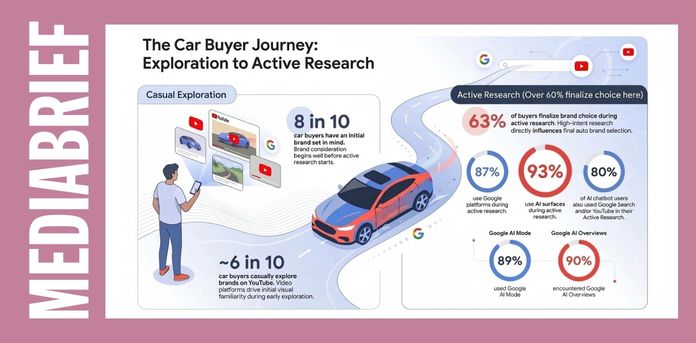
In India, the path to buying an automobile is now fundamentally enabled by AI: 93% of shoppers actively turn to AI surfaces1 during their research phase, according to the Google-commissioned Kantar study, Automobile Purchase Journey in the Age of AI. Within this landscape, Google Search AI experiences play a critical role in evaluating complex specifications and financing.
AI surfaces act as a launchpad for today’s digitally savvy car buyers. Consumers using AI actively navigate an average of 7.8 touchpoints to research and validate choices, reflecting a deeply considered, non-linear purchase journey. Across this expanded path, digital discovery remains central: the study reveals that 87% of car buyers engage with Google platforms—including Search, YouTube, Maps, and Gemini—with Google Search widely cited by respondents as a key destination in the active research phase.
Commenting on the evolving consumer journey, Siddharth Shekhar, Director, Google India, said, “The car buying journey in India is deliberate, non-linear, and deeply digital—particularly ahead of the festive season, when consideration peaks. Buyers move between discovery on YouTube and conversational validation on Search. Among surveyed Google Search users, 90% come across AI Overviews and 89% use AI Mode to navigate nuanced, complex queries. As AI helps buyers navigate complex choices, our ad and commerce solutions help automotive brands respond to their intent—connecting initial curiosity directly to the showroom.”
Key findings from the study:
From premium add-ons to baseline non-negotiables
Indian car buyers view their vehicle as a fundamental visual representation of personal achievement and lifestyle. However, final vehicle selection has decisively shifted toward a collaborative household effort, with 64% of consumers involving the whole family and 53% deciding alongside spouses. This shared deliberation has elevated features like five-star safety ratings and futuristic styling from optional luxury add-ons to baseline requirements.
YouTube functions as the virtual showroom for casual exploration
Long before stepping into a dealership, automotive consideration begins as an ambient, visual journey, with 8 in 10 car buyers already having an initial brand set in mind before active research begins. YouTube functions as an always-on virtual showroom, where ~6 in 10 car buyers casually explore brands well ahead of their purchase decision.
Through personalized Home Feeds, lifestyle vlogs, and creator content, passive discovery evolves into active consideration, anchored by 77% of YouTube users who rely on professional reviewers for trusted advice.
AI acts as an expansionary force in active research
AI has become an expansionary research companion, helping buyers compare complex specifications, evaluate features, and calculate financing options. Across this journey, Google Search AI experiences play a central role in active deliberation.
Among surveyed Google Search users, 90% come across AI Overviews and 89% leverage AI Mode for nuanced, conversational queries. Conversational AI triggers deeper validation: 80% of surveyed car buyers who use AI chatbots also turn to Google Search and/or YouTube during active research.
Commenting on the impact of a full-funnel strategy, Virat Khullar, Head – Marketing, Hyundai Motor India Limited said,“The automotive purchase journey is increasingly shaped by moments of discovery, research and intent across digital channels. Our partnership with Google helped us harness the scale of YouTube to build awareness and the intelligence of AI-powered Search ad solutions to identify and convert high-intent consumers. By unifying upper- and lower-funnel marketing, we were able to deliver a more relevant and efficient customer experience, turning consideration into action and driving strong sales momentum for Hyundai VERNA.”
The study was conducted by Kantar in May 2026 across Metro and Tier 1 cities in India, surveying 1,022 recent automotive shoppers identified by vehicle price, engine capacity, and buying behaviors.