































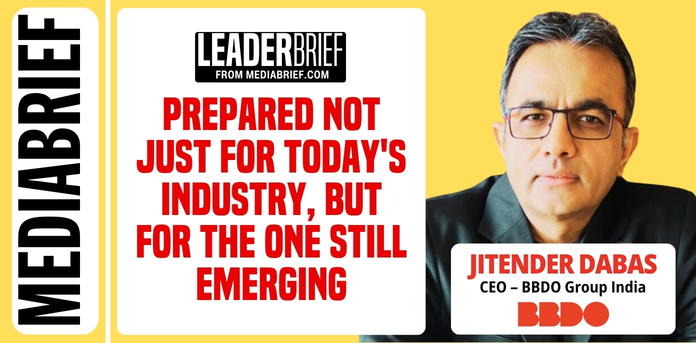
As he takes charge of the newly consolidated network, Jitender Dabas, Chief Executive Officer, BBDO Group India, speaks to MediaBrief.com about its next phase of growth, the importance of preserving the distinct strengths of BBDO, Ulka and Mudra, the role of AI in amplifying human capability, and why culture remains the ultimate competitive advantage in an increasingly technology-driven industry. Read on.
For Jitender Dabas, the biggest opportunity before BBDO Group India is not simply expanding its size but strengthening its value as a strategic business partner. “The biggest opportunity is that we sit at a very interesting intersection of scale, diversity and capability,” he says.
While agency groups are often evaluated by their size, Dabas believes the real advantage comes from the extraordinary breadth of businesses the Group works with. In a single week, teams could be solving growth challenges for Indian giants such as Amul, Adani, ITC, ICICI or Tata Motors while simultaneously partnering with global brands including Mercedes-Benz, McDonald’s, Mars, P&G, Royal Enfield, WhatsApp, Truecaller and Red Bull. That exposure, Dabas explains, creates a unique perspective. “When people think of agency groups, they often think in terms of size. What excites me more is the range of business challenges we get exposed to.”
For Dabas, however, future growth isn’t about increasing billings or merely adding more capabilities. “The opportunity ahead is not simply to grow billings or add capabilities. It is to become a more valuable partner to clients at a time when business is becoming more complex than ever. The organisations that will win are not necessarily those with the largest structures. They will be the ones with the most relevant thinking.”
That philosophy underpins his vision for the Group. “My focus is on building exactly that kind of organisation—one that combines strategic depth, creative ambition and technological fluency to help clients unlock growth.”
Three brands, one shared ambition
One of BBDO Group India’s greatest strengths lies in the distinct identities of BBDO India, Ulka and Mudra, three agencies with different histories, cultures and client relationships. Rather than bringing uniformity across the Group, Dabas believes preserving these differences creates greater value. He says, “I think people often assume that scale requires uniformity. I believe the opposite. The strength of our Group comes precisely from the fact that we bring together three very different legacies and perspectives.”
Today, both Ulka and Mudra operate under the broader BBDO umbrella while sharing the global philosophy of ‘Do Big Things.’ According to Dabas, this provides a common ambition without erasing the distinct character each agency has built over decades. He adds, “That gives us a shared ambition and a common belief system, while allowing each brand to remain true to its own character.”
Each agency continues to bring something unique to the table. Ulka has earned long-standing trust through enduring client relationships, with several of India’s most respected companies partnering with the agency for decades.
Mudra has developed deep expertise in understanding entrepreneurial India and businesses focused on growth, while BBDO contributes a globally recognised reputation for creativity and effectiveness.
“These are not merely different agency brands,” says Dabas. “They have different strengths, different histories and different ways of creating value for clients. The opportunity is not to blur those distinctions. It is to amplify them.”
“Our job is to combine the strengths of the three agencies without diluting what makes each of them valuable,” he adds.
‘Do Big Things’ starts with solving bigger problems
For decades, ‘Do Big Things’ has served as one of BBDO’s defining philosophies. Yet Dabas believes it is often misunderstood as simply producing larger campaigns or attracting greater visibility. “I think people often interpret ‘Do Big Things’ through the lens of output—bigger campaigns, bigger launches or bigger visibility. But to me, it starts much earlier than that.” For Dabas, philosophy begins with intent. “It starts with intent.”
The first questions, he says, should never be about execution. “What problem are we trying to solve? How meaningful is that problem? And can solving it create a disproportionate impact for the client?”
Only after answering those questions should creativity come into play. “The philosophy is not about producing more communication. It is about applying creativity, strategy and innovation to challenges that genuinely matter.” Sometimes the solution may indeed become an advertising campaign.
At other times, it could evolve into a product innovation, a customer experience intervention, a partnership or an entirely new way of approaching market opportunities. “The scale of the output is less important than the scale of the impact. The real challenge is to remain focused on outcomes.”
Ultimately, he believes the most valuable agencies will be those that help clients uncover new avenues for business growth rather than simply creating communication. “That is why I believe the most valuable role an agency can play is not simply to create communication but to help clients identify opportunities that can unlock meaningful business growth,” Dabas says. As he succinctly puts it: “When we start with bigger problems, we usually end up creating bigger impact.”
AI is a people story, not just a technology story
Artificial intelligence may be dominating conversations across the marketing industry, but for Jitender Dabas, its true potential lies far beyond automation or efficiency. At BBDO Group India, AI is being approached not merely as a technological advancement but as an opportunity to fundamentally enhance human capability across the organisation. “I think AI is often discussed as a technology story. For us, it is fundamentally a people’s story.”
Rather than viewing AI as a replacement for human talent, Dabas sees it as a tool that empowers individuals to do better work, regardless of their role within the organisation. “The biggest opportunity with AI is not automation. It is amplification.” This philosophy has shaped the way BBDO Group India is embedding AI into its operations. Instead of limiting AI adoption to specialist teams or technology experts, the organisation is encouraging every employee to explore how these tools can enhance their own work.
“We see AI as a force multiplier for the entire organisation. Not for one department, not for one specialist team, but for everybody. Whether you are a strategist, a creative professional, an account leader, a producer or someone working in operations, AI has the potential to expand what you can individually achieve,” Dabas adds.
Recognising that meaningful transformation begins with people rather than processes, the Group’s first step was to understand where employees stood in their AI journey. “One of the first things we did was conduct an organisation-wide assessment to understand where people genuinely were on the AI curve. From there, we created what we called an AI Play Date.” The programme intentionally avoided rigid learning structures or immediate performance expectations.
He adds, “The objective was deliberately simple. We wanted people to explore. No pressure, no formal agenda, no expectation of immediate outcomes. Just curiosity and experimentation.”
For Dabas, this mindset shift is critical because real transformation happens only when AI becomes an everyday tool rather than something reserved for experts. “Because the real shift happens when people stop viewing AI as something that belongs to experts and start treating it as a tool that can make them better at their own jobs,” Dabas adds.
Today, AI is being integrated across multiple aspects of the organisation—from strategy and consumer understanding to creative development, content creation, testing and optimisation. However, Dabas stresses that these applications are only one part of the larger vision. “Today we are integrating AI across strategy, consumer understanding, creative development, content creation, testing and optimisation. But the larger ambition is cultural. We want AI embedded into the way people think, work and learn every day.”
Ultimately, he believes the organisations that derive the greatest value from AI will be those that use it to strengthen human potential rather than simply improve operational efficiency. “The organisations that use AI only to improve efficiency will certainly benefit. The organisations that use it to multiply human capability across every function will unlock a much larger advantage,” Dabas adds.
Why creativity will matter more than ever in an AI-driven world
As generative AI makes content creation increasingly accessible, questions continue to emerge around the future role of agencies and creative professionals. Dabas believes these conversations often begin with the wrong assumption—that agencies exist primarily to produce content. “One of the risks in conversations around AI is that we start reducing the role of agencies to the production of content.”
In his view, that significantly underestimates what agencies actually contribute to businesses. “I think that is far too narrow a view of what our industry does,” Dabas adds.
He argues that agencies are not simply competing with content creators, nor is storytelling the sole value they bring to clients. “Agencies are not simply in competition with content creators. Nor is our role limited to storytelling alone. Storytelling remains important, but it is only one part of the value we create.” Instead, the industry’s true purpose lies in applying creativity to solve complex business challenges. “Our real role is helping clients solve business problems through creativity,” Dabas says.
That creativity, according to Dabas, extends far beyond advertising or communications. “It can be applied to communication, but it can also be applied to products, experiences, partnerships, business models, distribution challenges and growth opportunities. In that sense, creativity is much bigger than content.”
As AI continues to democratise execution, he believes the differentiator will no longer be the ability to produce more content, but the ability to identify the right opportunities and create meaningful business impact.
“As AI makes content creation easier and more accessible, execution will become increasingly democratised. What will become more valuable is the ability to identify the right problem, frame the right opportunity and apply creativity in a way that creates business impact. For the next generation of talent, I believe curiosity, judgement and business understanding will become even more important,” Dabas adds.
Beyond technical skills, Dabas believes exceptional talent will be defined by its ability to connect multiple disciplines. “The ability to connect culture, technology, consumer behaviour and commercial outcomes will distinguish exceptional talent from average talent.”
While AI can undoubtedly accelerate ideation and generate countless possibilities, he maintains that human judgement remains indispensable. “Technology can help generate options. Human intelligence still determines which options are worth pursuing.” That distinction, he believes, will separate enduring creative excellence from mere content production. “The future belongs not to people who can simply create more content, but to people who can create more value,” Dabas adds.
Returning home to build what’s next
For Jitender Dabas, returning to Omnicom is more than a career milestone; it is an opportunity to help shape the future of an organisation where his own journey first began. Having started his career as a Star One trainee at Ulka before taking on leadership roles across different agency networks, Dabas describes his return as both familiar and forward-looking. “Coming back feels both familiar and new at the same time.”
While there is undeniable personal significance attached to the move, he is quick to point out that nostalgia isn’t what motivates him. “There is a personal dimension because I began my career as a Star One trainee at Ulka. But what excites me is not nostalgia. It is the opportunity to help shape what comes next.”
That future, he believes, will be defined less by organisational structures and more by culture. Reflecting on his leadership journey, Dabas says one lesson has consistently stood out over the years. “One thing I’ve learned over the years is that organisations often spend too much time discussing structures and not enough time discussing culture,” Dabas adds. Unlike organisational charts that can be redesigned whenever necessary, culture is built gradually and compounds over time. “Structures can be redesigned relatively quickly. Culture compounds over time.”
Since taking charge of BBDO Group India, one of the aspects that has impressed him most is the calibre of talent across the organisation. “What has impressed me most since joining is the quality of talent across the Group. We are fortunate to have exceptional people at every level, and equally fortunate to have leaders who continue to raise the bar.”
Among those leaders, Dabas singles out Chief Creative Officer Josy Paul, whose influence, he says, extends well beyond creative excellence. “I am particularly fortunate to have Josy Paul as our Chief Creative Officer and creative leader. Everybody knows Josy’s reputation and contribution to the industry,” Dabas adds.
However, what has stood out to him most isn’t Paul’s industry recognition but the mindset he brings to work every day. “What stands out when you work with him is the energy he brings every day. The curiosity, the optimism and the relentless belief that there is always a better idea waiting to be discovered.”
You might also like: LeaderBrief | Josy Paul of BBDO India: Create acts, not ads – Stop building campaigns. Start building experiences people choose
For Dabas, that kind of leadership creates a ripple effect across the organisation. “That kind of energy has a profound effect on an organisation because it inspires everyone around it to keep pushing boundaries.”
His return has also reinforced another belief: that despite their distinct identities, BBDO, Ulka and Mudra share far more common ground than many people realise. “What has also been reassuring is discovering how aligned the underlying values of BBDO, Ulka and Mudra actually are.”
While outsiders often focus on the differences between the agencies, Dabas sees a strong cultural alignment rooted in shared values. “From the outside, people tend to focus on the differences. From the inside, what I see is a common respect for creativity, relationships, ambition and problem-solving.”
That philosophy also shapes his understanding of leadership in today’s rapidly changing business environment. “Leadership today is less about providing answers and more about creating an environment where talented people can do the best work of their careers.”
Rather than positioning leaders as decision-makers with all the answers, he believes their role is to create conditions where ambitious people can continue learning, growing and reinventing themselves. “If we can build an organisation that attracts ambitious people, gives them room to grow and encourages them to keep reinventing themselves, relevance takes care of itself.” Ultimately, that is the organisation Dabas hopes to build at BBDO Group India.
Dabas concluded by saying, “What we’re trying to build at BBDO Group India is an organisation that is prepared not just for today’s industry, but for the one that is still emerging.”