









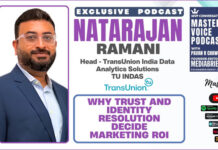



















Watch Natarajan Ramani on MVP – The Master’s Voice Podcast
Listen to Natarajan Ramani on MVP – The Master’s Voice Podcast
This episode of our award-winning series MVP – The Master’s Voice Podcast features Natarajan Ramani, General Manager and Head, TransUnion India Data Analytics and Solutions (TU INDAS), in a conversation about trust, data, identity, analytics and marketing effectiveness in India’s rapidly evolving digital economy.
Natarajan explains TU INDAS through a simple enterprise journey: turning data into insights, insights into decisions, and decisions into actionable results. He outlines how TruAudience, TruValidate, TruContact and TruIQ connect targeting, identity, engagement and analytics around the customer.
As India generates more data across more channels, he argues, enterprises face data overload, asymmetry and fragmentation. Identity resolution therefore becomes a central business capability — helping reduce duplication, lower costs and improve the efficiency of customer outreach.
The conversation also moves into marketing mix modelling across digital, social, OTT, connected TV, print, television and out-of-home; TransUnion’s recognition as a Leader in the 2025 Gartner Magic Quadrant for Marketing Mix Modeling Solutions; and the role of privacy, consent and responsible data use in building stronger consumer trust.
For CMOs and CEOs, Natarajan’s message is clear: success will not simply belong to organisations with more data, but to those with the confidence to use it responsibly, efficiently and with trust at the centre. Watch. Listen. Read. Revel.
Why this episode matters
As customer data fragments across channels, marketing inefficiency can hide in duplicated identities, disconnected measurement and repeated outreach. This conversation connects identity resolution, holistic media measurement and privacy-first data use to one underlying business principle: trusted information should lead to better decisions and more effective action.
10 Big Ideas from this episode
1. Natarajan Ramani on TU INDAS and enabling trust across enterprise decisions
How TU INDAS uses data, analytics, identity and insights to help enterprises make more confident decisions across the customer journey.
2. Why data overload and asymmetry have become an enterprise problem
How rapidly expanding digital information across multiple channels can leave businesses with more data but greater difficulty connecting it meaningfully.
3. Natarajan Ramani on moving from data to actionable results
Why the real value lies in converting data into insights, insights into decisions and decisions into business action.
4. How TruAudience, TruValidate, TruContact and TruIQ fit together
How targeting, identity validation, trusted customer contact and analytics can work as connected parts of one customer journey.
5. Why identity resolution can reduce duplication, waste and cost
How recognising the same customer across multiple channels can prevent repetitive outreach and make marketing more efficient.
6. Natarajan Ramani on efficiency as the next growth imperative
Why a growing economy may make growth easier today, while the ability to acquire and engage customers efficiently will matter increasingly.
7. Why marketing mix modelling must connect digital and offline media
How marketers can look holistically across digital, social, OTT, connected TV, television, print and out-of-home instead of measuring channels in isolation.
8. Privacy, consent and transparency as foundations of trust
Why responsible data use can deepen consumer confidence and, in turn, encourage stronger engagement with enterprises.
9. What CMOs should understand about fragmented customer data
Why inefficiency, excessive contact and consumer dissonance can become hidden costs when identities remain unresolved across data silos.
10. Natarajan Ramani on why CEOs need confidence in data, not simply more of it
Why the organisations that succeed may not be those possessing the most data, but those most confident in how they understand and use it.
In this episode
- What TU INDAS does and how it enables enterprise decision-making
- Turning data into insights, decisions and actionable results
- India’s growing problem of data overload and asymmetry
- TruAudience, TruValidate, TruContact and TruIQ
- Digital, OTT, connected TV and the wider media mix
- Identity resolution, duplication, efficiency and marketing ROI
- TransUnion’s Gartner recognition for marketing mix modelling
- Privacy, consent, transparency and responsible data use
- What CMOs and CEOs should understand about trusted consumer intelligence
The Podcast Conversation: Natarajan Ramani of TU INDAS
Below is the transcript of my conversation with Natarajan Ramani, General Manager and Head, TransUnion India Data Analytics and Solutions (TU INDAS), on MVP – The Master’s Voice Podcast. Repetitions used for spoken emphasis have been removed, and logical paragraph breaks and thematic subheads have been added.
At the centre should be trust, at the centre should be consent, at the centre should be identity resolution: Natarajan Ramani
(EDITOR’S NOTE: Any figures, organisational details or time-sensitive references in this conversation should be read in the context of the recording and publication date shown on the live episode page.)
Introducing TU INDAS and its role in enterprise decision-making
Pavan: Hello and welcome to MVP the Master’s Voice Podcast from MediaBrief.com. I am your host and friend Pavan R Chawla and today’s conversation is about trust, data, identity, analytics and marketing effectiveness in India’s rapidly evolving digital economy.
Consumers today are interacting with brands across multiple media, apps, platforms, dealerships and many other touchpoints. For businesses, that creates opportunity, but it also creates complexity.
How do you understand the consumer better, the customer better, and how do you measure marketing more meaningfully? How do you use data responsibly, how do you reduce duplication, build trust, improve targeting, prevent fraud and make more confident growth decisions?
To discuss quite a lot of this and hopefully more, my guest today is the eminent Natarajan Ramani, General Manager and Head, TransUnion India Data Analytics and Solutions, TU INDAS.
Natarajan, welcome to MVP the Master’s Voice Podcast and thank you ever so much for your time.
Natarajan: Thank you so much Pavan for having me here. Wonderful to be on the show.
Pavan: Thank you very much indeed. And Natarajan, I also want to thank Gurunath Birnale, Neeta Gupta and Manibalan Manoharan of Adfactors PR and of course Kimberly Rowe of your Corp Comm team at TU INDAS, and all of these people made the interaction possible.
Natarajan, I am looking forward to our chat. I know it’s going to be short, but thank you very much for hosting us in your office. Beautiful office here in Mumbai.
Those in the space know TU INDAS and all that it does, and they look to it for a lot of assistance that is empowering business-wise.
But for those who may not be very aware of it, please introduce TU INDAS for viewers and listeners who may know TransUnion largely through its credit information work. But what does TU INDAS do and who are its solutions built for?
Natarajan Ramani on how TU INDAS enables trust
Natarajan: Perfect. I think a great question to begin with, right? So as TransUnion, we are a global information and insights company. And what we do specifically in India, through TU INDAS, is we are in the business of enabling trust across all the levers of decision making for an enterprise.
We are in the business of enabling trust across all the levers of decision making for an enterprise: Natarajan Ramani
So if you take an aspect of trust, our main purpose and motto is to change data into insights, from insights to decision making, and from decision making to actionable results. That’s what we do as TU INDAS.
The TU INDAS solutions
In terms of solutions or areas where we play, if you look at a customer journey, if we put the customer at the centre of every enterprise, what does an enterprise do with a customer?
It will first acquire the customer. So we have solutions to help with that. Once you acquire the customer, you engage the customer and you manage the customer. So we have solutions around that aspect of it.
Once you have it, you also need to ensure that the customer keeps on adding value to you, so we have solutions around that.
Natarajan Ramani on TruValidate, TruAudience and TruContact
Broadly, in terms of what TU INDAS offers in India, we have TruValidate, which works around identity, device and behavioural insights, basically to identify the individual rightfully so, so that enterprises can take the right decisions from that.
Then we have something called TruAudience, which is more on the marketing side of things. Once you acquire the right customers, how do you target them more effectively? So that’s TruAudience from that perspective.
And then we have TruContact, which is basically how do you reach out to the consumers in the right and more efficient way. So basically in a more trusted manner.
Our main purpose and motto is to change data into insights, from insights to decision making, and from decision making to actionable results: Natarajan Ramani
Pavan: Wonderful. So right from the first step of we have data, from data you pull out the insights.
And that data and the pulling out of the insights can be either targeting customer acquisition for the first time or even before that customer awareness for the first time.
So right from awareness to acquisition to engagement to post engagement, engagement and support. And then from the data that you receive across the entire value chain, you have more insights to go ahead.
Natarajan: Absolutely.
Pavan: So that sums it up.
Natarajan: Absolutely. You summed up really well.
Pavan: This is really very interesting. I sincerely hope that you don’t just give it to the biggest and largest enterprises because you’re a huge entity.
And it only makes sense to sort of work at this level with this kind of complexity and offering of solutions with the largest enterprises.
I sincerely hope someday very soon you also are able to provide smaller little beautiful nests and pockets of such services for even the smaller companies and entities, they may not be enterprises, but more strength to you. Really.
Wonderful. So Natarajan, TransUnion CIBIL is widely associated with credit information in India, while TU INDAS operates in a very different space like you said, focused on data, analytics, and identity driven insights, right?
So as India’s digital economy becomes more, let’s say, fragmented and obviously data led. How has this shift created the need for a business like TU INDAS and how do you define its core value proposition for clients today?
In fact you summed up everything beautifully, but I’d still like you to specifically focus on these two questions. One, how has the shift created the need for a business like TU INDAS and how do you define its core value proposition for clients today?
Natarajan: Okay, so before I answer that Pavan, I think it’s very important to understand what has changed in India for all of us over the last few decades.
India’s data explosion and data asymmetry
Natarajan: One is obviously, there has been a huge influx of digital information coming in. Now the way India is progressing leaps and bounds in terms of creation of data.
Data is getting created every millisecond by every consumer in the country. It could be your digital footprint, it could be your voice footprint, it could be your interactions, what you’re doing with bots, with computers. Now this is a lot of data.
Now more and more what’s happening is data is getting created, but data is also getting created across multiple channels. So there is a data overload and there is a data asymmetry.
So now if you look at data overload and data asymmetry, how do enterprises bring all of this together to take out actionable insights from the data? Now that is the purpose of TU INDAS.
Because today, given that we have so much of a data element, we are playing in the world of TruValidate, which is the entire element of risk, identity, fraud; marketing; TruContact; TruIQ, which is our analytics suite of solutions.
So all of this becomes very crucial for us to gather all this information and then play with that and then obviously give actionable insights to enterprises.
Pavan: Wonderful. So the entire back end, the technological super brain that’s working, pulling out all the inputs and then sort of understanding and evaluating them in connection with everything else that’s coming in as inputs.
It’s a fantastic thing, it’s like the heart in the middle of the human body and there are so many arteries and veins and capillaries and everything supplying blood to it and it regulates the whole system.
So you are literally like the heart in the middle of the business brain of every enterprise, I would say, oversimplifying here.
Your portfolio also includes TruAudience, TruValidate and TruContact. How do these three, let’s say, fit together as one larger trust, identity and analytics business? Rather than as three separate products?
How the TU INDAS solutions fit together
Natarajan: Perfect. I think the answer to this lies in the way we have named our solutions.
Now if you understand it from a customer’s journey perspective, which I was alluding to in the first part of the session, first you start acquiring or engaging a customer. That’s a customer journey in any enterprise.
That’s where TruAudience comes in. Because then we rightfully so ensure that we identify the right consumers for the right set of targeting.
Pavan: Hence Tru.
Natarajan: Hence Tru. Hence truth. Once you acquire a customer, then you want to assess the customer from a validation perspective.
Whether this is the right customer, does he have the right intent, is he the right customer with the right credentials coming in. That’s where TruValidate…
Pavan: So with TruAudience you already had all your parameters in place to identify and get them. Then you have another fail-safe, which is a validation that you indeed have the true audience, which you’ve called TruValidate. Excellent. Please continue.
Natarajan: Yes, TruValidate. So if you look at it from a TruValidate perspective, the focus is more on identity, more on device, more on behavioural insights about that consumer. How do you assess the consumer from those elements?
So now you have TruAudience, you have TruValidate.
Now if you look at TruContact, how do you engage with these consumers? You do calling to them. You speak to them. That’s where TruContact comes in, wherein we ensure that the way we reach out to the consumers, there is a trust through which the enterprises can reach out to the customers from that perspective.
Now if you look at all these three elements, this is a customer journey from that perspective.
Now if you overarch these solutions, TruAudience comes in again because in TruAudience we also have a marketing mix modelling solution, wherein we help enterprises optimise their overall marketing spends.
And then, overleveraging again on top of this is our TruIQ, or the analytics suite of products. So you have the data. How do you take out insights from the data?
So therein is where our powerhouse of TruIQ comes in, wherein we do a lot of analytics for the customers and enterprises to take out actions.
Pavan: Lovely. You know what you just told me about the media mix and advising the customer, your enterprise customer, on what is the best mix for a given scenario.
So there are, you know, everybody uses much the same kind of, or they dip into the same media platforms bucket that is available to everybody, it’s like a huge bouquet. Right?
So, in the past, it used to be said that linear TV is huge, massive, and I produced shows like Aahat, CID, Heena, so I know how huge it is. Yes. In the linear days.
And today of course CTV is huge and linear is set to be now a huge mass reach thing which is blunt. You don’t know where it’s going and who’s watching it and there are no really adequate measurements. So forget, we won’t go there.
But if I were to ask you which are the most common media kind of verticals that enterprises, businesses, large, massive, huge, small, across are using, if I were to say CTV, in digital, and maybe also social and other media, what is the normal mix which is quite popular today?
Media mix: Digital, OTT, CTV and beyond
Natarajan: Yeah, I think more and more obviously a lot of focus is on digital media. Correct. Okay.
Now again, digital media, today given the scope of digital media, you have various ways to do it. Today you have social media, which is obviously the biggest channel. But now you have all the OTTs, which is also there.
So today even in digital media now all the enterprises are trying to see how we can reach out to a digital media.
Pavan: So that is big. And connected TV is huge. Connected TV is huge. Is massive.
Natarajan: But from an overall perspective, it’s not only ending here.
Today there is marketing, there is media spends, there is what you see across billboards, you see across TV, across print, out of home, all of that.
Now, for a marketer or for a CMO, the biggest challenge is how does he derive actionable results from an out of home advertisement? Or from a paper ad, because he doesn’t know that this paper has reached which consumers, which segment of customers.
But now through digital media obviously, through a lot of advancement in digital, you exactly know whom you have reached, what you have reached, what is actionable.
Pavan: It’s all addressable, targetable, measurable.
Natarajan: It’s addressable. But how do you take care of the remaining aspects?
I think that’s where TransUnion does a great job of it because we bring all of this together in a more holistic manner for the CXOs to take good decisions.
Pavan: Super. So in the end they also get to know which medium or which platforms or which pipelines give you the best business results and cost you the least also.
So the ROI obviously has to depend on the quality of the customer and what the customer does in terms of engaging with you and or their enterprise, your enterprise partners, really. Very nice.
So what are the biggest growth avenues for TU INDAS in India over the next three or five years?
What you’ve told me makes it a no-brainer for any enterprise to go with. And I’m very sure of that because I talk to so many people and many marketers have told me, or have sort of, well, they say ya my boss really doesn’t know too much of marketing. And every CEO, every entity needs a lot of guidance.
So Natarajan, what you just told me just tells me in no uncertain terms that TU INDAS is a great entity to come to for every kind of advice. And growth related problems, conundrums, call it what you will.
So, nevertheless, having told me that, I still want you to give me a short answer to what you believe and what your entire entity, your leadership, partners, everybody, what do they believe are the biggest growth avenues for TU INDAS in India over the next three to five years?
Natarajan Ramani on growth through efficiency and effectiveness
Natarajan: Yeah, so the answers remain pretty much similar, because if you look at it from any enterprise perspective, and from an Indian economy perspective, there is always an influx of more and more digital data coming in.
Every enterprise now has lots of data, lots of information.
Now India as we know is a growing economy. So you spend 100 rupees or you spend 100 crores, you will grow. There is no end to growing because there is consumerism in the country. India is growing.
So from that overall perspective I think the country is growing well.
But where we come in is that, hey, you spent an X amount of money or X amount of rupees in something, how do you get more efficient?
Because tomorrow, not today, maybe a year or two years down the line, what will matter is the efficiency of all of this.
Because today it is not about reaching out to the customer, it is about reaching out to the customers more efficiently and effectively.
So if you look at efficient and effective, that is what we try to solve for.
And what does that relate to? It basically relates to the same thing. You take data, you take data to information, you convert information to insights, and from insights you convert into actionable results. That’s what we do.
Today it is not about reaching out to the customer, it is about reaching out to the customers more efficiently and effectively: Natarajan Ramani
Pavan: So where is the most important thing which is what you work on, the data, where does that come to you from? What are the sources of that data?
Enterprise data and the privacy-first principle
Natarajan: So data comes to me from all the enterprises we work with. Obviously we don’t generate our own data sets. Sure. We work with all the enterprises and we work on their data sets from that perspective.
Pavan: So first party and perhaps even third party data from those platforms which the enterprises are contracted with and where all the privacy is obviously always maintained.
Natarajan: That’s right. And again, just to maybe close that question, now given the aspect of Indian consumerism, you have Gen Zs and Millennials who are going to drive the economy going forward.
I think one thing which all of them are worried or concerned about is a more secure and more privacy oriented environment. Absolutely.
Now, how do you enable all of that with a more privacy and trusted, in an overall economy perspective? That’s what TransUnion believes in, or TU INDAS believes in.
So we work with all our solutions by keeping the privacy first principle so that we ensure that data is never compromised from any angle.
Pavan: Wonderful. So Natarajan, just to take this a little ahead, how does identity resolution help brands unlock better ROI through cleaner data, sharper audience insights, and more effective measurement? I think I answered the question, but still tell me.
Identity resolution: Reducing duplication and cost
Natarajan: Yeah. Again, it’s simple. As I said, today all enterprises are creating data sets in multiple channels.
So the same Pavan coming in to an enterprise through digital, through print, through media and even through digital across, that information is there with an enterprise, albeit in a very siloed manner.
So now, it could very well happen that an enterprise is reaching out to Pavan five times in the same week. Or 20 times in the same month, because they are not able to identify that this Pavan across all the channels is the same Pavan or not.
So one of the most important elements for all our work across TruValidate, TruAudience, TruContact and TruIQ is the layer of identity.
How do you ensure that the person whom the enterprise wants to onboard or wants to target is the same person?
Now how will that help? One, obviously it helps in redundancy. It helps in reducing duplication. And the biggest lever which is there, it helps reduce cost.
Because there is no point reaching out to Pavan five times in the same week for the same message when I can do it very well otherwise.
Or, I don’t know that it is the same Pavan, but I’m going to Pavan for five different products when I know Pavan is the same person.
One of the most important elements for all our work across TruValidate, TruAudience, TruContact and TruIQ is the layer of identity: Natarajan Ramani
Pavan: I got it. You know, about a year back maybe, the then president of Response in The Times of India, my dear friend Partha Ghosh.
He also said one thing to me. He says, you know, and the strength of TU INDAS, a strength of it is whether it’s print, television, linear, CTV, digital, social, across out of home, all of that, you look at everything.
And Partha also said this to me, he says, you know Pavan, you in the morning are reading a newspaper while you’re sort of fiddling around with your phone also and then something is on in on the TV, then when you drive to work you might listen to a bit of the radio, you might do something else.
The same guy is consuming information at different points on different media across the day and, you know, at night.
So, what you’re saying actually beautifully closes the whole, I mean gives me the umbrella answer for this. And so the identity resolution sits right at the centre, the solar plexus of every enterprise’s success and well-being.
Natarajan: Absolutely. Yes.
Pavan: Wonderful and you help them polish that space. Very good.
Okay, now let’s talk about some good things that have happened in terms of recognition for TransUnion. It was recognised as a Leader in the 2025 Gartner Magic Quadrant for Marketing Mix Modeling Solutions.
I promise you, I will get a bit of a deep dive in DeepBrief from him later, it will be a lovely long Q&A session where we talk about your excellence in marketing mix modelling solutions and how it helps.
But for now let me ask you, what does that recognition, being recognised as a Leader in the 2025 Gartner Magic Quadrant for Marketing Mix Modeling Solutions, what does that recognition mean for TransUnion and how does it strengthen your conversations with marketers in India?
Natarajan Ramani on Gartner recognition and marketing mix modelling
Natarajan: Yeah, brilliant. I think it’s much more beyond the recognition. It also talks about how marketing is changing over the many years across all continents.
Now one aspect is that for many years marketers have had access to multiple data points. Marketers have had access to multiple mediums. Marketers have had access to multiple channels for distribution.
Now the challenge always is how do you bring all of this together? How do you bring all of this together to ensure that the marketing mix modelling is much more effective to an enterprise and to a marketer?
Now, as Gartner did all of these studies across multiple players, the way we work with enterprises is we work in a more holistic manner. Okay.
Obviously every enterprise has a very solid or very enhanced digital tracking mechanism. But is digital the only way to reach out to the customers? No, right?
You reach out to the customers out of home. You reach out to the customers through print.
Now how do you bring all of this in a more holistic manner is what TransUnion has done well and that’s how we got rewarded and awarded by Gartner.
Pavan: Wonderful. And it’s at the crux of everything that is to be done. Yes.
Right from TruAudience to TruValidate, which together helps you resolve the identity beautifully. That’s right. And which sits at the centre of it all. You closed every loop beautifully.
So, now Natarajan, with consumers interacting across TV, digital, social, retail, other channels. While privacy and consent become increasingly important, how should brands balance effective measurement and media investment with responsible data use, and you said you’re very careful about it?
Where do approaches like marketing mix modelling fit into this equation?
Privacy, consent and trust
Natarajan: Yeah, I think as I said, today’s consumers are extremely aware of the privacy aspect of all aspects.
And the way TransUnion, obviously the way enterprises work, and obviously there has been a conflicting view of how much privacy will help, will it curtail marketing on the other side?
So the question is a very important and a pertinent one.
So today I think enterprises who put the consumer in the middle and the consumer at the centre and take care of all of its involvement, including the consent, including the privacy, those are the enterprises which will do really well going forward.
Pavan: That’s a beautiful message for everybody.
Natarajan: Because why we do that very well and why we want to promote that very well is that what it enables is trust. Yes.
If the consumer is trusting an enterprise with the protection of the data what the consumer is giving to the enterprise, the consumer wants to engage more with the enterprise.
So if you look at trust as an enabling factor, that becomes very crucial and that can only be enabled if people are much more transparent, people have all the consents in place, and people use the data for which the information has got collected from an overall perspective.
Pavan: Right. So not just as per the rules and everything but from within, from the DNA of the work culture of every organisation or entity such as yours, it has to stem from a responsibility angle.
It’s my duty. And I have to do it. And yeah absolutely. And wonderful.
So what should every CMO understand about identity resolution, Natarajan, and what are the hidden business costs of duplicated or fragmented customer data?
What CMOs should understand about identity resolution
Natarajan: Yeah. I think one of the biggest hidden costs in marketing is I would put it as inefficiency.
So today if any CMO or any marketer wants to be efficient, they have to ensure that the data which is residing across all the multiple silos, how cohesively are they able to bring it together to garner information and insights?
So I would say inefficiency is one of the biggest hurdles for this and that’s something which CMOs and marketers should look at very closely from an overall aspect to ensure that their return on investment keeps on going up.
Now if you also look at identity resolution. As I said, maybe India has a growing economy, we were not worried about reaching out to the same consumer for multiple products.
But as the information overhang increases, as the information overload increases, it can also lead to dissonance.
Today consumers can start disengaging with a brand if the brand is reaching out to the consumer many more times.
And why is that happening? Because maybe the enterprises are not able to solve for identity resolution in the best capable manner.
So for a CMO I think again, as I said, at the centre should be trust, at the centre should be consent, at the centre should be identity resolution. If you solve for all these three, then everything else takes care of itself.
At the centre should be trust, at the centre should be consent, at the centre should be identity resolution. If you solve for all these three, then everything else takes care of itself: Natarajan Ramani
Pavan: Natarajan, what should CEOs understand about marketing mix modelling and trusted consumer intelligence?
Natarajan Ramani on what CEOs need from data
Natarajan: For CEOs particularly, I think organisations that succeed over the next decade are not necessarily the ones which have a lot of data. It is enterprises who will have the greatest confidence to deal with that data.
And that confidence comes in by putting trust in the data element. So that’s what.
Organisations that succeed over the next decade are not necessarily the ones which have a lot of data. It is enterprises who will have the greatest confidence to deal with that data: Natarajan Ramani
Pavan: Wonderful and working with a good partner.
Natarajan: Yeah.
Pavan: More strength to you.
You know Natarajan, the conversation that we’ve had so far, I have so many other questions, but I promise you we will take this up another time.
I think what you’ve shared with us so far about TU INDAS and all that it does and how it empowers enterprises across India, and I hope you empower MSMEs too sometime with a smaller agency or a smaller part of your company, and that will really help you truly empower the Indian ecosystem, but anyway, you have your priorities.
But I must tell you I enjoyed our conversation, Natarajan, really thank you so much for your time and all the insight. And what did you think of your chat with me on MVP the Master’s Voice Podcast?
On MVP and MediaBrief
Natarajan: I think it was wonderful. I think it brings in a fresh perspective about what we want to do.
I think one of the most important things is, as an enterprise, how can we reach out to the maximum set of people to say, hey, what is in it for the country, what is in it for the enterprises, and what is in it for the consumers.
So if you look at it from all these elements, that’s what TU INDAS has a role to play. But wonderful interacting with you.
Pavan: Natarajan, thank you, you are very kind and I truly enjoyed the conversation, I’m very happy you did too.
And what do you think about what MediaBrief does on the whole for professionals in the marketplace?
Natarajan: I think Pavan, you and MediaBrief, what you’re doing, I think is very interesting. You’re bringing in a new flavour into conversations. I think that’s what is going to add a lot of value to all the listeners on your platform listening to you. Because you’re not doing something which is dedicated to one stream of work. You’re trying to take different streams of work and trying to see, hey, what’s going to add value to an enterprise or to professionals or to consumers from that perspective. I think from that perspective — great thought and great job.
Pavan: Thank you very much indeed Natarajan.
Natarajan: Thank you Pavan.
Pavan: So that was Natarajan Ramani, General Manager and Head, TransUnion India Data Analytics and Solutions, TU INDAS, on MVP the Master’s Voice Podcast.
It was a conversation on trust, data, identity, marketing mix modelling, responsible analytics, consumer intelligence and the changing realities of India’s digital economy. So much you packed into one episode for me. Really, very grateful to you, Natarajan.
Till we meet again in the next episode of MVP the Master’s Voice Podcast, this is your host and friend Pavan R Chawla signing off saying take care, stay safe, stay invested and work with great partners. Bye bye.
About MVP – The Master’s Voice Podcast
MVP – The Master’s Voice Podcast is MediaBrief.com’s award-winning flagship series of in-depth conversations with leaders shaping media, advertising, marketing, communications, technology, business and society. Hosted by Pavan R Chawla, Founder-Editor of MediaBrief.com, the series captures experience, insight and leadership thinking as enduring knowledge.
The show is on YouTube and top global podcast directories across India and the world. It is listed on: Apple Podcasts, Spotify, JioSaavn Podcasts, Gaana, Amazon Prime Music, TuneIn, Alexa, Stitcher, iHeartRadio, Overcast, Castro, PocketCast, Podcast Addict, and Castbox. Just click on any of the directories, and you will be taken to MVP – The Master’s Voice Podcast there for expert conversations with MVPs.