
































In an exclusive interaction with MediaBrief, Aditya Mihir, Executive Director, Cura Ayurvedic & Unani Ltd. speaks about the company’s 26-year journey, the resurgence of preventive healthcare, evolving consumer expectations, the growing importance of trust and transparency, and why the future of wellness will belong to brands that can combine authenticity with accountability. Read on.
For more than two decades, Cura has quietly built its presence in India’s wellness landscape by focusing on scientific validation, research and consumer trust. At a time when wellness conversations are increasingly driven by evidence, transparency and preventive healthcare, the company believes its long-term approach is beginning to align with broader consumer expectations.
Reflecting on the company’s evolution, Executive Director Aditya Mihir, says its journey began with a belief that Ayurveda should not be viewed as an alternative to modern wellness, but as its foundational framework.
Speaking about the company’s origins and growth, Mihir says, “Cura’s story begins over two and half decades ago, born from a simple but firm belief, that Ayurveda is not an alternative to modern wellness, but its original blueprint. We started as a small, science-led enterprise committed to bringing authenticated, clinically validated Ayurvedic formulations into Indian households.
“Over the past 26 years,” he says, “our journey has been one of patient, deliberate growth never chasing trends, but building trust one relationship at a time. Rather than positioning ourselves as a fast-moving consumer brand, we have consistently invested in research, testing and education, even during periods when the broader market was preoccupied with marketing spectacle over substance.
“Today,” Mihir says, “as India rediscovers Ayurveda through a more scientific and preventive lens, Cura finds itself at a point where two decades of quiet conviction meet a market that is, at last, ready to listen.”

Bridging tradition and scientific rigour
Elaborating on how the company views its role in today’s wellness ecosystem, at a time when consumers increasingly demand proof alongside promises, Mihir says, “We see Cura’s role today as that of a bridge between centuries of traditional wisdom and a consumer who now demands scientific rigour before belief.
He continues, “Our growth over the last 25 years has been steady rather than explosive, and deliberately so. We have always believed in creating relationships with our consumers rather than transactions, which meant our core pillar of expansion has never been marketing spend, but R&D, clinical testing and market education.
He adds, “There have been periods when brands around us were far more preoccupied with visibility than validity, we continued regardless, largely because we anticipated a moment such as this one an India that is genuinely conscious and informed about its health and wellness choices. That moment has arrived, and we believe our long-standing focus on substance over spectacle positions us well within it.”
The return of preventive healthcare
One of the most significant shifts shaping the wellness category today is the growing emphasis on prevention rather than treatment. Discussing this transition and its impact on the company’s business strategy, Mihir says, “Half a century ago, Indian healthcare culture was fundamentally preventive in nature.”

He continues, “Consumers were far more attentive to lifestyle and early intervention, which, in turn, meant considerably fewer cases of diabetes, obesity, hypertension and the other lifestyle disorders that trouble our society today. Somewhere along the way, as convenience took precedence over caution, that preventive instinct faded. What we are witnessing now is, in many ways, a return to that original wisdom, a shift that we believe can meaningfully reshape India towards a healthier future.
“In step with this, our product development and business strategy remain firmly anchored to our core values: not merely to heal, but to help deliver a genuinely happier and healthier lifespan,” adds Mihir.
Understanding the modern wellness consumer
As Gen Z and millennials continue to reshape the wellness landscape, brands are being challenged to rethink long-held assumptions about what these consumers value. Touching upon the biggest misconceptions brands have about younger wellness consumers, the Executive Director says, “One of the biggest misconceptions is assuming today’s younger consumer is easily swayed by aesthetics or influencer endorsement alone. In truth, the modern consumer faces a challenge previous generation rarely did they must sift through an ocean of information, much of it inaccurate, dressed up as fact.
He adds, “The internet has been both a boon and a bane for the modern wellness consumer, it has democratised access to knowledge, but it has also allowed short-lived brands to make bold claims without the research or laboratory testing to support them. What brands often fail to appreciate is that this generation does not forgive easily.
“As the saying goes, the Gen Z and new-age consumer lives by the phrase, ‘fool me once, shame on you; fool me twice, shame on me.’ They are quick to try, but quicker still to walk away the moment trust is broken and social media ensures that verdict travels fast.”

Why transparency matters more than ever
The rise of informed consumers has raised the bar for transparency and accountability across the wellness industry. Sharing his perspective on how legacy Ayurvedic companies can build and sustain trust in an era of heightened scrutiny, Mihir says, “Trust, in our experience, is earned in decades, not campaigns. For legacy wellness companies such as Cura, credibility in today’s climate comes down to transparency at every level: being open about ingredient sourcing, publishing clinical data rather than merely referencing it, and welcoming scrutiny instead of shying away from it.”.”
He adds, “Consumers today are far more discerning, they read labels, question formulations and expect brands to substantiate claims with evidence, not tradition alone. We believe the companies that will endure are those willing to be consistently, sometimes uncomfortably, transparent because a single unsubstantiated claim can undo years of goodwill, whereas sustained honesty compounds into genuine trust.”
Education beyond marketing
As consumers seek deeper understanding of the products and practices they adopt, education is increasingly becoming a core pillar of wellness marketing. Discussing what meaningful consumer education looks like and how brands can measure its impact on business outcomes, Mihir says, “We have always maintained that education is not a marketing tactic at Cura, but a responsibility. Meaningful consumer education goes beyond product pamphlets or catchy captions it means helping a consumer genuinely understand why an ingredient works, how a formulation was developed, and what results they can realistically expect.
He continues, “It is a slower, less glamorous form of communication, but it builds informed consumers rather than impulsive buyers. As for measuring its impact, we look less at immediate conversion and more at repeat purchase, consumer advocacy and the depth of engagement with our content indicators that suggest a consumer has understood us, not merely noticed us.”
Digital discovery reshapes the path to purchase
From social media recommendations to creator-led content and peer-driven communities, digital touchpoints are increasingly influencing wellness purchase decisions. Reflecting on how consumer discovery and buying behaviour have changed over the past few years, Mihir says, “The path to purchase has transformed considerably. Where once a consumer’s first interaction with an wellness brand might have been a family recommendation or a visit to a local store, today it is far more likely to begin with a piece of content a video, a review, a conversation within an online community.
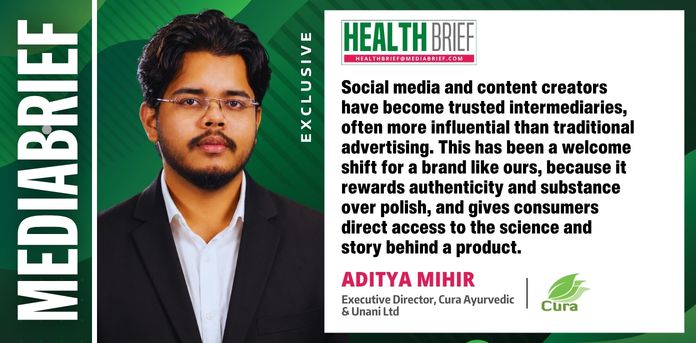
He adds, “Social media and content creators have become trusted intermediaries, often more influential than traditional advertising. This has been a welcome shift for a brand like ours, because it rewards authenticity and substance over polish, and gives consumers direct access to the science and story behind a product before they ever make a purchase.”
Staying authentic amid global wellness trends
With consumers increasingly exposed to international wellness ideas and practices, brands are under pressure to innovate while preserving their heritage and credibility. Commenting on this balancing act, Mihir says, “Indian Ayurvedic brands must engage with global wellness trends without losing sight of what makes Ayurveda distinct its foundation in centuries of documented practice, not passing fashion.”
“Biohacking and functional nutrition offer useful vocabulary and consumer curiosity that we can build upon, but authenticity means resisting the temptation to simply relabel Ayurvedic principles in borrowed language.
“Our approach,” he says, “has been to draw genuine parallels where they exist, while remaining firmly rooted in our own scientific validation and heritage, rather than chasing every global trend that surfaces.”

Looking ahead
With wellness moving beyond traditional remedies towards a more integrated, evidence-led approach, the category is poised for its next phase of growth. Discussing what will define the wellness brands of tomorrow and CURA’s role in that future, Mihir says, “The next generation of wellness brands in India will be defined by those who can combine authenticity with accountability, brands that are transparent about what they offer and can prove it. Consumers will continue to grow more informed, and patience for unsubstantiated claims will only shrink further.”
“Cura,” he says, “intends to remain positioned exactly where we have always stood: at the intersection of traditional Ayurvedic wisdom and rigorous scientific validation.”
Mihir wraps up by saying, “We see our future not in reinventing what we do, but in continuing to do it with greater transparency, deeper research and a sustained commitment to genuine consumer education.”