

























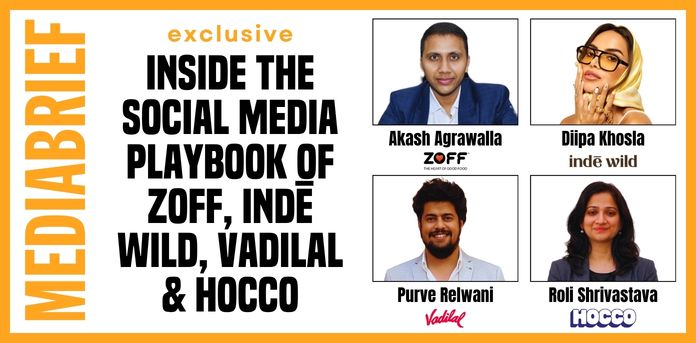
She continues, “At HOCCO, we don’t think of social media merely as a content distribution channel. We think of it as our fastest consumer research lab. Every comment, meme, share and trend tells us how people are thinking, feeling and consuming.”
“That’s why our marketing starts with conversations, not campaigns,” says Shrivastava. “Whether it’s launching a mango-shaped ice cream or creating culturally relevant moments during Ganpati, uttarayan or even sunburn, our objective is simple. Make people stop scrolling.”
The power players in the Marketing Mix
While a multi-channel strategy is standard practice today, different platforms serve vastly different strategic purposes depending on a brand’s audience. Breaking down the individual platforms currently anchoring their marketing mix and why these specific spaces yield the maximum impact for their brands, Akash Agrawalla, Co-founder, ZOFF Foods, says, “Instagram plays the biggest role because it gives ZOFF Foods a personality.”
Elaborating on this, he says, “While quick commerce platforms like Blinkit, Zepto, and Swiggy Instamart are great at fulfilling demand, they don’t build brands. Through Reels, recipes, and creator content, Instagram helps consumers discover and connect with ZOFF Foods before they make a purchase. It turns curiosity into consideration, while quick commerce converts that consideration into sales.”
Sharing a similar sentiment, Diipa Khosla, Founder — indē wild, too finds the strongest favor for Instagram, she says, “Instagram is still home for us. It’s where our community has really grown alongside the brand, and where you can experience the most complete version of our story.
“But,” she says, “TikTok has become a really exciting platform as we expand in the US. It’s where discovery happens at lightning speed, and we’ve been having a lot of fun experimenting with content that’s a little more playful while still staying true to who we are.”
Purve Relwani — Brand Manager, Vadilal, says, “Today, it’s less about the marketing mix and more about the content mix. Every platform has its own algorithm, audience behaviour, and content language. The real strategy lies in decoding the right mix of storytelling, creators, and topical content for each platform, rather than pushing the same message everywhere.”
He adds, “Instagram continues to be a key platform for us because it thrives on visual storytelling, creator collaborations, and cultural moments. YouTube, on the other hand, allows us to tell deeper brand stories and build stronger engagement through long-form content. Ultimately, no single platform is the answer brands need to be present where their audiences are spending time.”
Social media has encouraged us to go beyond selling a product and start explaining it… Social media has not just changed how we market; it has changed what we compete on: transparency, trust, and quality: Akash Agrawalla of ZOFF Foods
Echoing the focus on visual storytelling and high-impact consumer connection, Roli Shrivastava, Vice President Marketing — Hocco, too highlights the platform’s critical role in their growth strategy: “Instagram continues to be our most influential platform because it’s where discovery, aspiration and engagement naturally intersect.”
She adds, “The brands winning today are those creating content people voluntarily spend time with. Instagram allows us to build narratives around innovation, collaborate with creators, leverage community content. That said, we don’t build platform-first strategies. We build consumer-first strategies. As consumer behaviour evolves, our content evolves with it.”
Decoding tomorrow’s trends and consumer shifts
The digital landscape is inherently fluid, driven by rapid technological advances and ever-evolving consumer expectations. To stay ahead of the curve, brands must shift from being mere observers to active participants in these behavioral changes.
Unpacking the digital shifts currently rewriting ZOFF Foods playbooks, Akash Agrawalla, says, “Consumers trust people more than brands, making authentic creator partnerships more valuable than one-off promotions.
He adds, “Our focus is on building long-term relationships with creators who genuinely use our products. This creates familiarity and credibility that traditional advertising can’t match. We also see consumers increasingly discovering products through engaging content rather than active searches, creating new opportunities for challenger brands like ZOFF Foods.”
For Diipa Khosla, keeping pace with the modern consumer requires a strategic pivot towards real-time engagement and authentic storytelling. She says, “People expect brands to show up consistently, not just when they have something to sell. Of course, we lean into trends (where they make sense), but we’re building something much bigger than just a viral moment.”
Citing a “great example” of this approach, Khosla points to the brand’s “indē wild baddies” moment at the Tyla concert. “It was a viral moment that cascaded into some much-needed discourse about Indian beauty on the global stage,” says Khosla.
She also adds, “Ayurvedistry is a cultural conversation, so alongside trendy, entertaining reels and whatnot, we spend a lot of time educating our community and creating content that people can actually come back to long after a trend has passed.”
Today, it’s less about the marketing mix and more about the content mix. Every platform has its own algorithm, audience behaviour, and content language. The real strategy lies in decoding the right mix of storytelling, creators, and topical content for each platform, rather than pushing the same message everywhere: Purve Relwani of Vadilal
Taking the discussion forward, Roli Shrivastava says, “Three shifts are defining how we market today.” First, she says, “People trust creators and communities more than polished brand communication. Authenticity consistently outperforms perfection.”
Second, she believes that culture moves faster than campaign calendars. Elaborating on this, she says, “Brands need to respond to moments while they’re still relevant, not weeks later after approvals are complete.”
Finally, she says, “The distance between discovery and purchase has almost disappeared. Someone can watch a reel, click on Blinkit, and have our product in their hands within minutes. That changes how we think about storytelling.”
“For Hocco,” Shrivastava adds, “success isn’t measured by how many people viewed a post. It’s measured by how many conversations, cravings, and conversions it creates.”
Offering another layer to the conversation, Purve Relwani of Vadilal says, “Consumers today are looking for authenticity over advertising. They’re influenced by creators they relate to, participate in cultural moments, and expect brands to engage in conversations rather than just campaigns.
“Another significant shift,” he says, “is the convergence of content and commerce. Discovery increasingly happens on social platforms, while purchase often happens seamlessly through quick commerce.”
The ROI debate: Influencer Advocacy vs. Platform Advertising
Sharing a similar outlook, Roli Shrivastava of Hocco says, “It’s not a choice between influencer marketing and platform advertising, they solve different business problems. She adds, “Influencers build trust. Platforms build scale.”
“At HOCCO,” Shrivastava says, “we’ve found that creator-led content often becomes the most effective creative asset for paid media because it feels native to the platform and resonates more authentically with audiences. The strongest campaigns today don’t separate the two; they integrate them.”
She continues, “The brands that will win aren’t the ones spending the most. They’ll be the ones creating stories people choose to watch, creators genuinely want to tell, and platforms can efficiently amplify. In the attention economy, relevance has become a far stronger currency than reach.”
People expect brands to show up consistently, not just when they have something to sell. Of course, we lean into trends (where they make sense), but we’re building something much bigger than just a viral moment: Diipa Khosla of indē wild
The alternate reality: Marketing without Social Media
Imagining a world without algorithms, feeds, and instant shares forces a brand back to the fundamentals of traditional brick-and-mortar strategies and legacy media. It begs the question: how would modern brands survive—and thrive—if the digital rug were pulled out from under them?
Akash Agrawalla, Co-founder, ZOFF Foods, paints a picture of an alternate strategy rooted in ground-level visibility and traditional touchpoints. He says, “Without social media, building the brand would have taken much longer and required significantly higher investments. Traditional sampling is expensive and offers slow feedback.
“Social media, on the other hand, provides instant consumer insights through comments and conversations, helping us understand what resonates and where we can improve. It allows us to learn faster, adapt quicker, and market more effectively,” Agrawalla adds.
Diipa Khosla, says, “Honestly, I think we’d spend a lot more time in living rooms rather than on feed. We’d be hosting events, building communities face-to-face and relying much more on word of mouth – the same online levers we use, just in an offline setting. At its core, that’s still what social media is for us, it just allows those conversations to happen at a much bigger scale.”
Purve Relwani says, “If social media didn’t exist, we’d invest even more in on-ground experiences and meeting consumers where they are. There’s no better way to build a connection than through a real, personal interaction.
“As a category driven by seasonality and indulgence, experiencing the product is everything. You can tell the story of an ice cream online, but tasting it, seeing it, and sharing that moment with friends creates a far stronger connection.
“Social media,” Relwani says, “has amplified discovery and engagement, but if it weren’t around, our focus would be on creating memorable brand experiences through retail, activations, events, and sampling.”
For Roli Shrivastava, Vice President Marketing — Hocco, the absence of digital channels wouldn’t change the brand’s core commitment to quality, but it would fundamentally alter the speed and cost of reaching the consumer.
Elaborating on this she says, “We would still build great products because product has always been the strongest truth for us at Hocco. But discovering those products would be slower, more dependent on retail visibility, word-of-mouth, traditional media and on-ground experiences.
Shrivastava wraps up succinctly, saying, “Social media has compressed what once took months into days. It has democratised discovery, allowing even challenger brands to earn relevance through creativity rather than sheer media budgets. Without it, marketing would become more expensive and less conversational.”