





























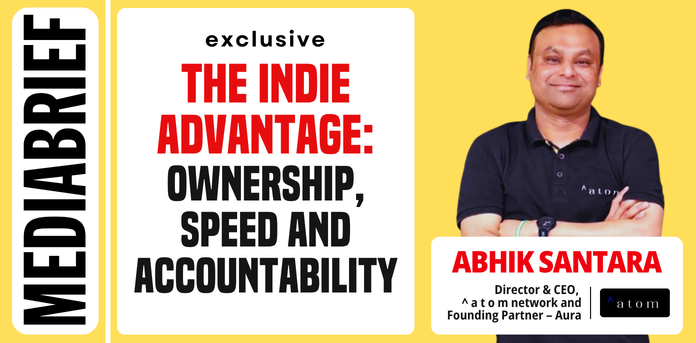
In an exclusive interaction with MediaBrief, Abhik Santara, Director & CEO, ^ a t o m network and Founding Partner, Aura, speaks about the evolving agency landscape, the growing appeal of independent agencies and the changing dynamics of client-agency relationships. Read on.
As independent agencies compete alongside large networks and specialist firms for increasingly complex mandates, the distinction between agency models is becoming more relevant. Speaking about what gives Indies an edge, Abhik Santara, Director & CEO, ^ a t o m network and Founding Partner, Aura, says, “The shift towards Indies is not merely an advertising trend. It is a decision-making trend.”
He continues, “Most people who build independent agencies aren’t looking for another job. They’re building the job they always wanted. In a network, you can spend years trying to rediscover your passion. As an independent founder, your passion is usually sitting on the client’s P&L. That tends to concentrate the mind.
“The other big advantage,” he says, “is access to actual senior leadership. Not the senior person who appears at the pitch and then disappears into a global meeting, but the one who is still involved when the business problem gets complicated and the client calls at 9.17 pm.”
“No committees. No artificial Chinese walls. No waiting for three markets to align. Just ownership, speed and accountability.”
“And frankly,” he adds, “when your own name is on the door, “someone else will handle it” is not a particularly comfortable business strategy.”
Abhik Santara on the role of procurement in agency pitches
While pitching has become a major part of agency life, procurement is playing a bigger role in how pitches are evaluated. When asked if the pitch itself has become too focused on proving efficiency rather than the quality of the idea, and about the growing role of procurement in agency pitches, Santara says, “I’ve always found the procurement conversation around advertising slightly amusing.
“The same person could be negotiating with a steel supplier at 11 AM, a logistics company at 2 PM and a creative agency at 4 PM. And somehow, by 4.05 PM, they are expected to understand how a great idea gets born.
“Naturally, we eventually arrive at the one language everyone understands: FTEs. How many people? How many hours? What does each person cost? Except creativity is not a supply chain.”
He elaborates, “Five people can spend 500 hours producing mediocrity. One brilliant person can crack a thought in 20 minutes that changes the trajectory of a brand.
“So when creative value is reduced to manpower arithmetic, we are measuring the input and completely ignoring the output,” he adds. “It is a little like buying a painting by calculating the cost of the paint. And if the procurement philosophy is ultimately pay peanuts, get monkeys, brands shouldn’t be surprised when the output starts looking like a jungle.”
Abhik Santara on rethinking agency team structures
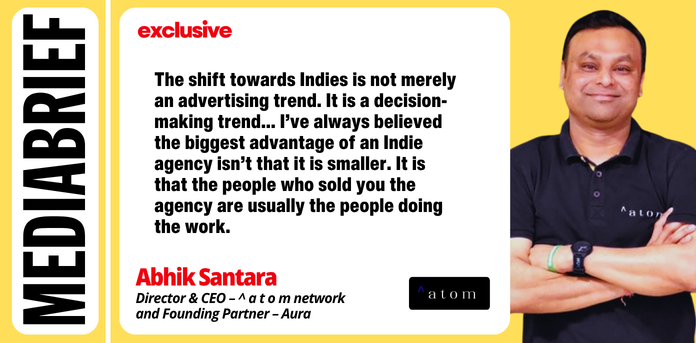
Touching upon how agencies need to rethink the way teams work, Santara says, “I’ve always believed the biggest advantage of an Indie agency isn’t that it is smaller. It is that the people who sold you the agency are usually the people doing the work.

“In network agencies, I’ve seen a strange organisational evolution. You start with a few people doing the work. Then you add people to manage them. Then people to manage those people. Before long, there are more people managing the work than actually doing it. It can become an 80:20 ratio.”
He adds, “Agencies obviously need thinkers and doers. What they don’t need are layers of people whose primary contribution is to sit between the client and the people creating the value, protected by process, hierarchy and the wonderfully convenient phenomenon called shared accountability.”
“In an Indie, involvement and accountability are not departments. They are the job,” says Santara. “Perhaps because founders don’t have the luxury of treating the agency as just employment. It is personal. When you have skin in the game, ‘someone else will handle it’ becomes a fairly poor operating model.”
How ^ a t o m balances reach and creative impact
Speaking about what agencies need to protect as they work under pressure to deliver more with less, Santara says, “Modern marketing needs two things simultaneously: reach and impact. Reach requires scale, speed, optimisation and a rather frightening number of assets. Impact requires strategy, thought and an unreasonable obsession with getting the idea right.
“That is precisely why we have two agencies,” he says. “Aura is built for scale – content production, optimisation and the relentless multiplication of assets that modern platforms demand. ^ a t o m is built for impact – strategy, brand thinking and creative ideas that deserve the time they take.”

He continues, “We don’t believe one model should do both jobs. Asking a brand-thinking agency to behave like a content factory is as inefficient as asking a factory to invent the brand. So the philosophy is quite simple: Aura creates more. ^ a t o m creates meaning. One gives brands the reach they need. The other gives them something worth reaching people with.”
Abhik Santara on six years of building ^ a t o m
Reflecting on what he sees differently after six years of building ^ a t o m, Santara says, “A lot has changed. I was evaluating a new client’s SOW today and found it rather amusing that creative had essentially been reduced to a quantity-and-turnaround exercise.
“How many assets? How quickly? How cheaply? Somewhere along the way, everyone started chasing volume while quality quietly moved to the back of the queue.
“Thankfully,” he adds, “we have relationships with brands like IndusInd, Welspun, Narayana, Limca etc., where the people running the business still believe something rather unfashionable: creative impact creates business impact. Those are the relationships we value and nurture. With care, patience and, frankly, quite a lot of love.”
“And for the rest,” he says, “we have developed a very simple philosophy: Let them manage us.”

Building long-term client relationships
When asked about the kind of work and client relationships ^ a t o m wants to build in its next phase, Santara says, “From day one, we made a very conscious choice: ^ a t o m would not be built around project business.