





























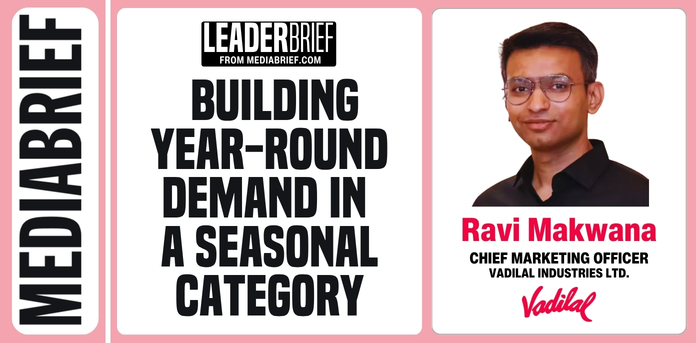
In a MediaBrief exclusive, Ravi Makwana, Chief Marketing Officer at Vadilal Industries Limited, speaks about the company’s efforts to make ice cream a year-round indulgence, the growing influence of quick commerce, and the role of premiumisation in category expansion. Makwana also shares insights on evolving consumer behaviour, media strategy transformation and the factors that will define FMCG success in the decade ahead. Read on.
For decades, ice cream consumption in India has been largely associated with the summer months. However, changing consumer behaviour, the rise of quick commerce and growing demand for premium experiences are reshaping the category. Speaking about Vadilal’s efforts to position ice cream as a year-round indulgence rather than a summer-only treat, Ravi Makwana, Chief Marketing Officer at Vadilal Industries Limited, says, “At Vadilal, we have been consciously working toward making ice cream a year-round indulgence rather than a summer-only product.”
He adds, “One of the most interesting shifts we are seeing is that consumers are no longer waiting for summer to enjoy ice cream. It is increasingly becoming part of celebrations, family moments, dessert occasions and even everyday indulgence.”
On the role of premiumisation and traditional Indian flavours in driving year-round consumption, Makwana says, “Indian flavours such as Kesar Pista, Rajbhog, Malai Kulfi and Badam continue to play an important role because they offer familiarity, nostalgia and cultural relevance. At the same time, consumers are increasingly willing to experiment with richer textures, authentic ingredients and more indulgent experiences, which is driving premiumisation across the category.”
He adds, “What is particularly interesting is that consumers are not choosing between traditional and contemporary experiences—they are embracing both. Our focus is therefore on creating a portfolio that balances trusted Indian favourites with modern indulgent formats, helping us stay relevant across seasons, occasions and consumer segments.”

Tailoring marketing strategies across India and global markets
As Vadilal expands its presence across domestic and international markets, the company is adapting its marketing approach to suit varying consumer behaviours and cultural contexts. Elaborating on this, Makwana says, “India and international markets require different marketing approaches, even though the brand ethos remains consistent.”
“In India,” he says, “communication is often rooted in emotional connection, family consumption, nostalgia and festive moments, while also adapting to evolving consumer behaviour shaped by Gen Z and digital-first discovery.”
He continues, “One of the most significant shifts we are seeing in India is that category growth is becoming more widespread and inclusive. Consumption is no longer being driven only by large metropolitan markets; emerging cities are playing a growing role in expanding the category and creating opportunities for brands to connect with diverse consumer segments and occasions.
“In international markets such as the USA, our strategy is more culture-led and community-driven,” says Makwana. “The Indian diaspora remains an important consumer base, particularly for authentic Indian flavours, while there is also growing interest from multicultural audiences exploring global food experiences and ethnic cuisines.”
He adds, “We continue to see encouraging opportunities across both India and international markets, although the drivers of growth differ. In India, growth is being supported by wider category penetration, evolving consumption habits and improved accessibility through channels such as quick commerce. Internationally, growth is being fuelled by diaspora loyalty, expanding retail presence and a growing appreciation for Indian food culture across global markets.”

How Vadilal’s media mix is evolving
On how Vadilal’s media mix has evolved across television, digital platforms, creators and commerce ecosystems, Makwana says, “Our media mix has become significantly more diversified over the past few years. Television continues to play an important role in delivering scale and reaching family audiences, particularly during peak consumption periods. At the same time, consumer attention is increasingly fragmented, which has made digital platforms, creators and commerce-led ecosystems far more important in our overall communication strategy.”
“Perhaps,” he says, “the biggest change is that media today is no longer just about building awareness. It is increasingly about reducing the distance between discovery and purchase. A consumer may see a creator recommendation, encounter the brand on social media and complete a purchase within minutes through quick commerce. That has fundamentally changed how we think about media planning and consumer journeys.”
He continues, “As a result, our approach is far more integrated than it was a few years ago. Television and high-impact formats help build salience and trust, while digital platforms, creators, quick commerce partnerships and commerce-linked media help drive engagement and conversion. The objective is no longer to optimise channels individually, but to create a seamless consumer journey from awareness to purchase while maintaining accountability across touchpoints.”
How quick commerce is reshaping FMCG marketing
Discussing the impact of quick commerce and evolving consumer behaviour on the FMCG landscape, Makwana says, “These shifts are fundamentally reshaping FMCG marketing and distribution. Consumer decisions today are happening much faster, often within seconds on digital platforms. As a result, brands have to communicate more clearly, improve discoverability and reduce friction between intent and purchase.
“Perhaps,” he says, “the most significant change is that convenience is now influencing consumption behaviour itself. Consumers are increasingly making decisions in the moment rather than planning purchases in advance, which places greater importance on visibility, availability and relevance at the point of consideration.”

“Quick commerce has accelerated this shift by creating an environment where discovery, decision and purchase can happen almost simultaneously. As a result, packaging visibility, platform presence, short-format content and real-time promotions have become increasingly important.”
“From a distribution perspective,” he says, “speed remains important, but so does the ability to anticipate demand and maintain availability. Companies need to respond to consumption patterns that are becoming more dynamic and immediate, placing greater emphasis on inventory planning, hyperlocal fulfilment and data-led decision-making.”
“More broadly,” Makwana adds, “the challenge for FMCG brands today is not just reaching consumers. It is being discoverable, available and relevant in the exact moment a purchase decision is made.”
Quick commerce and the new consumer journey
The rise of quick commerce has fundamentally altered how consumers interact with impulse categories, prompting brands to rethink visibility and engagement strategies. Speaking about the opportunity, Makwana says, “Quick commerce has transformed the way consumers discover and purchase impulse categories like ice cream. Earlier, purchases were often linked to planned store visits, but today availability within minutes has created entirely new consumption moments.”
He adds, “What began as a convenience channel is increasingly influencing category behaviour itself. Consumers are incorporating ice cream into a wider range of occasions because they know the product can be accessed almost instantly. In many ways, quick commerce is helping expand the category by reducing the gap between craving and consumption.”
“As a result,” he says, “in-app visibility, search optimisation, platform-led promotions and conversion-focused campaigns have become increasingly important. However, the opportunity extends beyond discoverability. Quick commerce is also encouraging greater experimentation with formats, flavours and premium offerings by making trial more accessible and frictionless.”
He adds, “We are working closely with our quick commerce partners to improve assortment visibility, seasonal merchandising and targeted campaigns that drive both trial and repeat purchases. Increasingly, these platforms are evolving from distribution channels into consumer engagement ecosystems, providing brands with an opportunity to influence discovery, consideration and purchase within the same journey.”

Why always-on marketing is becoming essential
Discussing whether Vadilal is transitioning towards an always-on marketing model, Makwana says, “Yes, that transition is already underway. While summer continues to remain the biggest consumption period for the category, consumer engagement today cannot be restricted to only a few months in the year.”
He adds, “As consumption occasions diversify, communication naturally has to become more continuous. Consumers are engaging with brands throughout the year, and marketing strategies increasingly need to reflect those evolving consumption patterns. Whether it is a family dessert occasion, a celebration, an impulse indulgence or a quick-commerce-driven purchase, the category is gradually becoming relevant across a wider range of moments.”
“We are increasingly adopting an always-on marketing approach through digital engagement, festive campaigns, product launches and partnerships that keep the brand relevant across seasons. The idea is to build stronger salience throughout the year rather than activate communication only during peak demand months.
“This,” Makwana says, “also helps strengthen long-term brand equity and supports category expansion beyond traditional consumption behaviour.”
Balancing category expansion and premium growth
Asked whether sales growth, market share expansion, premium portfolio penetration or increasing consumption occasions currently rank highest on Vadilal’s agenda, Makwana says, “All of these priorities are interconnected for us, but if we look at the broader direction of the business, increasing consumption occasions and premium portfolio growth are particularly important areas at this stage.
“Historically,” he says, “category expansion was closely linked to seasonal demand. Today, one of the biggest opportunities lies in broadening the moments when consumers choose ice cream—whether as a dessert, a family-sharing experience, a celebration or an impulse indulgence. The more relevant the category becomes in everyday life, the greater its long-term potential.”
“At the same time, premiumisation is reshaping consumer expectations. Consumers are increasingly looking for differentiated experiences, authentic ingredients and more indulgent formats that deliver both quality and novelty. This creates opportunities to elevate the category while delivering greater value to consumers.”
He adds, “We are also focused on strengthening distribution reach, improving visibility across emerging channels and continuing innovation across formats and flavours. Ultimately, sustainable success comes from balancing accessibility, relevance and innovation while evolving alongside changing consumer behaviour.”

Navigating seasonal demand across markets
While India continues to be a largely summer-driven ice cream market, consumption in several international markets tends to be more evenly distributed throughout the year. Explaining how this influences Vadilal’s approach, Makwana says, “In India, media and retail strategies become significantly more aggressive during the summer months because demand acceleration remains very strong during that period. Retail visibility, freezer placements, local activations and high-reach campaigns become particularly important in driving awareness and availability.
“In international markets, consumption tends to be more evenly distributed through the year, so communication is generally more continuity-driven rather than highly seasonal. Retail partnerships, diaspora engagement and premium product positioning play a larger role in building long-term preference and loyalty.”
“The more fundamental difference, however, lies in the maturity of the category,” says Makwana. “In many international markets, year-round consumption habits are already well established. In India, there remains a significant opportunity to expand consumption beyond summer and create newer moments of relevance across desserts, celebrations, family occasions and impulse indulgence. The product mix also varies across geographies, reflecting local preferences, consumption habits and cultural familiarity with Indian flavours.”
Keeping a legacy brand relevant for younger consumers
The challenge for established FMCG brands today is staying culturally relevant without diluting their core identity. Speaking about how Vadilal navigates this balance, Makwana says, “For a legacy brand, relevance comes from evolving with consumers without losing authenticity. Younger consumers today look for brands that feel contemporary, relatable and culturally connected, but they also value trust and familiarity.
“One common misconception is that younger consumers automatically gravitate towards newer brands. In reality, they are willing to embrace legacy brands as long as those brands continue to evolve with changing lifestyles, preferences and cultural conversations.”
“At Vadilal,” he says, “we are focusing on innovation across formats, flavours, packaging and digital storytelling to connect with younger audiences. At the same time, our heritage remains one of our greatest strengths because it represents trust built over generations.”
“The challenge is not preserving legacy; it is making legacy relevant. We believe the brands that succeed will be those that continue to evolve with consumers while staying true to the values that earned their trust in the first place.”
Flavour innovation as a driver of engagement
In a category where consumers are constantly seeking new experiences, innovation has become a key driver of trial, engagement and premiumisation. Commenting on the importance of flavour-led differentiation, Makwana says, “Flavour innovation plays an important role in keeping the category exciting and relevant. Consumers today are constantly looking for new experiences, and innovation helps generate curiosity, encourage trial and create opportunities for deeper engagement, particularly among younger audiences.”
“Limited-edition launches also help brands participate in cultural conversations and remain contemporary. However, innovation is most effective when it is rooted in genuine consumer insight rather than novelty for its own sake. It should reflect evolving tastes, preferences and consumption habits.”

“One of the most interesting shifts we are seeing is that consumers are not choosing between traditional and contemporary flavour profiles—they are embracing both. While there is growing interest in globally inspired and indulgent experiences, classic Indian favourites continue to hold strong cultural and emotional relevance.
“For us,” Makwana says, “this creates a meaningful opportunity to innovate across both spaces. The combination of trusted Indian flavours and contemporary experiences allows brands to drive engagement, encourage trial and support premiumisation in a way that feels both relevant and authentic.”
What will define FMCG leadership in the next decade
In an environment where consumer behaviour, technology and distribution models are evolving rapidly, no single capability will be enough to sustain long-term growth. Reflecting on the future of the FMCG sector, Makwana says, “Going forward, competitive advantage will come from a combination of capabilities rather than any single factor. Distribution will continue to remain extremely important in India, especially for categories like ice cream where cold-chain infrastructure and product availability remain critical.”
“However,” he adds, “consumer insight, speed of innovation and digital agility will increasingly differentiate brands in a highly competitive environment. As consumer preferences evolve faster than ever before, brands will need to identify emerging behaviours, respond quickly and remain relevant across a growing number of consumption occasions and touchpoints.
“Cultural relevance will also become increasingly important because consumers today connect more strongly with brands that understand their lifestyles, preferences and aspirations rather than simply offering products.”
“Perhaps the biggest shift over the next decade is that competitive advantage will no longer come from a single capability. Brands will need to combine distribution strength, consumer understanding, innovation, digital agility and cultural relevance simultaneously. The winners will be those that can adapt at the speed of consumers while retaining the trust that takes decades to build.”
“Ultimately,” he wraps up by saying, “brands that can combine scale with agility, and heritage with innovation, will be best positioned for long-term growth.”