































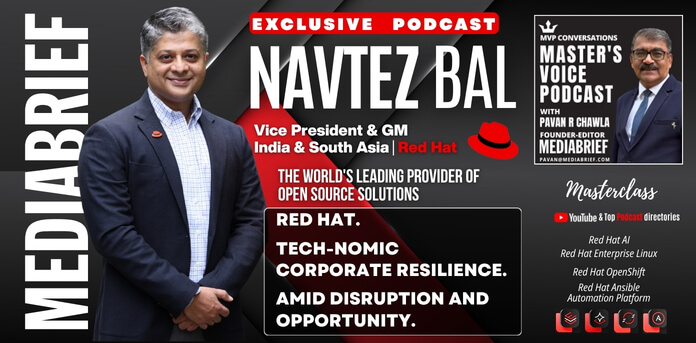
Navtez Bal, Vice President and General Manager, India and South Asia, Red Hat, is my distinguished guest on this episode of Mediabrief.com’s award-winning podcast series, MVP – The Master’s Voice Podcast.
Navtez brings a clear, business-facing view of technology at a time when AI, automation, hybrid cloud and enterprise modernisation — powered in significant measure by India’s strong open-source foundations — have become solid boardroom priorities.
That context matters. Open source is not a new arrival in India’s technology story. For 25 years and counting, Red Hat has stood as world’s leading provider of Open Source Solutions, playing a foundational role in the country’s enterprise, digital-public-infrastructure and technomic evolution — shaping how organisations build, scale, secure and modernise their technology systems.
Press play to listen to MVP with Navtez Bal of Red Hat
In this episode, Navtez discusses how enterprises can build resilience in an environment where technological disruption is relentless, proprietary lock-ins can limit strategic freedom, and business leaders are under pressure to modernise without losing control of cost, security, governance or long-term flexibility.
This is not a narrow technology conversation. It is a sharp and timely discussion on the business of technology, the technology of business, and the leadership choices that will decide how effectively organisations use AI, automation, hybrid cloud and open-source systems in the years ahead. (And so rich are Navtez’s insights, even the excerpts from the In This Episode opener section run nearly of 5 minutes)
Navtez traces Red Hat’s India journey from enterprise Linux to a wider and more strategic role across application modernisation, automation, hybrid cloud and AI infrastructure. He also discusses India’s growing significance as an engineering hub for Red Hat, with strong capability centres in Bengaluru and Pune.
The conversation moves from Red Hat’s early growth sectors in India — including BFSI, telecom and government — to newer areas of demand across manufacturing, energy and AI-led enterprise transformation.
Navtez also speaks about a question many organisations are now confronting: why do some AI experiments remain pilots, while others become production-grade business systems?
That, as he explains, is not only a technology challenge. It is also a governance challenge, a security challenge, a privacy challenge, an ROI challenge, and very importantly, an organisational-change challenge.
For C-suite leaders, this is where the episode becomes especially relevant. AI is no longer a side project for innovation teams. It is becoming central to how enterprises plan, compete, serve customers, manage cost, build resilience and make decisions.
Navtez discusses why adoption varies across sectors, why some margin-pressured industries are moving faster, and why others remain cautious because of data-sharing, safety and quality-control concerns.
He also makes an important case for open-source AI — not as a slogan, but as an enterprise advantage. In a world where AI costs, model choices, chipsets, cloud strategies and vendor dependencies are becoming serious management issues, open-source thinking gives enterprises more control, flexibility and room to innovate.
The episode touches upon inferencing costs, multiple accelerators, on-premise and cloud combinations, model sizes for different tasks, and the growing need for organisations to avoid being locked into one vendor, one stack or one way of working.
But this conversation is not only about architecture and infrastructure. It is also about trust.
Navtez speaks about guardrails, human oversight, enterprise risk, ethics, data protection and the importance of keeping people meaningfully involved in high-impact decisions. As AI systems become more autonomous, these questions will only become sharper.
There is also a strong India story running through the episode.
Navtez reflects on India’s digital public infrastructure, its language diversity, its data-rich enterprises, and the opportunity for Indian IT and software companies to combine AI with human expertise in a way that can create distinctive value.
And then there is leadership.
Navtez speaks with clarity on what it takes to lead through uncertainty: staying focused on the basics, remaining humble, redeploying resources quickly, making reversible decisions, encouraging dissent, and building organisations where the best ideas can win.
That makes this episode valuable not just for CIOs, CTOs and technology leaders, but also for CEOs, CMOs, founders, policymakers, consultants, enterprise decision-makers and professionals across sectors who want to understand what technology-led transformation now really demands.
Because the deeper question is no longer whether organisations should adopt AI, automation, hybrid cloud or open-source systems.
The real question is whether they can use them with enough clarity, discipline, governance and imagination to create lasting business advantage.
Watch or listen to this episode of MVP – The Master’s Voice Podcast with Navtez Bal, Vice President and General Manager, India and South Asia, Red Hat, for a sharp and timely conversation on why open source — and an open mind — remain the quiet but powerful foundation of enterprise resilience, AI readiness and India’s technomic future.
Important themes in the episode:
- Open source as enterprise resilience
How open platforms help organisations modernise while retaining flexibility, control and long-term strategic freedom. - Red Hat’s evolution in India
From enterprise Linux to application modernisation, automation, hybrid cloud and AI infrastructure. - AI beyond pilots
Why enterprises struggle to move AI from experimentation to production, and what governance, security, privacy and ROI discipline must look like. - The open-source AI advantage
How open-source AI can reduce cost, support multiple architectures, enable cloud-plus-on-premise flexibility and reduce dependence on a single vendor. - India’s digital and engineering opportunity
Why India’s digital public infrastructure, language diversity, data-rich enterprises and software talent create a distinctive AI opportunity. - Leadership under disruption
Why humility, speed, redeployment, reversible decisions, dissent and meritocracy of ideas matter when technology and markets are changing fast.