
































In an exclusive piece for MediaBrief, Shlok Hari, Business Head – SW Network, writes about how programmatic advertising has evolved from a cost-focused tool to a strategic lever for brands, the rise of contextual and data-driven targeting, and the role of creative engagement. Hari also shares insights on omnichannel campaign integration, measuring true effectiveness beyond CPMs, and the future of programmatic in a cookieless world. Read on.
Over several years, programmatic advertising was treated as a cost-saving method, a way to achieve greatest impressions at minimum cost. It was the workhorse of digital efficiency, synonymous with automation and scale, but rarely with creativity or strategic depth. The objective was clear, to reach more people for less money.
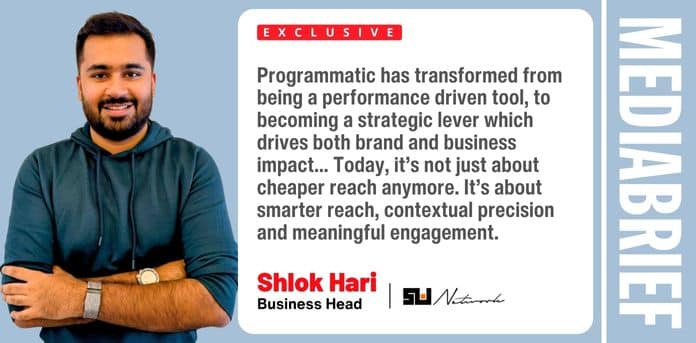
That definition no longer fits the current situation. “Programmatic” has transformed from being a performance driven tool, to becoming a strategic lever which drives both brand and business impact. At our agency, we have seen firsthand how this change has made clients rethink their expectations and the way campaigns are designed. Today, it’s not just about cheaper reach anymore. It’s about smarter reach, contextual precision and meaningful engagement.
From broad reach to smart impact
Early programmatic campaigns were built around automation buying impressions efficiently and optimizing CPMs. While that brought operational gains, it didn’t necessarily translate into stronger brand outcomes. As the ecosystem matured, so did the expectations of marketers who began asking a sharper question – what kind of reach actually drives impact?
The integration of multiple Data Management Platforms (DMPs) and Demand Side Platforms (DSPs) has changed the current game. What was once known as a blunt instrument has now become a precision tool.
Today, we can reach audiences defined not just by demographics, but by behaviour, context and environment. A financial brand, for example, can now identify users who frequent airport lounges and regularly read Business Line, all within premium, brand safe inventory. This is reach with the aim of intent & not just reach for the sake of numbers.
Relevance in the age of attention scarcity
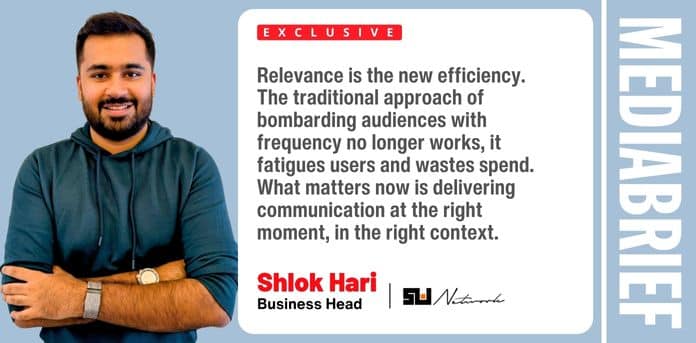
In an era where consumer attention is shrinking by the second and ad clutter is growing, relevance is the new efficiency. The traditional approach of bombarding audiences with frequency no longer works, it fatigues users and wastes spend. What matters now is delivering communication at the right moment, in the right context.
Programmatic enables this by combining data signals with real time decisioning. We have used contextual targeting to help brands to connect with audiences when they are most receptive, rather than simply most reachable. It is a shift from media efficiency to message effectiveness, ensuring that every impression serves a purpose.
When creativity meets technology
As the fight for attention intensifies, static and linear formats are losing ground. Rich media and gamified assets are taking center stage, allowing brands to turn ads into experiences. This is where programmatic moves beyond being a delivery mechanism and becomes an engagement platform.
Think of a paint brand ad that lets users tap to experiment with wall colors, or a bike company’s ad that responds when you shake your phone to “rev the throttle.” These formats transform passive viewers into participants. They build recall not through repetition, but through interaction. At our agency, we have seen interactive units consistently outperform standard videos in both engagement and dwell time.
More importantly, these ad interactions generate behavioral data that feeds back into the programmatic system, improving future targeting. It’s a closed loop of creativity driving data, and data enabling creativity.

Unified campaigns, seamless ecosystems
The evolution of programmatic isn’t just about data or format, it’s about integration. With stronger DSP and publisher collaborations, advertisers can now run unified campaigns across OTT, socials, news and various other platforms through a single interface.
This omnichannel control allows for consistent messaging, smarter frequency capping and better optimization across touch-points. For brands, it means much greater transparency and coherence. For agencies, it means true orchestration—a single campaign architecture that connects screens, contexts and outcomes.
At our agency, this integration has allowed us to plan holistically rather than channel by channel. We can track how a user exposed to a connected TV ad later engages with a social unit or display placement and attribute value across the journey rather than at isolated points.
From efficiency to effectiveness
It’s time to move past the old metrics. CPM and CTR tell only part of the story. The real value of programmatic lies in its contribution to brand equity, recall and incremental reach. Efficiency remains important & primary, but effectiveness is the new benchmark.
Every impression now carries an opportunity cost. The objective should be to make each impression meaningful by matching message, moment, and mindset. Programmatic enables that, but only when approached as a strategic framework, not just an operational one.

The strategic future of programmatic
Moving ahead, the interplay of data, creativity and media will define programmatic’s next chapter. The deprecation of cookies and stricter privacy frameworks are already pushing advertisers to rely more on first party data, contextual intelligence and advanced AI driven optimization.
The agencies and brands that gain, will be those who see programmatic not as a backend process, but as the nervous system of their digital ecosystem. It’s not just about where the ad is placed, but why it’s placed there and what behaviour or perception it’s designed to influence.
Programmatic is no longer a lever for efficiency. It’s a lever for intelligence, innovation, and intent. The brands that recognize this shift will move beyond chasing impressions to creating impact that lasts.