
































In an exclusive piece for MediaBrief, S. Anand, Founder and CEO of PaySprint, reflects on India’s fintech evolution, the growing importance of trust and awareness in driving adoption, and why communication is emerging as the industry’s next competitive advantage. Anand also shares how fintech companies can make innovation more relatable, bridge adoption gaps among MSMEs, and unlock the next phase of growth beyond technology and infrastructure.
India’s fintech story is, by any measure, one of the most extraordinary economic transformations of our time. In January 2026, UPI recorded an all-time high of 21.7 billion transactions in a single month, according to NPCI data.
Today, UPI accounts for nearly 85% of all digital payment volumes in India, a rail that did not exist a decade ago. The Indian fintech market, currently valued at USD 142.5 billion, is projected to reach USD 595 billion by 2034. We have built infrastructure that countries around the world are studying with admiration.
Over the last decade, the industry has focused on solving some of India’s biggest challenges: access, scale, efficiency and trust. And in doing so, fintech has quietly transformed the way businesses and consumers interact with money. The next phase of growth, however, presents an equally exciting opportunity: making these innovations more relatable, more visible and more deeply understood by the people and businesses they empower.

Having spent over two decades in financial technology and several years building PaySprint, a B2B fintech infrastructure company serving more than 5,000 clients across India, I have witnessed this evolution firsthand. Like many companies in the ecosystem, our initial conversations naturally revolved around technology, integrations and compliance frameworks. Over time, we realised that while technology enables outcomes, people connect with impact.
That shift changed our perspective. Instead of beginning with what our products did, we began with what our customers were trying to achieve. The conversation moved from APIs and infrastructure to speed, convenience, confidence and growth.
Because technology, ultimately, is not the story. Technology is what makes the story possible. And India has no shortage of remarkable stories.
A business owner in Pune who no longer spends days reconciling payments manually. A startup that launches faster because essential financial infrastructure is already available. A marketplace founder who scales operations without proportionately increasing overheads. These stories reflect the real value fintech creates every day, and they deserve a larger place in the narrative.
To its credit, the industry has made significant progress in creating awareness and trust. But as fintech expands beyond metros and reaches deeper into India’s entrepreneurial landscape, communication itself becomes an important enabler of adoption. Financial inclusion is not only about access to products; it is also about ensuring that businesses understand and feel confident about embracing them.
Studies suggest that nearly 65% of MSMEs continue to face financial and digital adoption challenges. Encouragingly, much of this gap can be addressed through greater awareness, education and confidence-building. The solutions exist. The opportunity lies in making them more accessible and relatable.
As embedded finance, AI-led services and governance frameworks shape the next chapter of fintech, the companies that stand out will be those that combine innovation with trust. And trust is built through clarity, consistency and meaningful engagement.
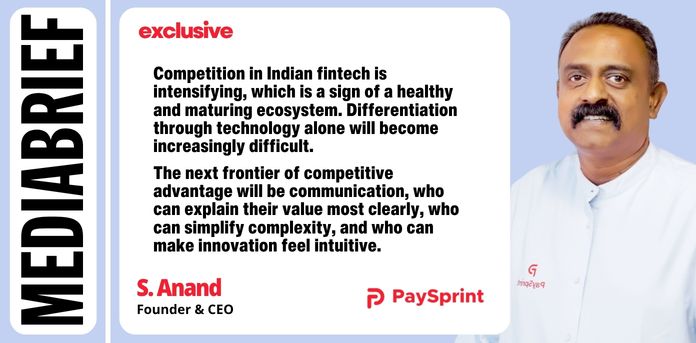
Competition in Indian fintech is intensifying, which is a sign of a healthy and maturing ecosystem. Differentiation through technology alone will become increasingly difficult. The next frontier of competitive advantage will be communication, who can explain their value most clearly, who can simplify complexity, and who can make innovation feel intuitive.
The good news is that India has already done the hard part. We built world-class digital public infrastructure. We earned regulatory confidence. We demonstrated scale in one of the world’s most diverse markets.
Now we have an opportunity to tell these stories with the same ambition with which we built them.
Because the story of Indian fintech is far bigger than transactions. It is a story of inclusion, empowerment and economic participation. It is a story of millions of businesses and individuals gaining access to opportunities that once seemed distant.
And perhaps the most exciting chapter of that story is still being written.