































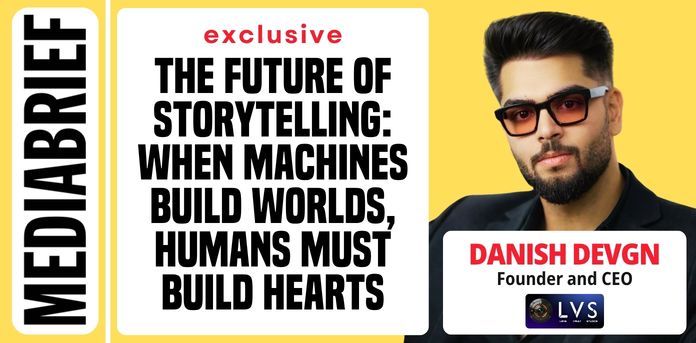
In an exclusive piece for MediaBrief, Danish Devgn, Founder and CEO of Lens Vault Studios, writes about how artificial intelligence is reshaping storytelling by removing traditional constraints, shifting creation from craft to engineering, and exposing an emerging authenticity paradox in an age of synthetic perfection. Devgn also reflects on the growing accessibility of generative tools, the rise of emotionally engineered narratives, and why human vulnerability remains the final differentiator in storytelling.
There’s a persistent myth circulating in creative circles: that artificial intelligence is killing storytelling. This couldn’t be further from the truth. What AI is actually doing is liberating it. The storyteller’s greatest enemy has always been constraint, budget, time, the physics of production. We have spent decades apologizing for what we couldn’t show audiences because the resources weren’t there. That era is ending.
A teenager in Bangalore can now spend an afternoon generating visual spectacles that would have required studio budgets, months of pre-production, and entire crews just five years ago. Deepfakes, generative imagery, synthetic actors, the tools have become so accessible and so powerful that the traditional gatekeepers of creation have effectively disappeared.
This is genuinely thrilling. But it’s also revealed something uncomfortable: the technical ability to create isn’t the same as the ability to move people.
From Creation to Engineering
The shift we are witnessing is profound. We have moved from storytelling as creation, the painstaking craft of building narrative, discovering character, finding truth in performance to storytelling as engineering. A world rendered overnight. A character that never ages because it never actually existed. A narrative that morphs based on algorithmic analysis of what keeps viewers engaged.
The machinery is astonishing. The output can be technically flawless. But flawless and moving are not the same thing.

I experienced this directly while directing our recent AI film Happy Birthday Joshi. There’s a moment in the film where the protagonist breaks down, not with dramatic wailing, but with something more devastating: the soft collapse of someone who’s held it together too long. His shoulders quake. A tear catches on his lip. His voice fractures on a single syllable.
The Authenticity Paradox
We are entering an era of acute scarcity, not of content, but of genuine emotion. The market is flooded with perfect visuals and synthetic performances. And in that flood, what cuts through is the opposite: imperfection, the pause, the tremor in a voice, the cultural specificity that can’t be templated, the lived experience.
Audiences have become sharper because they’ve been conditioned by spectacle. They don’t just watch anymore, they interrogate. They sense when something is performed versus when it’s felt. Authenticity is no longer assumed. It has to be earned, moment by moment, through the accumulation of small, honest choices.
This is the real advantage creators still have over machines: we can hurt. We can remember. We can understand the weight of a specific moment in a specific culture at a specific time. We can create not just content, but testimony.
The Future Architecture
The future of storytelling doesn’t belong to the purists who reject AI or to the techno-utopians who think machines can replace human imagination. It belongs to a third category: creators who understand AI as a force multiplier, not a substitute.
The best tools in the creative future won’t be the ones that generate perfect content, they’ll be the ones that eliminate friction, allowing creators to spend less time wrestling with logistics and more time wrestling with meaning. Imagine an AI that handles the tedious rendering while you focus on performance. That captures technical precision while you capture emotional truth.
But that’s a collaboration, not a replacement.

The Irreducible Human
No matter how sophisticated these systems become, how perfectly they can simulate reality or generate narrative, there is something they cannot manufacture: connection. The feeling of being seen. The recognition of shared humanity. The sense that someone who made this understood something about what it means to exist, to suffer, to hope.
AI can scale stories to billions of screens instantly. But it cannot create the intimacy of recognition, that rare moment when a story feels like it was made for you, by someone who understands the specific weight of your specific life.
That remains the province of humans alone.
The tools will get better. The technology will become more seamless. But the work of storytelling ‘the real work’ will always be the work of reaching into your own experience and finding something true enough, vulnerable enough, human enough to offer others.
The machines can build the worlds.
Only we can build the bridges between one heart and another.
Danish Devgn is a Director, Producer and Entrepreneur who heads Devgn Films, serves as CEO of Lens Vault Studios, and also helms Prismix Studios, a pioneering tech-driven production house and GenAI firm. He delivers high-impact content that bridges Bollywood’s legacy with the next generation. He works towards bringing technology and innovation into Bollywood and is a face of modern filmmaking blended with technology.