





























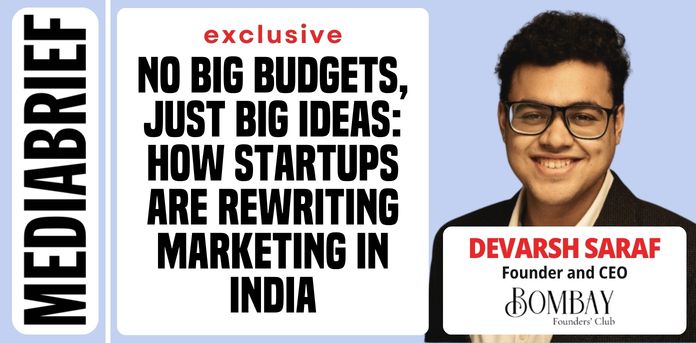
In an exclusive piece for MediaBrief, Devarsh Saraf, Founder and Chief Executive Officer of Bombay Founders’ Club, explores how rising digital ad costs in India are forcing early-stage startups to rethink traditional marketing and turn to more creative, community-led growth strategies. Saraf highlights how founders are increasingly building brands through owned communities, authentic storytelling, and experiential engagement rather than relying on paid media alone. He also shares examples of how startups are leveraging their teams, personal networks, and real-world experiences to drive organic discovery and long-term brand trust. Read on.
Digital ads in India are more expensive than they have ever been. This affects the big brands and established players a lot less than the early-stage founders in the startup ecosystem. However, in the true spirit of resilience and creativity which is emblematic of startups, some founders have completely aced their marketing by looking at what they already own and doing something far more interesting than running another ad.
Here’s a microcosm of some lovely efforts that illustrate some unique and truly innovative marketing strategies by startups of different scales and sizes.
The rockstar founders of Manetain led with community
In 2018, Hinshara Habeeb and Yuba Aga were both dealing with a problem the Indian beauty industry had completely ignored. As curly haired women growing up in India, they had spent years being told their natural hair needed fixing, and every time they went looking for products built for hair like theirs, there was simply nothing to find.
As women founders, they knew the odds were never going to be in their favour. But they walked in with an asset most brands spend years trying to manufacture. A community that was already there, already frustrated, and already waiting for someone to show up. They met on a WhatsApp group, started Manetain in 2018, and built the brand from inside that community.
Every product was shaped through real feedback, every activation rooted in education, and their Mane Ambassador Program amplified real lived experiences over scripted campaigns. As they put it themselves, “community was never a marketing strategy for Manetain, it was our starting point, and when a community truly believes in what you are building, it becomes a moat no competitor can replicate.”
The Bandra Cafe that turned its team into a show
Opening a cafe in Bandra and getting people to notice it, in a neighbourhood where a new cafe opens every other month and every menu looks identical, is where most founders struggle. Karreena Bulchandani knew this when she opened Mokai.
The menu was genuinely different, built from years of living across China, Japan, and Southeast Asia, but with so many cafes around her, she found herself sitting with a question she could not shake. “As much as we know that our product is out there, how do we set ourselves apart from everyone else?”
The answer came from an unlikely place. Karreena had been watching The Office obsessively during the stressful early days of building Mokai, and somewhere between episodes, the idea formed. What if the team at Mokai could become characters and be completely themselves on camera? That’s when Karreena turned to Suraksha, her very first hire and the one person she trusted without question, and made her the face of it all.
It was a single reel of Suraksha bantering with a customer that changed everything. It went viral, and at that moment Karreena understood exactly what was working. People were not just watching a cafe’s content, they were following a story, and walked through Mokai’s doors because they already felt like they knew everyone inside.
As Karreena puts it, “make sure your brand feels like a human.” That one decision, made on instinct and built on trust, turned Mokai from a cafe into something people genuinely wanted to be part of.
Nailinit put community at the centre of its launch strategy
Tanishq Ambegaokar and Shubham Singhal looked at nail care in India and saw that the category was booming, content around nails was everywhere, and young Indians were deeply invested in how their nails looked.
Other brands were selling but nobody was building a culture around it. Tanishq and Shubham saw that as an opportunity and instead of launching with a campaign, nailinit launched with an experience.
A high energy event in Mumbai, over two hundred prominent creators in the room, and a brand moment that travelled far beyond that one evening. By the time the product launched, the community was already built, already invested, and already talking about them.
The Croffle Guys let its founders tell the story
The Croffle Guys had a product nobody in India had heard of and no real way to make people curious enough to try it. Both Rahul and Veer came with a film industry background, and they brought that instinct directly into how they built the brand.
Instead of running ads, they put the four founders at the centre of everything, making witty, watchable content that showed them exactly as they were. The content spread, curiosity grew, and that curiosity translated into organic discovery on Swiggy and Zomato, where the brand topped search results largely on the strength of content.
Finding customers in the most unexpected places
The founder of a Mumbai based ticketing platform spent nine months struggling to find his customers. He had a solid product, a clear vision but no customers. Every channel he tried was either too expensive or already owned by someone bigger.
So he stopped looking at where everyone else was advertising and started thinking about where his audience actually was. His target audience was young, single women, and they were spending their time on dating platforms.
So instead of running another ad, he went to where they already were, built events around that insight, and created speed dating nights and social experiences that brought people together in real life. The people who showed up became repeat customers, and those customers brought their friends.
Nine months of struggling to find an audience, solved by showing up in the one place nobody else had thought to look.
Even the busiest founders are now their own biggest narketing asset
Arjun Vaidya built his personal brand the way most founders build their companies, consistently, publicly, and with a clear point of view. People trusted him, followed his work, and listened when he had something to say, and his personal presence was doing more for his brand than any campaign could have.
But as V3 Ventures grew and his calendar filled up, keeping that presence alive became the real challenge, because there is only so much one person can do and that is a problem every founder with a real personal brand eventually struggles with.
So Arjun started thinking about how to solve it, exploring AI avatars that carry his voice and perspective into spaces where he simply cannot always be present, and the idea behind it is that a founder who shows up consistently builds trust, trust builds an audience, and that audience follows the founder into everything they build next and compounds over time in a way that no paid campaign ever could.
India’s most creative marketing is emerging from founders who had no choice but to think differently. And what they built in the process were communities, characters, channels, and credibility, which turned out to be far more valuable than anything a media plan could have produced. The founders who figure this out early are building something that actually lasts, and in a market this competitive, that is the only thing worth building.