








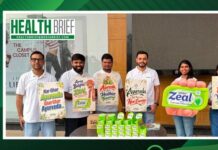









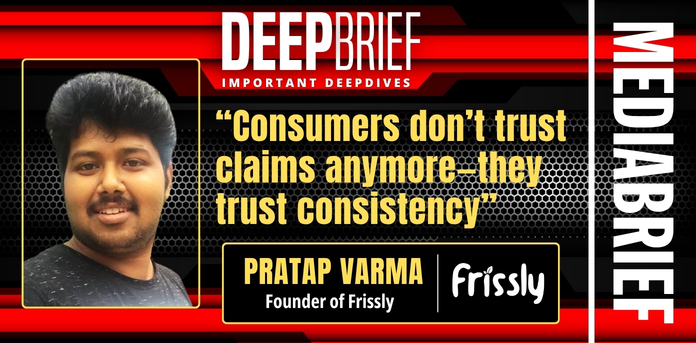
In an exclusive deep-dive interaction, Pratap Varma, Founder of the certified organic quick-commerce brand Frissly, speaks about why he believes India’s packaged food industry needs a fundamental reset, the philosophy behind building a clean-food brand, and Frissly’s journey from concept to a portfolio of over 300 certified organic products.
Varma also shares his perspectives on ingredient integrity, evolving consumer preferences, common misconceptions around clean-label and organic foods, and Frissly’s expansion roadmap as the brand looks to scale across India.
Frissly for the uninformed
For readers hearing about Frissly for the first time, what does the brand offer, what gap is it addressing, and how are you building the business in terms of manufacturing, footprint, team, distribution, sales channels and business model?
Frissly was not built to participate in the current food industry; it was built to challenge it. Today’s packaged food ecosystem is largely optimized for shelf life, cost efficiency, and marketing perception, often at the cost of real nutrition. We exist to reverse that. Every product we make is 100% certified organic, free from chemicals, preservatives, refined flours, and refined oils.
We manufacture in our own certified facility in Hyderabad under strict quality standards and deliver fresh in under 100 minutes. With a growing portfolio of 300+ products, Frissly is building what everyday food should have always been–clean, honest, and uncompromised.
What does the name Frissly mean, and what inspired you to choose it for the brand?
‘Frissly’ comes from ‘Friss,’ meaning fresh, but we intentionally challenge how the industry defines freshness today. Freshness is not about when something was made, it is about what has been done to it. Most packaged food is engineered to appear fresh while being chemically extended.
At Frissly, freshness means zero intervention: no preservatives, no artificial stabilizers, and no synthetic corrections. It means food that has not been altered to survive shelves or optimise appearance. The name reflects our stance: we are not redefining food, we are restoring it to what it was always meant to be.
You began working on Frissly in 2023 but launched it only in 2025. What inspired its creation, and what went into the two-year journey before launch?
Because we refused to take the shortcuts the industry depends on. The journey began years before Frissly, with organic farming, farmer networks, and running organic supermarkets like Farmer’s Best with over 2,000 products. COVID exposed a deeper issue: even when sourcing was clean, packaged food remained fundamentally compromised. That realisation led to the creation of Frissly.
We spent two years building the foundation—certified sourcing, in-house manufacturing, strict compliance systems like GMP, HACCP, ISO, and deep R&D. We didn’t delay the launch—we rejected the idea of launching something that didn’t meet our own standards of purity, quality, and trust.

How would you describe Frissly’s offerings today across everyday food categories?
We don’t create ‘health products’; we rebuild everyday food without compromise.. The industry has normalized chemical-heavy, refined, and overly processed staples across categories.
At Frissly, we’ve reconstructed these categories using certified organic ingredients and clean processes. Today, we offer 300+ products across breakfast, snacks, bakery, sweets, chocolates, flours, batters, ready-to-eat and ready-to-cook foods.
Across every category, the standard is absolute: no preservatives, no refined flours or oils, and no artificial additives. The goal is not to change consumer behaviour; it is to fix what consumers are already eating.
Who is Frissly’s target consumer, and what needs or lifestyle is the brand designed to serve?
Frissly is built for households that have started questioning food but haven’t found real answers yet. Particularly parents who are no longer comfortable trusting labels blindly, and professionals who want convenience without compromising health.
But fundamentally, we are building for the next generation. If children grow up consuming clean, authentic food that genuinely tastes good, that becomes their baseline expectation. That’s where real industry change begins, not through awareness campaigns, but through everyday consumption habits shaped early..
The journey before Frissly
Before launching Frissly, you spent years working in organic farming, farmer-direct food systems and food trust. What were the key milestones that shaped your journey and ultimately led to the creation of the brand?
The journey began with organic farming and deep engagement with farmers across India. Building platforms like Rythu Online and Farmer’s Best gave us firsthand understanding of both sourcing challenges and consumer expectations. We saw how difficult it was to maintain integrity across the food chain.
Running organic supermarkets with thousands of products further highlighted the gap: availability existed, but consistency and trust did not. COVID exposed structural weaknesses, especially in packaged food. Each of these milestones led to one conclusion: improving the system wasn’t enough; it had to be rebuilt.
What did those experiences teach you about Indian consumers and what really drives trust and repeat buying?
The biggest learning is that consumers don’t trust claims anymore—they trust consistency. The industry has overused labels to the point where they’ve lost meaning. What drives repeat buying is not positioning—it’s experience. If a product consistently delivers clean ingredients without compromise on taste, it naturally becomes part of a household’s routine.
Our ~70% repeat rate reflects that shift. When consumers stop second-guessing what they’re eating, trust is established. And once trust is established in food, switching behaviour becomes natural, not forced.

At what point did you realise the larger opportunity was not only in fresh produce, but in packaged food used every day at home?
Because that’s where the biggest compromise exists. Fresh produce still retains some level of integrity, but packaged food is where the industry has systematically optimized for shelf life over health.
During COVID, when fresh supply chains broke down, families had no choice but to depend on packaged foods they did not fully trust. That exposed the real problem: not availability, but reliability. That’s when it became clear that the larger opportunity, and responsibility, was in rebuilding everyday packaged food.
Why Frissly, why now
Why did you believe the market needed Frissly despite the growing number of brands already positioned around health and wellness?
Because most brands operate on partial truth. They highlight what works for them and quietly ignore what doesn’t. This creates confusion for consumers trying to make informed choices.
The market doesn’t lack options; it lacks honesty. Frissly exists to remove that ambiguity. We don’t optimise for perception; we optimise for process. When the process is clean, the product speaks for itself. That clarity is what differentiates us in a crowded market.
What are Frissly’s clearest USPs in a crowded organic and clean-food space?
Our differentiation lies in discipline. Every product is built on four non-negotiables—certified organic ingredients, zero chemicals, zero refined ingredients, and uncompromised taste. The industry designs food for shelf stability—we design it for integrity.
We invest 6 to 12 months in R&D for a single product because approximation is not acceptable in this category. Another key distinction is that we don’t position clean food as premium or occasional—it is meant for daily consumption.
If you had to convince a skeptical first-time buyer in three points, what would you say?
Scepticism in this category is justified; it has been built over years of misleading claims. We don’t try to counter that with more claims. Instead, we focus on clarity.
When a customer sees transparent ingredients, experiences clean taste without artificial enhancement, and receives consistent quality across orders, skepticism naturally reduces. The shift doesn’t come from persuasion; it comes from removing doubt. That’s what we focus on.

Building awareness and demand
How are you building awareness and demand for Frissly in the market today?
We’ve taken a fundamentally different approach to awareness. Instead of relying on heavy advertising, we focus on product experience. Sampling within communities, schools, and family networks has been one of our strongest growth drivers.
Clean food is difficult to communicate purely through messaging; it has to be experienced. Once people taste the product and understand the difference, trust builds organically. That trust then drives word-of-mouth, which has proven to be far more effective than traditional campaigns.
What does your marketing mix currently look like across social media, influencer engagement, community-led outreach, content, performance marketing, partnerships, marketplace visibility, and other channels?
Our marketing is intentionally grounded. We prioritize direct engagement over large-scale visibility. Social media is used to educate, not exaggerate. Influencer collaborations are selective and based on alignment, not reach. Community engagement remains central—families, residential spaces, and real users.
Performance marketing supports discovery, but it is not the core driver. In this category, over-marketing often signals product weakness. We focus on ensuring the product stands strong enough to carry the brand.
What kinds of campaigns, creatives, content formats, or customer-acquisition approaches have worked best for Frissly so far?
What works best is clarity and consistency. Content that shows real ingredients, real processes, and real outcomes performs far better than high-production campaigns. Sampling remains one of the most effective acquisition tools because it removes doubt instantly. Customer testimonials and repeat user behaviour reinforce credibility. In a category where trust is low, authenticity is not a strategy—it is a requirement.
Our creative philosophy is simple—represent the product as it is. The industry often relies on visual exaggeration to create appeal. We avoid that. Our product visuals focus on actual textures, ingredients, and outcomes. Packaging reflects clarity and simplicity. Founder and process visuals highlight the journey rather than brand posturing. For us, creative work is not about attraction—it is about alignment with reality.
How do you decide the right balance between education-led communication and sales-led communication when marketing a brand like Frissly?
Education is the foundation. Consumers today are exposed to too many claims and too little clarity. If we focus only on sales, we contribute to that confusion. By helping consumers understand ingredients, sourcing, and preparation, we enable informed decisions. Sales then follow naturally. This approach may be slower initially, but it builds stronger trust and long-term retention.

What role do digital tools such as targeted advertising, e-commerce marketing, retail-platform visibility, or programmatic media play in your growth strategy today?
Digital is an enabler, not a differentiator. It helps with accessibility, discovery, and convenience—especially for consumers actively seeking better alternatives. Our D2C platform allows us to maintain control over the customer experience. However, digital alone cannot build trust in food. That comes from product consistency. We use digital tools to support growth, but not to substitute product quality.
How important are nutrition experts, influencers, regional communities, home cooks, and word-of-mouth in your customer-acquisition journey?
We prioritise credibility over amplification. Word-of-mouth remains our strongest acquisition channel because it reflects real experience. Influencers and nutrition experts add value when there is genuine alignment, but we avoid over-reliance on paid endorsements. Trust in this category is fragile, and it cannot be outsourced. It has to be earned directly through product experience.
Product integrity, ingredients, and trust
How do you maintain ingredient integrity and a clean-label promise across such a wide portfolio?
Ingredient integrity cannot be managed at the end—it has to be designed at the beginning. At Frissly, it starts with sourcing exclusively from certified organic farmers, where traceability is non-negotiable. From there, we maintain full control through in-house manufacturing under GMP, HACCP, and ISO-certified systems.
Every product is made in small batches, aligned with demand, not inventory. The industry often tries to balance quality with cost—we remove that trade-off entirely. No preservatives, no refined ingredients, no artificial corrections at any stage. Integrity is not a claim we maintain—it’s a system we’ve built to eliminate compromise.
Palmolein oil remains widely used in snacks, biscuits and packaged foods, including by leading brands. Does Frissly use palmolein oil in any of its products, and what is your view on its continued use in packaged foods given the health concerns around it?
We do not use palmolein oil or any refined oils—by principle, not by exception. The widespread use of palmolein in the industry is largely driven by economics and shelf-life convenience, not nutritional value. It allows products to be cheaper and last longer—but at a cost consumers don’t always see immediately.
At Frissly, we’ve consciously moved in the opposite direction. We use only certified cold-pressed oils, even though it significantly increases production cost. Because for us, ingredient quality is not a variable—it is the foundation of the product.
The brand reports around 70% recurring orders. What does that say about trust, acceptance, and changing household behaviour?
A ~70% repeat rate signals something deeper than satisfaction—it signals a behavioural shift. Consumers are not just trying Frissly, they are integrating it into their daily routines. That only happens when trust replaces doubt. In a category where people are used to second-guessing ingredients and claims, consistency becomes the biggest differentiator.
When customers experience clean, chemical-free food that consistently tastes good, they stop experimenting—they commit. That shift from trial to habit is what defines long-term trust.

Consumer shifts and category realities
What are the biggest shifts you are seeing in Indian household food choices today?
The most significant shift is from passive consumption to active questioning. Consumers are no longer accepting labels at face value—they are asking what goes into their food and how it is made. There is also a clear demand for convenience without compromise.
Families want ready-to-eat and packaged foods, but not at the cost of health. This is a fundamental shift. The industry built itself assuming consumers wouldn’t question deeply. That assumption is now breaking—and that’s reshaping the category.
Do you see clean and organic food in India as a niche premium space or an emerging mainstream category?
It is moving toward mainstream—but the industry hasn’t fully caught up yet. Awareness has grown significantly, but accessibility and trust remain inconsistent. For a long time, clean food was positioned as premium or niche. That perception is changing as more consumers understand the long-term cost of compromised food. The shift will accelerate as reliable ecosystems emerge. At Frissly, we are building for a future where clean food is not an upgrade—it is the default.
Growth milestones and the road ahead
Looking back at the journey since inception, what would you describe as the most important growth milestones Frissly has achieved so far?
The most meaningful milestones are not just scale—they are indicators of trust. Building a portfolio of 300+ certified organic products across everyday categories is one. Achieving a strong repeat rate is another. Establishing full control over sourcing and manufacturing has been critical.
Operationally, creating a system that delivers fresh products within 100 minutes is a significant step. But the real milestone is this—Frissly is becoming a habit in households, not just a product they try once.
Beyond repeat orders, which business milestones matter most to you over the next 12 to 24 months: city expansion, dark-store rollout, franchise growth, product-category expansion, customer retention, supply-chain depth, or something else?
The focus is not just on growth—it is on scaling without dilution. Expanding into new cities like Chennai, Pune, Vizag, and Mumbai through a franchise-led model is a priority. But expansion alone is not success. Maintaining the same level of product integrity, sourcing quality, and customer trust across geographies is critical.
Strengthening supply chains, deepening farmer networks, and expanding product categories will be key. Growth is easy to achieve—consistency at scale is what defines a serious brand.

As Frissly expands into more cities, what are the most important strategic priorities and operational milestones you are aiming to achieve?
The primary priority is replicating trust—not just operations. Every new city introduces complexity in sourcing, production, and delivery. Our focus is on building systems that maintain the same standards across locations. That includes strong partner alignment, disciplined processes, and supply chain depth.
Many brands expand quickly but lose consistency. We are consciously building slower, but stronger. Because in food, once trust is broken, it is extremely difficult to rebuild.
Over the next three to five years, what kind of company do you want Frissly to become, and what wider shift would you like to help create in Indian food culture?
Our vision is to make clean eating the default in India. Not a premium choice, not a conscious upgrade—just the way food is consumed. Frissly is not just a product company; we aim to build a clean-eating infrastructure that spans sourcing, manufacturing, and distribution.
The larger shift we want to create is cultural—where food is no longer engineered for shelf life, but crafted for well-being. If we can make compromised food unacceptable, we’ve achieved what we set out to do.
Myth-busters and consumer misconceptions
What is the biggest myth people believe about organic food in India?
The biggest myth is that certification alone guarantees purity. Certification is important—but it is only one part of the equation. Processing methods, ingredient combinations, and manufacturing practices matter just as much.
A product can carry an organic label and still be heavily processed or nutritionally diluted. True organic integrity is end-to-end—from sourcing to consumption. Without that, certification becomes a partial truth.
What is the biggest myth around clean-label food?
The biggest myth is that ‘clean-label’ automatically means clean food. In reality, the term is loosely defined and often used as a marketing tool. Ingredients can be substituted or disguised while maintaining a ‘clean’ perception. True clean-label food is not about removing a few additives—it is about eliminating unnecessary interventions entirely. Without that depth, the label becomes cosmetic rather than meaningful.

Is it still true that organic food is mainly for affluent urban consumers, or is that assumption becoming outdated?
That perception is largely urban and outdated. Organic food, in its purest form, is simply unadulterated food—something rural communities have consumed for generations without labeling it as ‘organic.’ The premium perception comes from packaging, branding, and access—not from the nature of the food itself. As awareness grows, more consumers across segments are prioritizing quality over convenience-driven compromises. This shift is expanding beyond affluent urban pockets.
Many consumers think healthy food must compromise on taste or convenience. How do you respond to that belief?
This is one of the most persistent myths—and it exists because most brands have failed to execute properly. When ingredients are genuinely high quality, taste improves—not declines.
At Frissly, we invest significant time in R&D to ensure that clean food delivers on flavour, texture, and experience. Convenience is addressed through ready-to-eat and ready-to-cook formats. Health, taste, and convenience are not trade-offs—they are outcomes of doing things right.
Consumers often confuse terms like natural, organic, preservative-free, and chemical-free. What do people most often misunderstand when they read these claims on packaging?
The confusion exists because these terms are often used without clear regulation or consistency. Consumers tend to associate them with overall product quality, without examining the full ingredient list or processing method.
‘Natural’ or ‘chemical-free’ can be selectively used to create a perception that may not reflect reality. True clarity comes from understanding the entire composition of the product—not just highlighted claims. Without that, labels can easily mislead.
What is one thing consumers should stop blindly believing about packaged food claims?
Consumers should stop assuming that front-of-pack claims tell the full story. Labels are designed to attract attention—they highlight positives while often downplaying or omitting compromises. Terms like ‘high protein,’ ‘organic,’ or ‘natural’ can create a perception that may not reflect the complete product reality.
Real understanding comes from looking deeper—at ingredients, sourcing, and how the product is made. Without that, decision-making is based on incomplete information.

Some people assume that preservative-free or clean-label automatically means impractical shelf life or inconvenience. How do you address that concern?
Shorter shelf life is often seen as a limitation—but in reality, it is a reflection of authenticity. Food without preservatives naturally doesn’t last as long, because it hasn’t been chemically extended. The industry has conditioned consumers to equate longer shelf life with convenience.
We challenge that assumption. With the right production and delivery systems, fresh products can still be highly convenient. At Frissly, we prioritize product quality at the time of consumption—not how long it can sit on a shelf.
Is there a myth on the other side too — that every packaged food brand is automatically suspect unless it is tiny, handmade, or artisanal?
The distrust around packaged food didn’t emerge without reason—it was built over years of compromise. However, the issue is not packaging itself—it is how the food is made. Large-scale systems often prioritize efficiency and shelf life, leading to compromises. But with the right sourcing, processes, and intent, packaged food can still be clean and reliable. The solution is not to avoid packaged food entirely—it is to demand better from it.
In your view, which food-label terms are the most misused or loosely used in the market today?
‘Organic,’ ‘natural,’ and ‘chemical-free’ are among the most misused terms in the market today. They are often used to create a perception of quality without fully delivering on it. In many cases, these labels are selectively applied while underlying compromises remain.
For consumers, the key is to look beyond terminology and focus on substance—ingredients, sourcing, and preparation. That’s where the real truth lies, not in the words printed on the front of the pack.
Frissly exists because the industry normalised compromise. We’re here to make that unacceptable again.