



























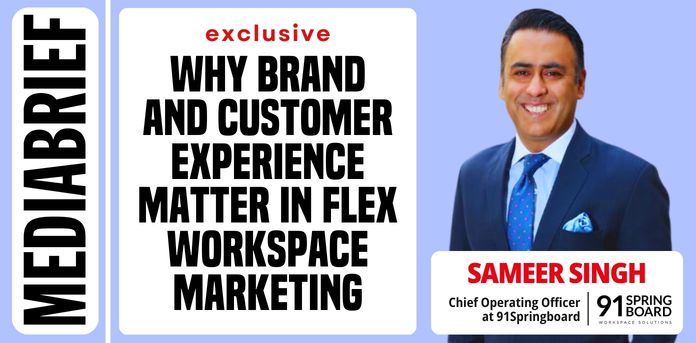
In an exclusive interaction with MediaBrief, Sameer Singh, Chief Operating Officer at 91Springboard, speaks about the evolution of flexible workspaces, businesses’ changing expectations, the economics of operating these spaces, and the role of marketing in a category built around physical experience. Read on.
91Springboard opened its first hub in 2012. Since then, the flexible workspace market has developed, and the range of businesses considering it has widened. Reflecting on how the company and the category have evolved, Sameer Singh, Chief Operating Officer at 91Springboard, says, “When we launched in 2012, we were amongst the first few players in coworking spaces in India, seen then as a niche product for startups and freelancers.
“That’s changed completely; today, even large enterprises treat flex-space as a serious strategic option. What has changed is not just the profile of the customer, but the role of the workplace itself, from a fixed real estate commitment to an operating lever that can move with the business.
“Over the years,” he says, “the nature of workspaces and business requirements has evolved considerably. Hybrid work, multi-city talent access, and the need for greater capital efficiency and business agility have brought our industry’s core value proposition into focus: office-as-a-service.”
He continues, “Today, we’ve grown into a full-stack workspace company with a presence across nine cities. Our approach has always been “density over breadth”, concentrated clusters in key markets rather than spreading thin, so we get deep insight into local demand.
“As India’s commercial real estate shifts from ownership and long-term leasing toward flexible, service-led formats, we see our role as the operational partner helping businesses, from early-stage startups to GCCs and large enterprises, scale with speed, discipline, and consistency while retaining the flexibility to adapt as their business needs evolve.”
What businesses expect from a workspace
Turning to what companies now seek from workspace providers, Singh discusses changing expectations around flexibility, service and the workplace experience. He says, “Clients today aren’t looking for a desk and Wi-Fi; they are looking for a workplace that works for their business and their people. Location, flexibility, amenities, service, and design thinking are now baseline expectations, not differentiators.”
He adds, “What has changed is the depth of expectation around each of these. Three shifts stand out. Hotelisation, hospitality-grade service and concierge-style support are increasingly becoming the norm. Premiumisation with purpose — demand for Grade-A, wellness-led environments that reflect a company’s brand — has grown significantly, led by GCCs and high-growth enterprises who now see workspace as a lever for talent retention, not just aesthetics. And flexibility itself has evolved from short-term seats to fully customised, managed environments that convert capex into opex while preserving agility.”
“Underlying all of this is a behavioural shift,” says Singh. “People move between focused work, collaboration and informal connection throughout the day, and the workplace has to support that rhythm. The office is no longer a static container for desks; it’s a service-led product that has to earn its user’s loyalty every day.”
Bringing hospitality into workspace operations
Asked what a hospitality-grade experience means in operational terms and where it gives 91Springboard a competitive advantage, Singh says, “At 91Springboard, it has always been about bringing the principles of hospitality into the workplace — creating an experience that is intuitive, responsive and effortless. At its core, hospitality is about understanding what people need and making it easy for them to get it.”
He continues, “Operationally, that means consistency and predictability at scale. Whether we’re onboarding a new team, expanding a client from 50 seats to 500, or resolving a service request, every touchpoint has to feel intuitive. Beyond the physical layer, there are also invisible services like scalable seat management, secure IT, integrated wellness and technology-enabled support that allow the workplace to respond to changing needs without the customer having to think about the complexity behind it.”
“This shows up in multiple ways: as a customer-centric proposition tailored to different cohorts; as a service model built on tech-enabled operations; as an investment lens that creates more stable returns for asset owners; and as a business model where an asset-light approach, much like hospitality’s Prop Co/Op Co structure, balances risk between owners and operators.”
“The real competitive advantage is trust,” adds Singh. “Organisations remember how consistently a workspace enabled their people to perform, not its furniture, and that consistency at scale is hard to replicate.”
Occupancy, operations and margins
Occupancy and profitability have long been closely linked in the flexible workspace business. Discussing how the sector’s economics are changing and the decisions shaping 91Springboard’s approach, Singh says, “The economics of flex are evolving as the category matures. The focus is moving from simply filling desks to building a more efficient and sustainable operating model, where occupancy, customer value and operational discipline work together. For us, sustainable growth has always been about building value, efficiency and scale for our stakeholders.”
He explains, “Our approach rests on a few choices: density over breadth, which allows us to build deeper customer insight and operational efficiencies in the markets we serve, and a product mix that addresses different stages of the customer lifecycle. Ready-to-use suites provide immediate flexibility, while built-to-suit workspaces and enterprise solutions allow business to create customised environments.”
“We also see the economics of flex increasingly moving closer to the hospitality model, where the value lies not just in the underlying asset but in how effectively it is operated. An asset-light approach, can create greater predictability for asset owners while giving operators the flexibility to keep innovating around service and experience.”
“Ultimately,” Singh says, “we believe the next phase of the sector will be defined less by how much space an operator adds and more by how intelligently that space is operated and how consistently it creates value for both businesses and their people.”
Flex in corporate real estate strategy
India’s commercial real estate market is seeing growing demand for flexible and managed workspaces. Asked whether he sees flex becoming a core part of corporate real estate strategy rather than an alternative to conventional office leasing, Singh says, “Real estate is increasingly being viewed as business infrastructure rather than simply a long-term commitment. Flexible workspace stock in India has crossed 100 million sq ft, nearly tripling since 2020, with adoption expected to climb further in the coming years.”
“Large enterprises and GCCs are increasingly using flex as a deliberate part of their real estate strategy, whether to enter a new city, scale teams or respond to changing business requirements without taking on a multi-year commitment.”
“For us, that is the real shift: flex is giving businesses the ability to make their real estate footprint move at the pace of the business. We see this as the beginning of flex becoming a distinct sub-segment of commercial real estate — one that brings greater agility and responsiveness to how businesses plan and manage their workplaces,” he adds.
Differentiating the 91Springboard brand
As competition in the flexible workspace market grows, providers often emphasise similar benefits, from amenities and technology to community. Asked how 91Springboard differentiates its brand, Singh says, “In a market where the visible product can look increasingly similar, differentiation moves from what you offer to how consistently you deliver it. Most providers can list flexibility, amenities and technology on a brochure; the real question is whether that promise holds true across every interaction and every location.”
He continues, “We see ourselves as a people business, and that shapes everything from design to service delivery. Our design philosophy is simple: let members focus on what they do best, while we create the environment that makes that possible, extending beyond the physical space into curated community events and member benefits most providers treat as an afterthought.”
“Localisation matters too, our Mumbai hubs are designed to reflect the city’s diverse business ecosystem and the needs of its members, while our Bengaluru hubs reflect the city’s startup and technology ecosystem, even as our operational discipline remains consistent across locations.”
“Ultimately,” Singh says, “our brand is built around bringing together two things that can often seem contradictory: giving occupiers agility while giving asset owners stability. Clients should experience us not simply as a landlord or workspace provider, but as an extension of their own team. That combination of flexibility, consistency and trust is what we believe is difficult to replicate.”
The role of storytelling in B2B marketing
Turning to marketing, when asked whether commercial real estate and flexible workspace brands are placing greater emphasis on storytelling, experience, content and brand building as B2B marketing draws more from consumer marketing, Singh says “Businesses are moving beyond the traditional evaluation factors such as location, pricing or square footage and prioritizing the overall experience, brand, community and the value it creates for their people. The fundamentals, economics, location, quality and functionality still matter, but as these become increasingly comparable across providers, experience, reputation and brand are playing a greater role in shaping preference.”
He adds, “In a sector like flexible workspace, storytelling can make a meaningful difference. The ability to communicate that a space is no longer just about physical infrastructure, but a powerful medium that enables collaboration, productivity, networking and employee engagement.”
“The ability to communicate that a space is more than just physical infrastructure, but a powerful medium that enables collaboration, productivity, networking and employee engagement.” Experiences, events, digital content and community-led initiatives are also becoming popular tools for building stronger brand affinity.”
“Ultimately,” he adds, “B2B marketing is moving from simply communicating what a company offers to creating a distinct point of view around why it matters. That is where we see the opportunity to build a differentiated brand in a flexible workspace.”

Digital discovery and physical experience
In a category where the product is a physical experience, when asked what role digital marketing, social media, customer testimonials and experiential marketing play in influencing B2B consideration and conversion, Singh says, “The customer experience doesn’t begin when someone walks through the door; increasingly, the first interaction with the brand happens digitally. That makes digital an important part of making the proposition visible, tangible and credible before the customer experiences it firsthand.”
He continues, “For flexible workspace, this is particularly important because much of the consideration journey happens before a site visit. Content, social media, customer stories and digital experiences can communicate more than what a workspace looks like; they can bring to life what it feels like to work there. This also gives the brand an opportunity to communicate what it stands for and the experience it promises to deliver.”
“But digital should not try to replace the physical experience. Its role is to create enough familiarity and confidence to encourage the customer to experience the product for themselves. Experiential marketing and customer advocacy then become powerful bridges between the promise made by the brand and the reality of the experience.”
“Ultimately,” he says, “the strongest brands are those where the story you tell digitally and the experience you deliver physically are one and the same. That consistency is what turns awareness into consideration, and consideration into trust.”
The next phase of the workplace
Looking ahead, when asked how he expects the relationship between employers, employees and physical workplaces to evolve over the next three to five years, and what that could mean for 91Springboard’s next phase of growth, Singh says, “The conversation is moving away from flexibility as a feature and toward adaptability as a baseline. The question a workplace has to answer is no longer ‘can I get my work done here’ but ‘why should I choose to come in today’, which means offices have to function as genuine human-to-human environments to earn the commute.”
He continues, “For operators, this means growing demand for “experience readiness”, spaces usable from day one, compliant and operationally predictable, with emphasis shifting from design-led novelty to reliability and consistency across locations. Location strategy will keep evolving too, organisations will increasingly operate through networks of hubs rather than a single headquarters.”
“For 91Springboard,” Singh says, “that means deepening our presence in core markets, expanding our enterprise and managed-office pipeline, and delivering a genuinely full-stack offering, design, operations, technology, and community, rather than just space. The operators who treat workspace as an operating lever, not a static asset, will be best positioned for the next phase of growth.”