




























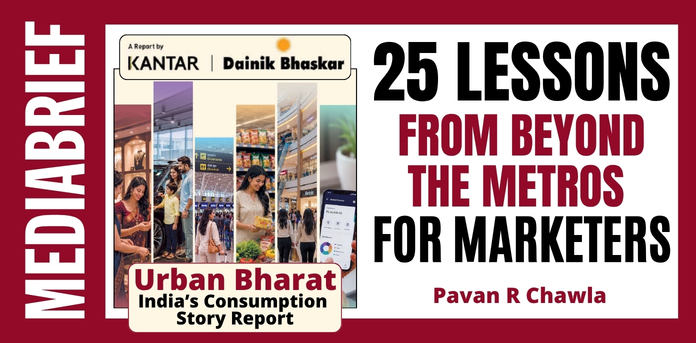
India’s next consumption story is no longer confined to Mumbai, Delhi and a few large metros. Dainik Bhaskar Group and Kantar’s Urban Bharat – India’s Consumption Story studies changing consumer behaviour across 11 sectors and introduces the Urban Bharat City Opportunity Index covering 50 cities. Mediabrief has drawn 25 lessons from the report for CEOs, CMOs, agencies, media planners, retailers and investors.
Why the Urban Bharat report deserves attention
Urban Bharat – India’s Consumption Story, jointly published by Dainik Bhaskar Group and Kantar, attempts to build a broad picture of India’s emerging urban markets.
It brings together demographic change, rising affluence, infrastructure, digital adoption, language, culture, media, retail and consumer behaviour. Its larger value lies in encouraging marketers to reconsider where India’s future demand may come from.
MediaBrief’s main takeaway is that Urban Bharat should no longer be viewed simply as India beyond the metros. It is a large and varied market with its own economic growth, aspirations and patterns of consumption.
We have drawn 25 lessons from the report. But first, it is useful to understand what the study covers and why it matters.
About the report
One of the report’s strengths is that it defines what it means by Urban Bharat instead of relying only on broad labels such as Tier II and Tier III India.
For this study, Urban Bharat includes markets across Madhya Pradesh, Rajasthan, Uttar Pradesh, Bihar, Punjab, Haryana, Uttarakhand, Chhattisgarh and Jharkhand, along with Maharashtra and Gujarat. Mumbai and Delhi are excluded.
Together, these cities and towns account for nearly one-third of India’s urban population. The report argues that they should no longer be treated as smaller economies dependent on metropolitan centres. Many now have their own employment, education, enterprise and consumer markets. This is the report’s central argument: Urban Bharat is no longer merely catching up with the metros.
The timing is useful too. As brands prepare their festive-season marketing, distribution and media plans, they must decide where additional investment can produce growth. A study that helps identify promising cities and markets can therefore support immediate business decisions.
The report covers automobiles, personal finance, e-commerce, education, FMCG, healthcare, jewellery, real estate, retail, telecom, travel and tourism. It concludes with a chapter on culture, language, trust and media.
This broad coverage helps the reader see patterns that appear across categories. Among them are the spread of premium demand beyond the metros and the need to move past Tier II as a single planning category.
Also read: Why the Kantar-Dainik Bhaskar Group Urban Bharat report is also a powerful story about print’s continuing strategic relevance
The Urban Bharat City Opportunity Index
One of the report’s most useful contributions is the Urban Bharat City Opportunity Index: UB Top 50.
Instead of treating Urban Bharat as one market, the Index ranks 50 cities using two measures:
- Market Affluence Score
- Market Population
The aim is to help businesses identify cities that combine spending power with population scale and may therefore deserve priority in business expansion, media investment, retail and distribution.
The report says future editions may add measures covering consumer demand, market maturity and economic activity.
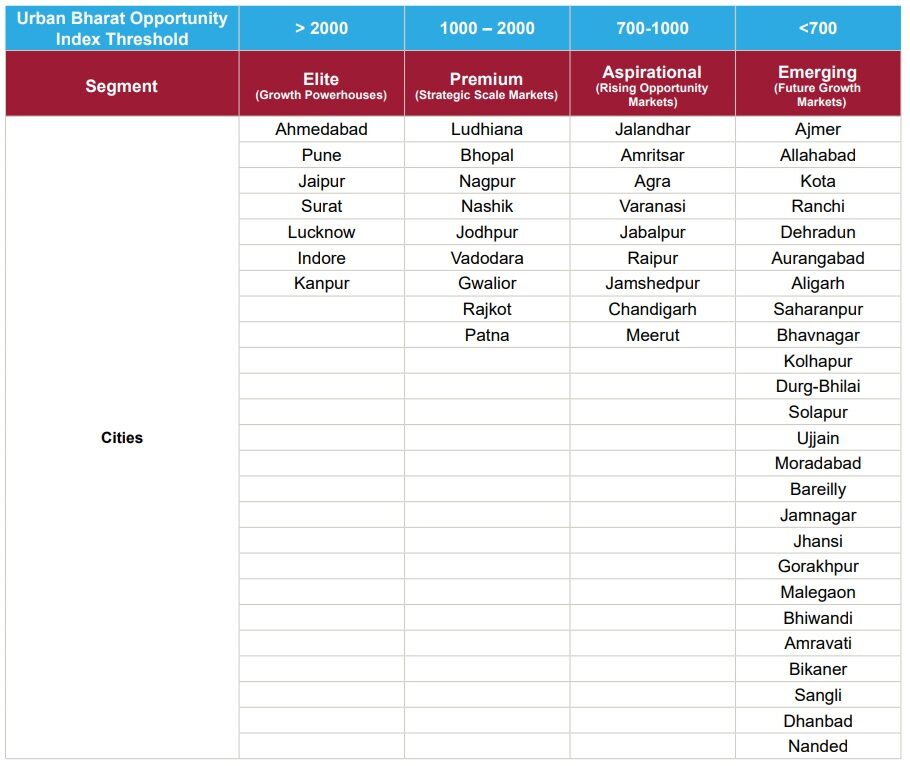
The classification shows why broad Tier II planning is inadequate.
Ahmedabad, Pune, Jaipur, Surat, Lucknow, Indore and Kanpur are placed in the Elite group. Other cities are classified as Premium, Aspirational or Emerging, based on their population, affluence and stage of development.
A city that can already deliver business at scale needs a different plan from one entering an early phase of consumer growth.
The more useful question, therefore, is not whether Urban Bharat matters. It is which Urban Bharat cities matter most for a particular business.
A useful initiative by Dainik Bhaskar Group and Kantar
The report is also a good example of a media company moving beyond audience reach to create useful business knowledge.
Dainik Bhaskar Group brings years of experience and understanding of many of the markets covered in the report. Kantar brings research design, consumer data and analytical discipline.
Together, they offer marketers more than readership or audience numbers. They provide a way to understand the markets behind those audiences.
Advertisers now expect media companies not only to reach consumers, but also to help explain how those consumers and their markets are changing. This report is a meaningful step in that direction.
25 lessons every marketer should learn
1. Urban Bharat is no longer merely catching up
The report argues that Urban Bharat should not be viewed as a delayed version of metropolitan India. Many of its cities have developed their own employment, education, business and consumption bases.
Most visible in: Ahmedabad, Pune, Jaipur, Surat, Lucknow, Indore and Kanpur, which make up the report’s Elite group.
Why it matters: A ‘metro first, others later’ approach may cause brands to miss important sources of growth.
2. India’s consumption map is spreading outwards
Urban growth is moving through district centres, regional cities and connected economic corridors rather than remaining concentrated in a few metros.
Why it matters: Expansion plans should consider infrastructure, regional links and the strength of surrounding markets, not only the size of an individual city.
3. Premium demand is growing in Urban Bharat
The report records a sharp increase in the affluent population of Urban Bharat, from 22.7 million to 39.9 million in six years. Its share of affluent consumers is also moving closer to that of Mumbai and Delhi.
Most visible in: Jaipur, Ludhiana, Ahmedabad, Pune, Lucknow, Indore and Amritsar. The report also notes the expansion of luxury automobile demand into Kanpur, Varanasi, Udaipur and Patna.
Why it matters: Brands should identify which premium products suit each city rather than assume such demand exists only in the largest metros.
4. Affordability and aspiration can coexist
The report suggests that the consumer question is changing from ‘How cheaply can I buy?’ to ‘What better product can I now afford?’
Consumers remain careful about value, but increasingly judge value through quality, convenience and aspiration as well as price.
Why it matters: Brands do not always have to choose between affordability and aspiration. The stronger offer may combine both.
5. A young population remains a major advantage
Urban Bharat has a large young population entering important earning and consumption years. Several cities have particularly high shares of younger consumers.
Most visible in: Patna, Ahmedabad, Lucknow, Kanpur and Jaipur.
Why it matters: The choices made by these consumers today can shape category growth and brand loyalty for years.
6. Infrastructure affects consumer demand
The report links better roads, logistics, connectivity and financial access with increased consumption. Infrastructure does not simply support economic growth; it also affects whether consumers can find, buy and receive products.
Most visible in: Uttar Pradesh, Rajasthan and Madhya Pradesh, particularly Lucknow, Kanpur, Jaipur, Indore and Gwalior.
Why it matters: Advertising can create interest, but poor distribution and weak access can prevent that interest from becoming a sale.
7. Tier II is too broad a planning label
The City Opportunity Index shows how greatly Urban Bharat cities differ in population, affluence and development. Ahmedabad and Pune, for example, cannot be approached in the same way as Meerut, Raipur or Jalandhar.
Why it matters: Brands need city-level groups based on real business opportunity rather than one large Tier II category.
8. Groups of connected cities can drive growth
The report finds several high-ranking cities concentrated across Rajasthan, Gujarat, Uttar Pradesh and Madhya Pradesh.
Most visible in: Rajasthan, Gujarat, Uttar Pradesh and Madhya Pradesh.
Why it matters: Brands may find it more effective to plan around groups of connected markets rather than treat each city separately.
9. E-commerce has moved into a new phase
The question is no longer whether Urban Bharat consumers shop online. E-commerce companies are now improving Indian-language access, logistics, fulfilment and seller participation for these markets.
Most visible in: Uttar Pradesh and Bihar, with logistics investment in Lucknow and Patna.
Why it matters: Simply being available online is not enough. Brands and platforms must make discovery, payment and delivery easy and reliable.
10. Being found is becoming as important as being available
The report says logistics, connectivity and payments have improved. Consumers are now more likely to choose between brands based on visibility, language, reviews and relevance.
Why it matters: Marketing must help consumers find a product, understand it and feel confident enough to choose it.
11. Digital payments are increasing consumer confidence
The report links UPI adoption with greater trust, higher transaction values and repeat purchases.
Most visible in: Lucknow, Patna, Jaipur and Indore.
Why it matters: A simple and trusted payment experience can influence whether a consumer completes a purchase and returns to the brand.
12. Organised retail and neighbourhood stores can grow together
The report does not suggest that organised retail will replace kiranas. Consumers are using different formats for different needs, moving between neighbourhood shops, modern retail and online platforms.
Most visible in: Uttar Pradesh, Madhya Pradesh, Rajasthan and Gujarat.
Why it matters: Brands should work with existing shopping habits instead of assuming one retail format will replace another.
13. Stores are becoming places to experience products
Consumers often research products online before buying them in a store, particularly in electronics, automobiles and fashion. Product demonstration, financing and the in-store experience can therefore influence the final decision.
Most visible in: Lucknow, Agra, Jaipur, Ahmedabad and Surat.
Why it matters: A store is not only a sales outlet. It can also help consumers understand, compare and trust a product.
14. Quick commerce is moving beyond the metros
The report says quick commerce is no longer limited to the largest cities. As dark stores and delivery networks expand across Urban Bharat, consumers are beginning to expect speed and convenience along with price and choice.
Most visible in: Lucknow, Ahmedabad, Jaipur and Surat.
Why it matters: Fast and reliable delivery is becoming part of what consumers expect from a brand.
15. Jewellery demand differs sharply across markets
The jewellery chapter shows that organised retail is growing at different speeds across states. Culture, buying traditions and financial habits continue to shape how consumers choose jewellery and where they buy it.
Most visible in: Gujarat, Uttar Pradesh, Rajasthan, Madhya Pradesh and Bihar. The report also highlights Jaipur’s Johari Bazaar and the Sarafa markets of Indore and Bhopal.
Why it matters: Jewellery brands need local knowledge as much as an understanding of spending power.
16. Luxury demand is spreading to more cities
The automobile chapter shows luxury manufacturers expanding their dealership networks beyond the largest metros. Cities that once received little attention from premium car brands are now becoming important markets.
Most visible in: Kanpur, Varanasi, Udaipur, Patna, Ahmedabad, Surat, Jaipur, Indore and Lucknow.
Why it matters: Luxury brands need city-by-city expansion plans, not only a metro strategy.
17. Market access can decide growth
Across the report, roads, logistics, banking access, fulfilment and retail expansion are closely linked with rising consumption. A market may have demand, but brands still need the reach and distribution to serve it.
Why it matters: Strong advertising cannot make up for poor availability.
18. Language remains central to growth
The report makes an important point: aspiration does not depend on English. Consumers increasingly expect brands and digital platforms to communicate in the language they understand and use every day. The e-commerce chapter also points to the growing use of Indian-language interfaces and voice search.
Why it matters: Language is not a final translation exercise. It should shape the campaign from the beginning.
19. Trust remains essential
The report’s chapter on culture, language, trust and media shows that consumers respond better to brands that understand their lives and avoid easy stereotypes.
Why it matters: Awareness may attract attention, but trust helps turn it into purchase and loyalty.
20. Print still matters in Urban Bharat
The report does not treat media planning as a choice between print and digital. It points to the continued importance of trusted Indian-language newspapers in several Urban Bharat markets and suggests that print and digital serve different purposes in the consumer journey.
Most visible in: Indore, Jaipur, Bhopal, Rajkot, Lucknow, Muzaffarpur and Dhanbad.
Why it matters: Digital offers speed, targeting and response. Regional print can add credibility, local relevance and strong visibility within a market.
21. Media planning should be city-specific
The Urban Bharat City Opportunity Index shows why state averages and broad tier labels are often inadequate. Cities within the same state can differ greatly in population, affluence and readiness for a category.
Why it matters: Better city-level planning can improve media investment, distribution and market expansion.
22. Categories do not grow in isolation
The report brings together changes in infrastructure, education, mobility, finance, retail, media and technology. These forces often work together to influence consumption.
A new road may improve distribution. Better digital access may increase product discovery. Easier payments may make purchase simpler. Retail expansion may then increase trust and access.
Why it matters: Marketing plans should take account of the wider conditions that help a category grow.
23. Urban Bharat is more confident
The report says better infrastructure, banking access and connectivity have reduced both physical distance and what it calls the ‘psychological distance from opportunity’.
Consumers are becoming more confident about income, choice and aspiration while remaining connected to their language and culture.
Why it matters: Brands should speak to these consumers with respect, not as people waiting to become like metro consumers.
24. Better market knowledge can improve decisions
The report’s value lies not only in individual statistics. It brings together a wide range of information to show where demand is growing, why it is changing and how markets differ.
Why it matters: Good research can guide decisions across marketing, sales, distribution, retail and product planning.
25. Urban Bharat needs its own plan
The report’s largest lesson is that Urban Bharat should no longer be treated simply as India outside the metros. It is large, increasingly affluent and far too varied to be grouped under one Tier II or Tier III label.
Not every city offers the same opportunity, and not every category will grow at the same pace. Marketers therefore need to understand the differences in income, infrastructure, consumer behaviour, retail development and market readiness.
Why it matters: Brands that understand Urban Bharat on its own terms will be better placed to find and serve its many different markets.
Final thoughts
Urban Bharat – India’s Consumption Story does not provide every answer, but it raises several important questions for marketers. Which cities deserve more investment? Where is premium demand growing? How should brands adapt their distribution, language and media plans? And which markets are ready for immediate expansion?
The Urban Bharat City Opportunity Index gives businesses a useful starting point by separating cities according to population and affluence. The report also brings together demographic change, infrastructure, digital adoption, retail, media and culture to explain why consumption is growing differently across markets.
Future editions could become more useful by tracking changes over time, adding more city and category case studies, and expanding the Index beyond population and affluence. This would help marketers see not only where opportunity exists, but how quickly each market is changing.
Dainik Bhaskar Group and Kantar deserve credit for creating a report that helps businesses understand these markets more clearly. At a time when many brands are looking beyond the largest metros for growth, that makes it a timely and useful piece of work.