































At a time when beverage conversations are increasingly dominated by café culture, cold brews, and international trends, Society Tea chose to return the spotlight to the fundamentals—what goes into a cup of tea, how it is made, why it tastes the way it does, and how a legacy brand continues to evolve without losing its core.
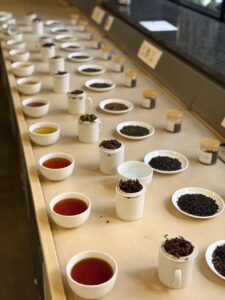 The brand recently hosted an immersive tea tasting and interaction session that brought together media for an in-depth discussion around products, sourcing, processing, consumer behaviour, and modern retail. Rather than a conventional brand presentation, the session unfolded through questions—many of them centred squarely on the product itself.
Why ‘Society’? The Name That Changed Everything
Some brands carry the weight of history in their name itself. Society Tea, born in Mumbai’s Lynn Society area in 1933, has spent nine decades understanding what Indians want in their cup. Today, as quick commerce promises delivery in minutes and coffee culture reshapes urban consumption, the blue-packaged brand is writing new chapters while staying true to its roots.
Before the blue packaging, before the distinctive identity, there was a name to be chosen. It wasn’t an easy decision.
 “The name came from my uncle,” Dhaval Shah, Founder and Director, Society Tea, recalls. “At the time, we explored many options with consultants and people from the advertising industry. Most of the names felt very common—things like Red Gate, Yellow Gate, or generic tea names. We wanted something different, something that resonated with people and what tea represents in everyday life. That’s how we landed on the name ‘Society’.”
The name was more than just branding—it was about what tea meant in the social fabric of India, the conversations it sparked, and the communities it brought together.
The Blue That Stands Out
Walk into any kirana store and scan the tea shelf. Amidst the greens and yellows, one colour immediately catches your eye: blue. It wasn’t supposed to work.
“Everyone advised us against it,” Shah recalls. “At that time, most tea brands were using green or yellow packaging. We were told that a blue pack would fail and that customers wouldn’t accept it. But my uncle believed in taking the risk. Today, when you go to a store and see a shelf full of tea brands, the blue pack stands out immediately. It gives the brand a distinct identity, and we feel proud of that decision.”
From Trading to Tea
“The company dates back to 1933. It was originally a trading company involved in exports, and over time, we moved into tea,” Shah explains. “We had daily interactions with consumers, and as the times changed, packet tea started becoming more relevant for working households. That’s when we introduced Society Tea as a packaged brand. From there, the brand continued to grow steadily.”
Being Where the Customer Is
If there’s one principle that has guided Society Tea through changing retail landscapes, it’s simple: follow the customer.
“Through all these channels, our family’s view has always been that, as a brand, we need to be channel-agnostic,” Shah says. “Wherever the customer moves, that is where we need to be present. That is exactly what we are doing. We were among the first few large tea brands to enter quick commerce around July–August 2020. We are moving with the customer, and our objective is to be present for them wherever they are, whether online or offline.”
The rise of quick commerce has fundamentally altered Indian consumer behaviour. “If I look at my generation—my brothers, my sisters, and even younger people—convenience has become continuous and expected,” Shah observes. “We use quick commerce all the time—for a nail cutter, an emergency purchase, or even when we are travelling and forget something. I remember being told once, ‘Why don’t you order it online?’ and it arrived in nine minutes. That power of convenience in India is unbelievable.”
And this convenience revolution isn’t limited to metros. “This is no longer just a metro phenomenon. Today, quick commerce is present in around 100 cities, and we see it expanding to another 100–150 cities over the next two to three years.”
Does Tea Still Matter in a Coffee-Led Culture?
Coffee cafés seem to open on every street corner in urban India. Millennials and Gen Z crowd into aesthetic spaces, willing to pay ₹200–₹250 for a cup. Does this worry a tea brand?
Not really, says Shah. “Coffee cafés offer a certain experience. People are comfortable paying ₹200–₹250 for a cup of coffee in that setting. Tea, on the other hand, is still perceived as something you enjoy in a cutting chai glass, often at a much lower price point. That perception hasn’t really changed. Most people are not willing to pay ₹150 for a cup of chai unless they are at places like airports where options are limited.”
More importantly, the coffee boom hasn’t dented tea’s growth trajectory. “Earlier, people didn’t have the luxury of choice,” Shah reflects. “If you go back 15 years, someone working as a tea boy in an office might go to a basic eatery. Today, the same person can order a burger, McDonald’s, or whatever they want, and have it delivered in half an hour. The aspiration to eat better food and wear better clothes has grown significantly. And tea has not stopped growing because of this. Despite the rise of coffee culture, we have seen year-on-year growth for tea in India across channels.”
“Tea is deeply rooted in Indian culture, and that has not changed,” he adds. “While coffee culture has grown, tea continues to grow consistently across India. What we are doing differently is expanding the way people engage with tea—without losing the essence of what tea stands for.”
Society Tea has positioned itself at key consumption points like Terminal 1 in Mumbai and certain metro stations. “At airports or transit locations, people want a good cup of tea and are willing to pay for it. That’s where such formats work,” Shah explains.
Reaching the Next Generation
Understanding that younger consumers engage differently with beverages, Society Tea has introduced new formats. “That is precisely why we introduced iced teas,” Shah explains. “We wanted to connect with a younger audience. My daughter is 14 years old, and when I observe her and her friends, their consumption habits are very different from ours. They are far more inclined towards quick, convenient formats and are influenced by trends rather than traditions. We realised that if we want to remain relevant, we need to offer formats that appeal to them without compromising on what tea stands for.”
“We have introduced freshly brewed iced teas and ready-to-drink formats. All the R&D is done in-house, and these are completely our own products,” Shah shares.
But does the younger generation still relate to traditional chai? “They do, but in a different context,” Shah observes. “Traditional chai continues to have a strong emotional connect, especially during exams, family time, or routine moments. However, they don’t necessarily associate it with indulgence or experimentation. That is where newer formats like iced teas and flavoured teas come in.”
“On our D2C platform, we’ve seen strong traction for iced teas, green teas, and ready-to-drink formats. The data clearly shows that these products appeal more to younger consumers.”
Balancing innovation with authenticity is crucial. “We are careful about that. For example, when it comes to flavoured teas or herb-based teas, we ensure the base remains tea. Everything has to align with our understanding of what tea should taste like. We don’t want to create something that feels artificial or disconnected from the core product.”
Tea Culture of the World: Premium Possibilities
Recognising a gap in their portfolio, Society Tea entered the specialty tea segment. “While regular tea remains our core, we realised we didn’t have a dedicated specialty tea division,” Shah explains. “It focuses on exotic teas, teas from around the world, and blends with natural flavours, fruits, and herbs.”
The specialty tea segment has formidable players. “If you look at brands like Vahdam, Tea Box, and others, they are heavily focused on exotic teas and premium marketing,” Shah acknowledges. “The segment is growing, but it is not an easy one. We are growing Tea Culture of the World slowly and steadily. Building a brand in this space takes time, and we are conscious of not rushing that process.”
Sampling plays a crucial role. “Absolutely. Tea is a product where sampling plays a critical role. A big part of our strategy is enabling people to taste the product. We have shop-in-shop counters across Nature’s Basket and Freshpik stores nationwide. The idea is that consumers sample the product offline and then repeat-purchase online.”
For Tea Culture of the World, the marketing approach differs from Society Tea’s mass-market strategy. “For Tea Culture of the World, we focus on digital marketing that communicates value, quality, and diversity rather than aggressive selling,” Shah notes.
Marketing Evolution: From Heritage to Humour
Society Tea’s marketing journey reflects the evolution of Indian advertising itself. For decades, the brand stayed away from the loud, celebrity-driven approach that dominated FMCG marketing.
“Historically, we never used film stars or celebrities,” Shah says. “Our brand communication was always more artistic and understated, very much like a heritage brand. If you look at our older advertisements, they had a nostalgic and emotional quality rather than being overtly commercial. However, we decided to experiment with a more commercial approach to cater to a different audience.”
Then came the shift. Society Tea brought comedian and actor Ritesh Deshmukh on board, marking a departure from the brand’s traditional aesthetic.
“We wanted to connect with audiences in cities like Pune, Nagpur, and other Tier 2 and Tier 3 markets. We felt that using a familiar and relatable face would help us reach those consumers more effectively. That decision became one part of our broader marketing strategy, without completely moving away from our brand’s core sensibility.”
The Ritesh Deshmukh campaign brought a lighter, more humorous tone to Society Tea’s communication—appealing to a younger, more mainstream audience while maintaining the essence of what the brand stood for.
“The character we chose for one of our campaigns had a younger, more humorous tone,” Shah shares. “The idea was to appear more approachable to a younger audience without alienating our existing consumers. We wanted to strike a balance between being contemporary and retaining familiarity.”
Digital now plays a significant role. “We do spend a significant amount on digital. As the business grows online, we continue to increase our investment in this area. Digital is dynamic—there is always something new happening—and we have to stay ahead of the curve, whether it’s e-commerce platforms or our own D2C channel.”
D2C: Reaching Every Corner
The direct-to-consumer channel has opened unexpected geographies. “Our D2C platform currently processes around 8,500 orders a month,” Shah shares. “What’s interesting is that these orders come from across the country, not just Maharashtra, which is our stronghold. We cater to customers in small towns, villages, and even remote areas like parts of Tamil Nadu and Jammu & Kashmir.”
What Exactly Makes Society Tea’s Cup Consistent?
Every morning, millions expect the same flavour in their cup. How does Society Tea deliver this consistency when sourcing from multiple gardens across India?
The answer lies in the art and science of blending. Tea production begins at the garden level, where leaves are plucked and processed through withering, rolling, fermentation, drying, and sorting. Society Tea primarily uses CTC (Crush, Tear, Curl) teas, which produce small, granular particles that brew quickly and deliver the strong cup most Indian consumers prefer. Orthodox tea involves gentler rolling that preserves leaf shape, resulting in lighter, more aromatic brews used for premium markets.
Tea is sorted into various grades—BOP, BOPSM, BP, dust—based on particle size. “Dust tea is not inferior by default,” Shah clarifies. “It produces a very strong brew and is preferred in many regions, especially in parts of Maharashtra.”
Procurement happens through tea auctions conducted through private brokers under government-regulated frameworks, now completely online. “I joined the business in 2003 and witnessed the transition from physical auctions to digital platforms around 2004–2005,” Shah recalls. The auctions operate through systems linked to the National Stock Exchange framework. “We bid against everyone—from large brands like Tata Tea and export houses to local traders and brokers.”
But here’s the key: “Every Society Tea blend contains tea from multiple gardens and grades. No single garden defines the flavour. It is a carefully controlled mix that ensures the final cup tastes the same every time. That blending formula is confidential and extremely important to us.”
Tasting is critical. “Every batch of tea that comes in is tasted. We have professional tasters who evaluate colour, aroma, strength, and aftertaste. Only after approval does the tea go into blending. This process ensures that even if raw materials vary, the final product remains consistent.”
“It is both,” Shah explains when asked if tasting is subjective or scientific. “There is training, experience, and a scientific understanding of flavour profiles, but there is also intuition developed over years. Our tasters know exactly what a Society Tea cup should taste like, and they work towards achieving that benchmark every day.”
“Consistency is the most critical part of our process,” Shah emphasises. “Every consumer expects the same cup of tea every morning. That consistency comes from blending.”
Water quality also plays a role. “Absolutely. Water quality plays a huge role. The same tea can taste very different depending on the water used. Hard water, soft water, mineral content—all of this affects extraction and flavour.”
Society Tea’s blends are designed to perform well across regional variations. “We know that people brew tea differently across regions. Some prefer stronger tea, some use more milk, some add spices. Our blends are designed to perform well across these variations.”
The Tea Board’s Role
 “The Tea Board of India mandates that a certain percentage of tea must be sold through auctions,” Shah explains. “This system has been in place for decades. One of the oldest tea brokers in India, J. Thomas, has archives dating back to the 19th century, showing how deeply rooted the auction system is in the tea industry.”
Tea’s journey in India itself is colonial. “Tea originally came to India during British rule. The British wanted an alternative to Chinese tea and started plantations in regions like Assam and Darjeeling. Over time, tea became deeply embedded in Indian daily life. What started as a colonial enterprise eventually turned into a national habit.”
Beyond Tea: Exploring Adjacent Categories
Society Tea isn’t limiting itself to beverages alone. “We manufacture milk products, and ghee is a by-product of that process,” Shah mentions. “At our facility in Vadodara, ghee production happens naturally as part of the system. It has performed well for us, especially on D2C channels, but tea continues to remain at the core of our business.”
Coffee too has found a place, albeit strategically. “We do offer coffee, but we don’t position ourselves as a coffee brand. Most of our coffee offerings are focused on B2B requirements—offices, vending machines, and institutional clients.”
Looking ahead, diversification is on the cards. “Yes, we are exploring adjacent categories. This could include coffee, snacks, or quick meal options. However, we are being cautious. We want to find the right fit at the right time rather than expanding for the sake of it.”
Going Global, Staying Rooted
“Yes, we already have a strong presence in the GCC region. Dubai, in particular, has been an important market for us since the 1990s. The Indian diaspora there connects deeply with tea, and Society Tea has been well received. We are looking to expand further, but our primary focus remains India, especially Maharashtra, which continues to be our strongest market.”
The Story Continues
As Society Tea marks over 90 years, the objective is clear. “We have been in this business for over 90 years, starting in the Lynn Society area back in 1933,” Shah says. “The objective now is to tell our story to a wider audience.”
The office itself holds history. “Earlier, this very space where you are sitting used to be a godown. This was actually our blending room. The office was much smaller, upstairs. We moved here sometime around 1987 or 1989. Back then, blending was done manually by people, by hand. Everything came here, and the blending happened in this very area. Over time, we modernised operations, but the core philosophy of quality and consistency remained unchanged.”
In an era where convenience arrives in nine minutes and coffee culture dominates urban conversations, Society Tea is proving that tradition and innovation need not be opposing forces. The blue pack that once seemed risky now stands proudly on shelves. The 90-year-old blend tastes the same in every cup. And somewhere, a 14-year-old is sipping iced tea while her parents enjoy their morning chai—both from Society Tea.