





















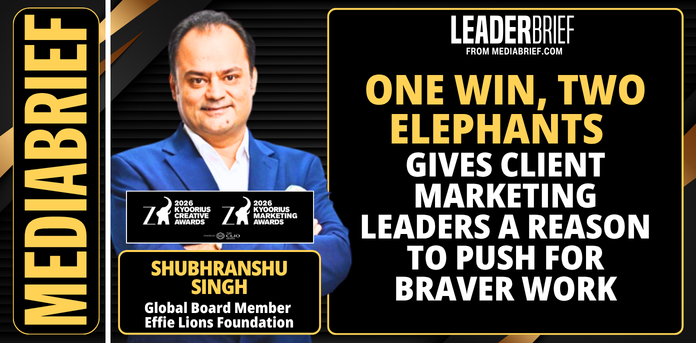
In an exclusive conversation on Kyoorius’s newly introduced ‘One Win, Two Elephants’ awards model, marketing veteran Shubhranshu Singh argues that this structural shift finally acknowledges what practitioners have long known: great work is never a solo act. By formally recognizing both client and agency with a single win, Kyoorius gives marketing leaders a tangible incentive to push for braver, more business-relevant work. Read on.
What was your first reaction to the ‘It takes two’ thought, and ‘one win, two Elephants’ approach?
It’s something practitioners have known for decades but the awards calendar has consistently refused to acknowledge. Great work is never a solo performance. Kyoorius recognising this structurally, through the award architecture itself is a meaningful and welcome shift.
How will this impact shared ownership between clients and agencies?
Ownership naturally follows recognition. When awards have historically gone only to agencies, the implicit message to the client organisation has been that they funded it, the agency made it. That framing is presumptive and erodes the internal case for marketing ambition. A CMO who cannot point to institutional recognition for the risks their team took will eventually stop taking those risks.
The ‘one win, two Elephants’ model changes the incentive structure. It gives client marketing leaders a reason to push for braver work because the upside of that bravery is now visible to their own organisation.
Does this model better reflect how great campaigns are actually created?
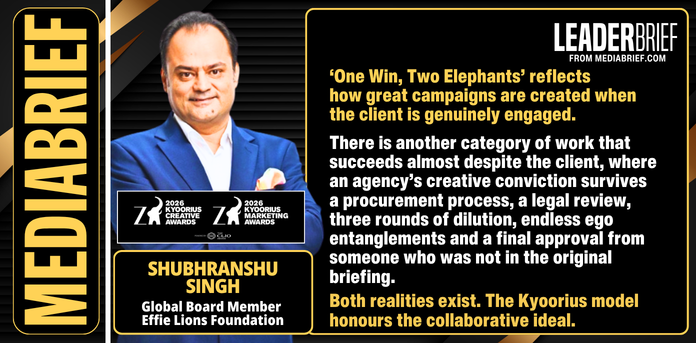
Yes, but I say it with one caveat: it reflects how great campaigns are created when the client is genuinely engaged. There is another category of work that succeeds almost despite the client, where an agency’s creative conviction survives a procurement process, a legal review, three rounds of dilution , endless ego entanglements and a final approval from someone who was not in the original briefing. Both realities exist. The Kyoorius model honours the collaborative ideal.
Also read:
-
LeaderBrief | Rajesh Kejriwal: One Win Two Elephants, because great work isn’t an individual act but a partnership that didn’t give up too early
-
LeaderBrief | Aniruddha Haldar: One Win, Two Elephants – Joint entry is not just a good idea, it is the intellectually honest position
-
LeaderBrief | Kavita Chaturvedi: ‘One Win, Two Elephants’ will inspire brand leaders to support brave and effective work
-
LeaderBrief | Yatnesh Pandey on Kyoorius 2026: Finally, an award that reflects modern marketing reality
-
PODCAST | Rajesh Kejriwal, Founder-CEO, Kyoorius Group
What does a client really contribute beyond the brief, the budget, and the final approval?
The most undervalued client contribution is the quality of the problem they bring. A well-defined business problem with genuine strategic tension is the raw material that determines the ceiling of the creative work. Beyond that is the courage to protect work in internal reviews, the willingness to hold an agency to a higher standard rather than accept the first safe option and the institutional memory to maintain a brand’s creative direction across leadership changes and agency transitions. None of these appear in a brief document.
What does Creative Courage mean to you as a CMO, in actual decisions rather than as a slogan?
It means approving work you personally find uncomfortable but intellectually recognise as right. It means going back to an agency and saying the safe version is not good enough, even when the safe version would pass every internal test. At Star, it meant building the Pro Kabaddi League around a sport that had no broadcast equity and no sponsor queue, because the brand logic was sound even when the market evidence was not yet there. Creative courage at the CMO level is fundamentally a resource allocation decision made under uncertainty.

What does great work have to survive before it reaches the consumer?
In roughly descending order of damage inflicted, it’s the internal legal review, the research debrief, the regional adaptation request, the CFO’s quarterly funding concern, the new business head who wants to put their stamp on things and the agency’s own fatigue from defending the idea across seventeen rounds of feedback. The Kyoorius line, ‘work that survived the process’ is sharper than it looks.
Can formal recognition of both parties encourage braver, more business-relevant work?
Recognition systems shape behaviour over time. If CMOs and their teams begin to see Kyoorius recognition as something that reflects on their professional standing, the calculus around risk changes. Awards that include clients in the winner’s circle are, over time, awards that will produce bolder clients.
Can this make awards stronger markers of brand leadership and marketing judgement?
That is the possibility worth taking seriously. Right now, a client’s relationship to awards is largely passive. If the award structure formally positions a win as evidence of marketing judgement and brand leadership, it is a meaningful expansion of what an industry award can do.

Should all major creative awards be entered jointly by client and agency?
Not mandatorily, because the collaborative model does not describe every piece of great work. But the option should exist structurally at every major show, and the joint entry should carry equal or greater weight in the evaluation.
When a campaign wins under this model, what should that say about the brand leader behind it?
That they had a point of view strong enough to shape the work and the restraint to let the right people execute it.
Anything to add?
The awards industry in India has a volume problem. There are too many shows, too many categories and too many metals that have been devalued by distribution. The ‘one win, two Elephants’ concept is an opportunity to double down on that selectivity.
About Shubhranshu Singh: Global Board Member Effie Lions Foundation, Global Fellow – The Marketing Academy London, and Member – Apex & Executive Committee, SEBI, Project Jagruk, Shubhranshu has more than two decades of global brand and category-building experience, and has been instrumental in shaping some of the most admired brands in India and internationally. He has held marketing leadership roles at iconic organizations including Tata Motors, Royal Enfield, Unilever, Diageo, Visa, and Star India.
This visionary marketer and respected thought leader is known for his sharp brand acumen, pioneering thinking, and an ability to lead and inspire high-performance teams. Shubhranshu’s work spans brand strategy, market development, demand generation and customer experience across diverse geographies and industries. In 2025, he was recognized in Forbes’ prestigious list of the World’s Most Influential CMOs.