


























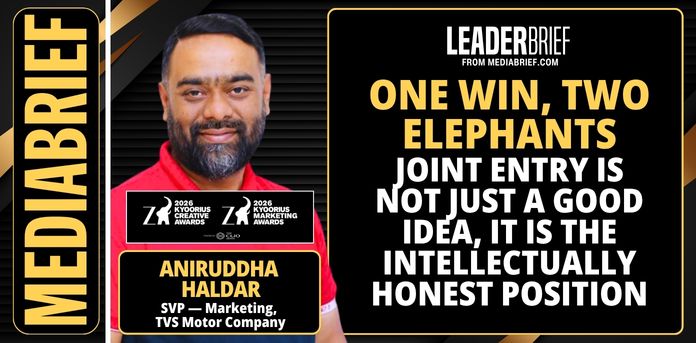
As the 2026 Kyoorius Awards introduce their ‘It Takes Two’ philosophy—recognising both agencies and the brand leaders who back them—Aniruddha Haldar, SVP — Marketing, TVS Motor Company, shares why this shift feels like a more honest reflection of how modern marketing really works. From creative courage and commercial accountability to the shared responsibility behind outcomes, he explains why great work is ultimately defined not just by what gets made, but by what survives the process and delivers in the real world.
What is your first reaction to the new avatar of the Kyoorius Awards — especially the ‘It Takes Two’ thought and the ‘One Win, Two Elephants’ approach?
My first reaction was that this is structurally honest in a way that awards have rarely been. Brand leaders — and I include myself in this — are fundamentally accountable for results. We do not run marketing to collect trophies. We run marketing to grow businesses, build brands that consumers believe in, and deliver returns that the organisation can measure, when success there is recognised it does feel good.
When a model like ‘One Win, Two Elephants’ brings the client into the recognition alongside the agency, it changes the nature of the celebration entirely. It stops being about only about craft and starts also being about work that a brand leader was willing to bet their reputation on.
That is a very different kind of Elephant — and a far more meaningful one.
Also read:
-
LeaderBrief | Rajesh Kejriwal: One Win Two Elephants, because great work isn’t an individual act but a partnership that didn’t give up too early
-
LeaderBrief | Shubhranshu Singh: Kyoorius’ ‘One Win, Two Elephants’ gives client marketing leaders a reason to push for braver work
-
LeaderBrief | Kavita Chaturvedi: ‘One Win, Two Elephants’ will inspire brand leaders to support brave and effective work
-
LeaderBrief | Yatnesh Pandey on Kyoorius 2026: Finally, an award that reflects modern marketing reality
-
PODCAST | Rajesh Kejriwal, Founder-CEO, Kyoorius Group
What impact could this approach have on the way clients and agencies take shared ownership of the work, the outcome and the larger marketing ecosystem?
Brand managers and marketing leaders are not hired to deliver famous advertising — they are hired to deliver outcomes. The moment you put both parties on the same award, by reassigning the criteria involved – you align both parties around the same question: did this work actually do something? Did it move consideration, drive purchase, build equity, grow market share?
Joint evaluation and recognition redirects that incentive toward work that performed in the real world. I think this could meaningfully improve the quality of client-agency conversations because both sides would now be asking — from the very beginning — whether the work is built to deliver, not merely to dazzle.
Does this recognition model better reflect how great campaigns are actually created — not as a one-sided agency output, but as a shared journey between brand and agency?
It does — and specifically, it reflects the version of that journey that results-oriented marketers actually live. The campaigns I am most proud of were not just well-crafted. They solved real business problems. They shifted metrics that the organisation tracked, not just metrics that look good in a case study. And those outcomes were never the agency’s doing alone.
The brand team brought the domain expertise of the industry, market intelligence, the consumer understanding, the business context, and yes — the pressure to ensure that what was beautiful also had to be effective. A model that gives both parties a seat at the winner’s table is really acknowledging that great work requires both creative excellence and commercial accountability. Those two things together are rarer than most people admit.

In your experience, what does a client really contribute to great creative work beyond the brief, the budget and the final approval?
The brief, the budget and the approval are table stakes. Beyond the problem statement, domain expertise of the industry, consumer understanding, the business context – What the brand leader also contributes is the insistence that the work has to earn its place in the market — not just in a jury room.
That means constantly asking: who is this for, what do we want them to do differently, and how will we know if it worked? It means pushing back when the work is visually spectacular but strategically hollow. It means protecting an idea that is genuinely connected to a consumer need, even when it is less showy than something else on the table.
The client’s real contribution is maintaining the discipline of purpose throughout a process that can easily drift toward artistry for its own sake. That is not a small thing. That is what separates campaigns that win and work from ones that merely win.
To you as a CMO, what does Creative Courage really mean — not as a slogan, but in the actual decisions, risks and responsibilities that shape great work?
Creative courage, for a marketing leader, is fundamentally a business decision. It is the willingness to back work that is differentiated enough to move people — even when the research says it is unfamiliar, even when the leadership team is not immediately comfortable, even when the category convention points in a safer direction. But here is what I think is often missed: real creative courage is not about being unconventional for its own sake. It is about being willing to take a creative risk in service of a results-oriented objective.
At TVS, some of our bravest creative decisions eventually turned out to be our most commercially profitable ones — because the courage was in service of a genuine consumer insight and a real business ambition. That is what separates courageous marketing from indulgent marketing.
The Kyoorius line says, ‘Come celebrate the work that survived the process.’ From a client-side perspective, what does great work usually have to survive before it reaches the consumer?
From a brand leader’s perspective, the process that great work has to survive is not primarily creative — it is commercial. Work has to survive the demand that it justify its media investment. It has to survive the question of whether it will move the needle on metrics that the business actually tracks.
It has to survive the comparison with last year’s approach and the risk-aversion that comes from not wanting to disturb something that was working adequately.
It has to survive the internal instinct to make it broader, safer and more palatable to everyone — which usually means it resonates powerfully with no one. The work that survives all of this intact does so because someone in the room kept asking not just “is this good?” but “will this work?” — and the answer to both was yes. And then there is the jury process a whole another story.
Can formal recognition of both agency and client encourage more brand leaders to support braver, more effective and more business-relevant work?
I genuinely believe it can — and here is the mechanism. Most brand leaders are cautious about creative risk not because they lack taste but because the upside of that risk has historically landed somewhere else. The agency gets the award. The client bears the consequences if it does not perform. Joint recognition restructures that equation.
If the upside of backing brave work now includes formal industry recognition for the brand leader, the calculus changes. More importantly, it changes for the right reasons — because the Kyoorius jury, as I understand it, evaluates work on whether it was inspirational, well-executed and delivered results. So the recognition is not for being audacious. It is for being audacious in a way that worked. That is exactly the kind of courage brand leaders should be rewarded for.

Awards are often seen as agency-led celebrations. Can this “one win, two Elephants” approach make them stronger markers of brand leadership, marketing judgement and business ambition?
Yes — and I think the Kyoorius jury framework is what makes this particularly compelling. The evaluation criteria, as I understand them, are not purely aesthetic. Work is being assessed on whether it was genuinely inspirational, whether the execution was of a high standard, and whether it delivered measurable results. That is a framework designed for marketers who are accountable for outcomes, not just impressions.
An Elephant earned against those criteria says something specific about the brand leader who backed the work: that they had the judgment to identify work that could be all three things simultaneously — inspiring, well-made and effective. That is a meaningful credential. It is the kind of recognition that belongs in a conversation about marketing leadership, not just creative achievement.
Should all major creative and impact-led marketing awards actually be entered jointly by the client and the agency? What would that change in the way the industry defines, evaluates and celebrates great work?
For effectiveness-led and strategy-led awards, I think joint entry is not just a good idea — it is the intellectually honest position. The reason is simple: if the results are part of the evaluation, then the party responsible for the results has to be part of the entry.
Brand leaders own the business outcomes. They own the media decisions, the market context, the go-to-market strategy, and the mandate within which the creative was deployed. Excluding them from entries that are partly judged on those outcomes creates a structural fiction.
A joint entry mandate would change the industry in a specific way: it would make the case study the shared responsibility of both parties — and that would sharpen the quality of thinking considerably, because both would have to stand behind every claim of performance and impact. In fact on atleast 2 other awards I have requested an insisted if not a joint entry atleast a brand signoff endorsing the entry was a bare minimum.
Finally, when a campaign wins under this new Kyoorius approach, what should that win say about the brand leader behind it?
It should say that here is someone who understood what marketing is actually for. Not for building a library of beautiful films. Not for accumulating recognition in a world the consumer never sees. But for creating genuine value — for the consumer, for the brand, and for the business.
A joint Kyoorius win, evaluated against the criteria of being inspirational, well-executed and results-delivering, should say that this brand leader had the judgment to recognise work that could achieve all three, the courage to back it through a process designed to dilute it, and the discipline to ensure that creative ambition and business accountability were never in conflict with each other. In a world that is increasingly scrutinising every marketing rupee, that is precisely the kind of leader the industry should be identifying and celebrating.