































In an exclusive interaction with MediaBrief, Parmesh Shahani, Head of Godrej DEI Lab and author of ‘Queeristan‘, reflects on how the conversation around diversity, equity and inclusion (DEI) has evolved in India, why inclusion must be rooted in culture rather than compliance, and the role businesses can play in building a more equitable society. Shahani also shares his views on DEI fatigue, measuring inclusion beyond policies, and the opportunities and challenges that AI and the future of work present. Read on.
You’ve been at the intersection of academia, activism, and corporate India for nearly two decades. What’s a belief you held about DEI ten years ago that you’ve completely abandoned today?
Ten years ago, I probably believed that if you presented enough data and enough evidence, people would naturally come around to the idea of inclusion. I was much more focused on making the rational case. Today, I realise that getting people to change is both emotional and intellectual and you need strategies for both.
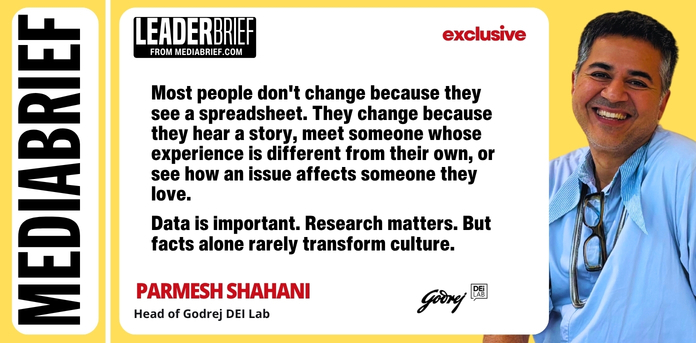
Most people don’t change because they see a spreadsheet. They change because they hear a story, meet someone whose experience is different from their own, or see how an issue affects someone they love. Data is important. Research matters. But facts alone rarely transform culture.
Over the years, I’ve seen that inclusion happens when we move something from the abstract to the personal. A leader may not connect with “gender diversity” as a statistic, but they may think differently when they see the opportunities available to their daughter. Disability becomes more than a policy discussion when it relates to a colleague or loved one. LGBTQIA+ inclusion becomes real when it’s about a friend, family member, or teammate.
That has fundamentally changed how I approach this work. Today, I spend as much time creating conversations, experiences, and stories as I do talk about policies and metrics. Lasting inclusion happens when people feel something, not just when they understand it.
For readers who may not be familiar with Godrej DEI Lab, could you tell us about its mandate within the Godrej Industries Group and the vision that led to its creation?
The DEI Lab was created because we believed inclusion needed a dedicated engine, one that could work both within the organisation and beyond it.
Within the Group, our role is to help businesses become more inclusive through policies, hiring, leadership engagement, culture-building, and measurement. We work closely with our group companies to improve representation, strengthen belonging, and ensure inclusion becomes embedded in business decisions.
But the Lab was never meant to be only an internal function. We also wanted to contribute to the broader ecosystem. That’s why we conduct research, publish reports, create media and storytelling platforms, host events, support grassroots organisations, and engage with students and future leaders.
Whether it is the Pride Fund, India Included on Campus, the Assistive Tech Conference, or our joint publishing label Queer Directions, our objective is the same: to expand the conversation around inclusion, collaborate with like-minded partners and create practical pathways for change.
The vision is simple. We want to help build a future where inclusion is not viewed as a special initiative or vertical in an organisation but as a horizontal that cuts across all functions. With thoughtful leadership, workplaces can be powerful drivers of a more equitable India, in which all of our citizens are able to participate in the progress. To me, that is the true meaning of a Viksit Bharat – a Viksit Bharat needs to be an inclusive Bharat.
You wrote Queeristan as a manual for inclusive workplaces. Since then, what’s one piece of on-ground reality that has made you more optimistic and one that has made you less optimistic?

What makes me optimistic is the younger generation.
When I visit campuses across the country, I meet students who are far more comfortable with diversity than previous generations. They are asking different questions. They care about purpose. They expect fairness. They want workplaces where people can be themselves.
That gives me a lot of hope.
What makes me less optimistic is how uneven progress can be. While some organisations and communities have moved forward significantly, many people still face barriers because of where they live, their socioeconomic background, their gender identity, disability, caste, or access to opportunity.
So, I don’t think the challenge is a lack of progress. The challenge is ensuring that progress reaches more people. The work ahead is not simply about moving forward. It’s about making sure nobody gets left behind.
In the US and UK, we’re seeing legal challenges to DEI programmes, rollbacks, and DEI fatigue. In India, the conversation still feels nascent. What’s a mistake India should not copy from the West’s DEI playbook?
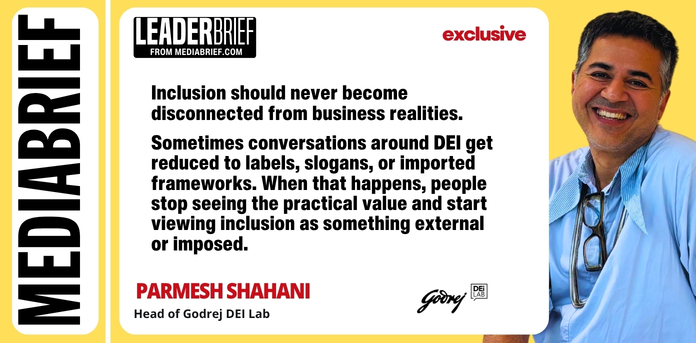
One lesson for India is that inclusion should never become disconnected from business realities or local context. Sometimes conversations around DEI get reduced to labels, slogans, or imported frameworks. When that happens, people stop seeing the practical value and start viewing inclusion as something external or imposed.
At Godrej, we have always rooted our inclusion efforts in our own foundational values. We are 129 years old and have always stood for equity and fairness. Other old Indian groups like Tata have done the same too. This is why – the DEI fatigue you are referring to, is non existent in India.
India’s diversity is unique. Our conversations need to reflect our realities. The most successful inclusion efforts I’ve seen are deeply rooted in local contexts and tied to solving real business challenges. They focus on expanding talent pools, improving innovation, strengthening culture, and creating opportunity.
Many Indian companies have Diversity & Inclusion policies on paper. What’s one thing Godrej does that would be genuinely difficult for a competitor to copy?
Policies can be copied. Benefits can be copied. Even programmes can be copied.
Culture is much harder.
What makes a difference at Godrej is that inclusion has been nurtured over many years and across multiple generations of leadership. It’s reflected not only in our policies but in our conversations, our events, our hiring practices, our leadership priorities, and the stories we choose to tell.
For example, we can organise a Pride March, publish books by queer authors, host conversations on menopause, launch a sign language learning programme, support LGBTQIA+ grassroots organisations, and discuss accessibility and disability inclusion, all within the same ecosystem.
Those activities may seem unrelated on the surface, but they are connected by a shared belief that every individual deserves dignity and belonging.
That culture takes years to build. It’s not something that can be replicated through a policy announcement.
How does the Lab measure its own ROI? Not just in feel-good stories, but in tangible business terms — retention, innovation, market access?
We look at a range of indicators. Representation trends, hiring outcomes, policy adoption, employee engagement, participation rates, retention, leadership accountability, and accessibility improvements all provide signals about whether our efforts are creating impact.
We also look at business outcomes. Are we reaching talent pools that were previously overlooked? Are teams becoming more diverse? Are leaders actively championing inclusion? Are employees making use of the policies designed to support them?
One example is the increasing adoption of caregiving, eldercare, and gender-affirmation benefits across the Group. Another is the growing participation in inclusion-focused initiatives and learning programmes.
But perhaps the most important metric is whether inclusion is becoming self-sustaining. When business leaders start driving these conversations themselves rather than waiting for the DEI team to initiate them, that’s a strong indicator that the work is creating lasting value. For our senior leaders at Godrej, those at the Vice President level and above, they compulsorily have 15% of their goal sheets dedicated to meeting inclusion and sustainability targets.
Today, remote work and AI are reshaping workplaces. Do these trends help or hinder inclusion?
Like most technologies, they can do both.
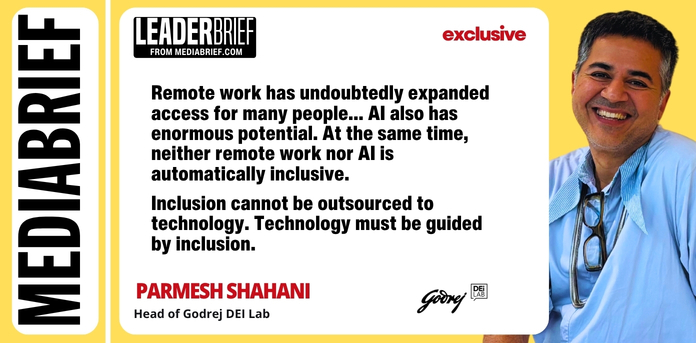
Remote work has undoubtedly expanded access for many people. It has created opportunities for caregivers, people with disabilities, individuals living outside major cities, and talent that might otherwise have been excluded from traditional workplace structures.
AI also has enormous potential. We’ve already seen examples of assistive technologies making information more accessible and helping remove barriers for people with disabilities.
At the same time, neither remote work nor AI is automatically inclusive. Remote work can sometimes reduce informal connections and mentorship opportunities. AI systems can reflect biases present in the data they are trained on. Most of the AI tools are developed by white, male engineers and as the excellent documentary film Coded Bias (available on Netflix) shows, us, these tools can exclude women, people who are non white, and people who are not from the Western world, in their data sets.
The question is not whether these tools are good or bad. The question is whether we design and deploy them thoughtfully. Inclusion cannot be outsourced to technology. Technology must be guided by inclusion.
Is there a risk that DEI becomes purely a talent acquisition tool for companies chasing “pink rupees” and global reputation, rather than a genuine lever for justice? How do you guard against that inside Godrej?
Any important idea can become transactional if people lose sight of its purpose.
Of course, businesses benefit from being inclusive. They attract talent, build stronger cultures, and often become more innovative. There’s nothing wrong with acknowledging those outcomes.
The problem arises when inclusion begins and ends with optics.
For us, the real test is whether our actions continue when there is no immediate reputational benefit. Are we investing in long-term policies? Are we supporting communities? Are we creating pathways for advancement? Are leaders accountable?
Initiatives like the Pride Fund, accessibility research, campus engagement, or our efforts around caregiving and disability inclusion are long-term commitments. They are not tied to a single campaign cycle.
The goal is not simply to attract people. The goal is to create environments where people can thrive.
Finally, what’s a criticism of your work that you think is fair even if it stings?
That it is not enough, that we are just skimming the surface, that the issues we are trying to solve for are too deep and too structural. All of this is true. But we are trying, and we understand that we cannot do this alone, which is why at our Godrej DEI Lab, we are always open to collaborating with other companies, universities, anyone actually, who wants to help us create a better tomorrow.
Looking ahead, what do you think will define the next decade of inclusion in India? Are there specific areas, communities, or innovations that business leaders should be paying closer attention to today?
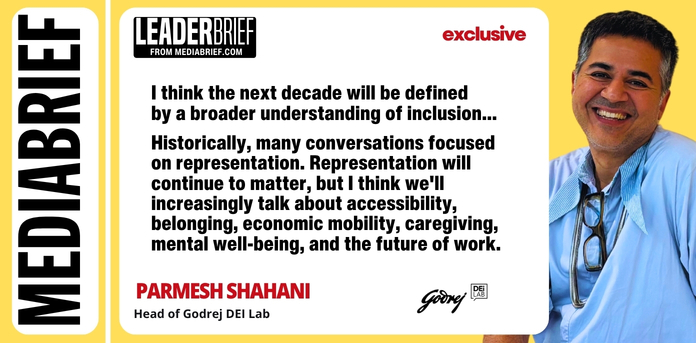
I think the next decade will be defined by a broader understanding of inclusion.
Historically, many conversations focused on representation. Representation will continue to matter, but I think we’ll increasingly talk about accessibility, belonging, economic mobility, caregiving, mental well-being, and the future of work.
Disability inclusion is one area that deserves much greater attention. Advances in assistive technology and AI have the potential to create entirely new opportunities if organisations invest thoughtfully.
Finally, I think we need to pay attention to talent beyond traditional urban centres. Some of India’s greatest opportunities lie in expanding access to people who have historically been excluded from formal employment pathways.
The future of inclusion in India will not be defined by a single community or a single issue. It will be defined by our ability to build systems where more people can participate, contribute, and succeed. That’s ultimately what inclusion is about like I said a Viksit Bharat needs to be an inclusive Bharat.