






























In an exclusive interaction with MediaBrief, Riddhi Verma, Founder and CEO, Baby-Led Weaning India, speaks about challenging deeply rooted beliefs around infant feeding, overcoming parental fears and cultural resistance to baby-led weaning, and how education, community advocacy, and social media have helped drive a mindset shift among modern Indian families.
India’s parenting and child nutrition space is seeing a surge in digitally savvy, first-time parents looking for credible guidance online. In this environment, Baby-Led Weaning (BLW) India, a platform by feeding expert and Stanford-certified coach Riddhi Verma, has carved a niche by combining real-time support, community, and structured expertise—building a model where content, education, and engagement form the core of growth.
From tech to tackling feeding myths
For Verma, the journey to Baby-Led Weaning (BLW) India began not in pediatrics or nutrition, but in tech. After 12 years at companies like Urban Ladder, FICO, and Palo Alto Networks, she approached problems methodically: define the process, follow the steps, get the output. Yet when she became a mother, feeding her own child made her question everything.
“Like most Indian parents, I was told to start with paani or purees,” says Riddhi Verma.
“It didn’t make sense—my baby was already getting complete nutrition from milk. And the questions… what can replace sugar in halwa? Is paneer or curd okay if cow’s milk is off-limits? How can a working parent manage three separate meals a day?”
She adds, “Western resources existed but were culturally misaligned; Indian advice was contradictory or outdated.”

Baby-led weaning explained
“While researching,” Verma says, “I came across Baby-Led Weaning (BLW) as a feeding philosophy. The more I read, the more it resonated, not just as a feeding approach, but as a framework for raising a child who has a healthy, independent relationship with food from the very beginning. It was structured, evidence-based, and it made intuitive sense.”
“I went on to complete a Diploma in Child Nutrition and a Stanford certification in Child Development and Behaviour. I started working with families pro bono while I was still training, and formally launched Baby-Led Weaning India as a practice in 2021.”
BLW, which allows babies to self-feed right from the start of their solid food journey, offered clarity: a structured, evidence-based philosophy that simplified feeding while framing it as a pathway to raising independent, confident eaters. Today, Verma has coached more than 10,000 families across 40 countries, tackling every feeding challenge imaginable.
BLW is not foreign to India
“Our grandmothers didn’t have baby food brands; they gave babies what the family ate, just modified. Dal-rice, soft roti strips—simple adjustments are all it takes,” she says.
Implementation challenges lie more in family dynamics than the food itself, says Verma. “I coach parents on language to use with grandparents, how to handle the ‘just one spoon’ pressure, and how to set boundaries respectfully.”
She warns against mealtime negotiation: “‘Two more bites and dessert’ or ‘eat your vegetables, then play’ teaches children to manipulate meals, turning eating into a power struggle.”
Instead, she advises serving the food, eating calmly alongside, and trusting the child’s appetite—allowing them to reconnect with their own hunger cues. The strategy reflects a careful balance between guidance and autonomy, creating habits that stick long term.
Real-time guidance via WhatsApp is the USP
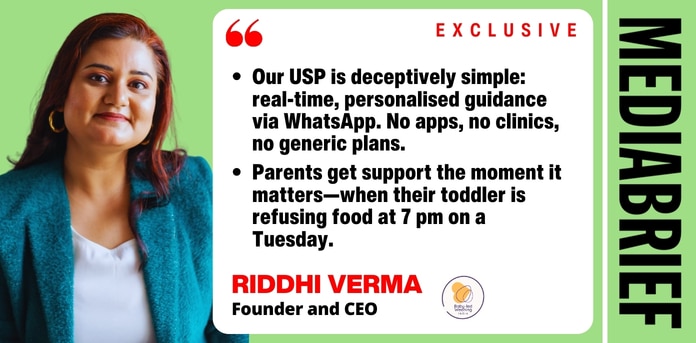
Speaking about Baby-Led Weaning (BLW) India’s USP, Verma says, “Its USP is deceptively simple: real-time, personalised guidance via WhatsApp. No apps, no clinics, no generic plans.”
She adds, “Parents get support the moment it matters—when their toddler is refusing food at 7 pm on a Tuesday.”
Speaking about the model the brand operates on, she says, “Each 10-day engagement is tailored to a child’s skills, behaviours, and home environment, making every session unique, even at scale. A 100,000-strong Instagram community further extends guidance, offering free advice long before parents sign up for paid sessions.”
Serving parents from Mumbai to Melbourne
Baby-Led Weaning (BLW) India primarily serves parents of children aged 6 months to 6 years, particularly first-time parents or families battling feeding challenges.
The anxieties are universal, says Verma, “Whether in Mumbai or Melbourne, parents stress about the same thing: ‘Is my child eating enough?’.
Picky eating—from 18 months to 3 years—is another common cross-cultural challenge. “The Japanese mom worried her toddler only wants rice; the Italian mom stressed about pasta; the Indian mom’s child refuses anything but dal-rice. Same developmental phase, different foods.”
“The toughest obstacle? Convincing them babies are capable of more than we think. Fear of choking and the assumption that spoon-feeding purees is essential were deeply ingrained,” says Verma.
“Scaling meant addressing those fears thousands of times, building trust through education, and showing results. Changing mindsets in a culture where feeding practices are passed down across generations isn’t simple—it feels almost disrespectful to question them.”
How BLW India structures its offerings
Speaking about the business model of the company, Verma says, “Personalised sessions are tiered by age and complexity, starting at ₹19,000, with longer programs for complex cases. Self-paced masterclasses start at ₹2,999, and subscription-based daily meal planning begins at ₹799.” She adds, “Corporate wellness initiatives extend support to working parents.”
Social media as a peer-driven support network
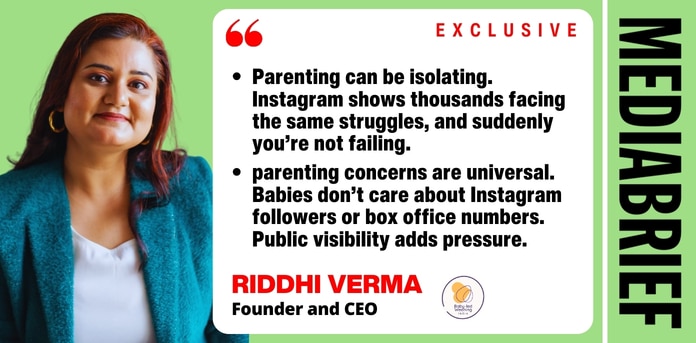
Speaking about the brand’s communication approach, Verma shares that social media has been critical to scaling awareness. She adds, “Parenting can be isolating. Instagram shows thousands facing the same struggles, and suddenly you’re not failing.” The community shares wins, struggles, and solutions, turning learning into a two-way, peer-driven movement.
Even celebrity parents face the same challenges, Verma notes: “Babies don’t care about Instagram followers or box office numbers. Public visibility adds pressure, but the parenting concerns are universal.”
For Verma, the journey of Baby-Led Weaning India is about more than food—it’s about trust, confidence, and independence, both for children and parents. By challenging long-held assumptions, providing practical guidance, and building a supportive community, BLW India is helping families navigate feeding complexities while demonstrating the potential of digital-first, content-driven approaches to growth.