































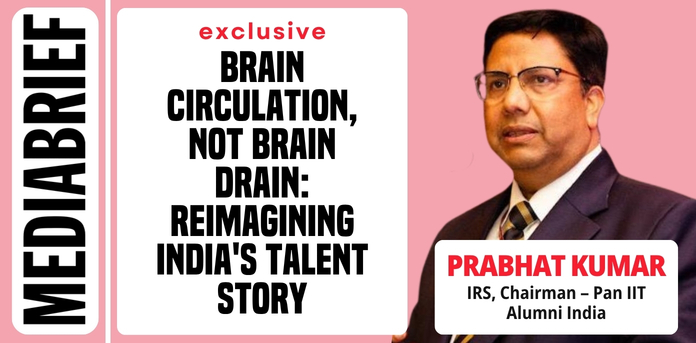
In an exclusive piece for MediaBrief, Prabhat Kumar, IRS, Chairman, Pan IIT Alumni India, writes about how India can transform brain drain into brain gain by leveraging its global talent diaspora, strengthening its innovation ecosystem, and creating opportunities that attract world-class professionals to contribute to the country’s growth. Read on.
A journalist called me last week. She asked a question I’ve heard more times than I can count over my years in public service. “Sir,” she said, “what’s it really going to take for India to bring its best minds back home?”
I paused before answering. Because honestly, I think we’ve been asking the wrong question all along.
It’s not about bringing people back. It’s about making India so irresistible that they want to come back—or at least, they want to be part of what we’re building here.
From Brain Drain to Brain Circulation
For years, we’ve used the term ‘brain drain’ like it’s a curse. And yes, it hurts watching our brightest young minds crack the IIT entrance exam, spend years at our institutes, and then board flights to America. We’d read about their successes abroad and feel a mix of pride and loss. But somewhere along the way, I started seeing things differently.
What we’ve actually built is something quite extraordinary. We’ve created a vast, interconnected global network of Indian talent that spans every field you can imagine. Our people are in Silicon Valley boardrooms, in global universities, in cutting-edge laboratories, in multinational corporations. They’re shaping the global knowledge economy.
That’s not a drain. That’s a strategic asset. The question is whether we have the wisdom to use it.

India Isn’t What It Used to Be
Today, we have the world’s largest youth population. Our startup ecosystem is the third-largest on the planet. We’re going big on artificial intelligence, quantum computing, semiconductors, space technology, and biotechnology. The India AI Mission, the National Quantum Mission, the RCD fund—these aren’t just government schemes. They’re serious bets on the future.
The India that couldn’t offer world-class research now has institutions that hold their own globally. India that had limited entrepreneurial infrastructure now has venture capital firms queuing up to back bold ideas. But here’s the thing. Opportunity isn’t enough. We need to get a few things right.
Five Things That Actually Matter
First, we need to build places where ideas can truly flourish. The best professionals don’t just follow the money—they follow environments that challenge and excite them. That means strong universities, well-funded labs, real collaboration between industry and academia.
Second, we’ve got to make the administrative side feel effortless. Ease of doing business isn’t a corporate buzzword—it’s the difference between someone choosing Mumbai over Melbourne.
Third, we need to go all in on deep-tech. India has done brilliantly with consumer tech and services. But the next wave belongs to AI, clean energy, defence tech, robotics, and advanced manufacturing. And here’s where our returning professionals can be game-changers—they’ve spent years working on exactly these things.
Fourth, we’ve got to stop treating our diaspora like they’re outsiders. We need real platforms for engagement—mentorship programmes, investment networks, advisory roles.
Fifth, and most important one—we need to genuinely appreciate contribution. I’ve met so many accomplished Indians abroad who desperately want to give back. But they often don’t know how, or they worry their efforts won’t be valued. A simple recognition can mean everything. When we celebrate a contribution, we invite more of it.
The IIT Story
The IIT alumni network is a perfect example. Our graduates are leading global corporations, driving cutting-edge research, shaping policy. They represent one of the most powerful knowledge networks anywhere. If we can channel even a fraction of their expertise towards India’s priorities, the impact would be staggering
My Appeal: Come Back to the New Indus Valley
Here’s what I want to say to every Indian professional abroad: come back to the new Indus Valley. Not out of nostalgia. Come with purpose. Come to build, to scale, to contribute. The days of incremental coding and service-led growth are fading. We’re entering an era of fundamental science, hardware, and systems that will define the next fifty years.
I’m not naive. I know not everyone can physically relocate. And honestly, that’s okay. In today’s world, contribution takes many forms. Mentor a startup over a video call. Invest in an Indian company. Advise policymakers on complex issues. Teach a course remotely. Set up a research centre while staying abroad. This isn’t about choosing. It’s about bridging.
The Time Is Now
The future of India won’t be built only by those living within its borders. It’ll be shaped by millions of Indians around the world who still feel that emotional connection to home—who want to be part of the story, not just spectators.
As we push towards Viksit Bharat 2047, we have a once-in-a-generation chance to flip the script. Brain drain can become brain gain—not by stopping people from leaving, but by creating an ecosystem where the world’s best Indian minds genuinely believe that India is the most exciting place to build, invest, and contribute.
The time has come to bring India’s global talent network closer to home. The time has come to turn brain drain into brain gain.