































In an exclusive interaction with MediaBrief, Chetan Siyal, CMO of SNITCH, speaks about how the brand scaled in the Gen Z menswear segment, the behavioural insights behind its strategy, and how Snitch reframed menswear from a low-engagement category into a culture-driven one. Read on.
For years, Indian D2C fashion growth was largely women-led. When asked what key consumer or behavioural insight helped SNITCH unlock scale in the Gen Z menswear segment, Chetan Siyal, CMO of SNITCH, says, “The biggest insight was this: young Indian men were interested in fashion, but the ecosystem was not speaking to them with the same energy, frequency, or cultural relevance as it did to women.”
“Menswear,” he adds, “was largely occasion-led and utility-driven. Gen Z men, however, were identity-driven. They were consuming fashion content daily on Instagram and YouTube, following creators, tracking global trends, and wanting constant newness. But the market offered limited drops, slow refresh cycles, and safe designs.”

Snitch’s approach reflects a deep understanding of Gen Z behaviour. Approximately 60–65% of its customer base falls within Gen Z, with repeat purchase rates around 38–42%, particularly strong among app users. The core age demographic splits as 18–24 (~35%), 25–30 (~40%), 30–35 (~15%), and 35+ (~10%).
Explaining the key behavioural shifts that the company tapped into, Siyal says, “We identified three behaviour shifts: Gen Z expects fashion to move at the pace of social media, prioritising speed over seasonality; they want statement pieces rather than just wardrobe fillers, putting expression over basics; and their purchase decisions are heavily influenced by peer culture and digital creators, highlighting the importance of community validation.”
Siyal says Snitch responded by “building a fast-fashion engine for menswear with weekly drops, trend-led capsules, and strong social-first storytelling. Instead of treating menswear as replenishment, we treated it like discovery. That shift helped unlock scale in a segment that was ready but underserved.”
Marketing to young men versus young women
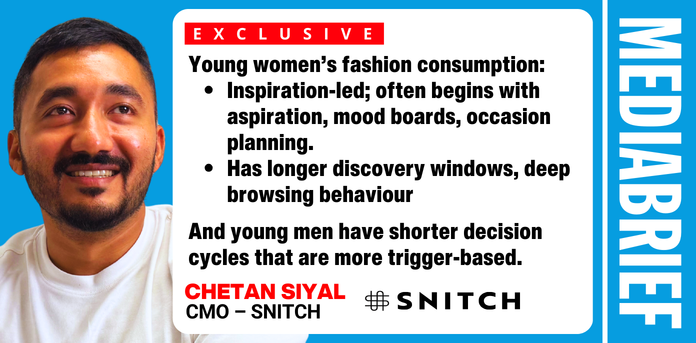
When asked how marketing to young men differs from marketing to young women in terms of content, storytelling, and purchase triggers, Siyal says, “There are structural differences in how young men engage with fashion content. For young women, fashion consumption is often inspiration-led. The journey can begin with aspiration, mood boards, or occasion planning. Discovery windows are longer and browsing behaviour is deeper.”
“With young men,” he continues, “decision cycles are shorter and more trigger-based. Content needs to quickly answer: How will this make me look? Where can I wear this? Will this get noticed?”
He elaborates on storytelling, saying, “Marketing to young men works best when it is direct and visually strong, rooted in relatability rather than high glamour, and focused on styling utility.”

“Styling videos, before-after transitions, street-style reels, and creator-led outfit breakdowns tend to outperform high-concept campaigns. Humour and confidence also play a large role. Young men respond strongly to content that feels culturally aware, slightly irreverent, and socially shareable,” Siyal adds.
“At Snitch,” he notes, “we build content that is platform-native first and brand-second. That approach has allowed us to convert attention into measurable sales.”
The brand’s top-performing categories among Gen Z include oversized shirts, trend-led trousers, party shirts, sneakers and perfumes. Its most effective digital acquisition channels span the Instagram and Meta ecosystem, influencer-led discovery, performance marketing across Meta and Google, app installs and retention marketing, and organic social reach through trend-led content.
On the role of digital and creator-driven marketing, the brand believes creator marketing plays a strategic role not just for awareness but also for conversion, working with micro and mid-tier creators who have strong relatability with urban Gen Z audiences. The brand also shared that “Styling-led collaborations outperform celebrity-heavy campaigns in driving measurable ROI.”
Content formats that work best for the brand include reels with styling transitions, “How to style” videos, street vox-pop style content, drop announcement reels and creator haul videos.
These are complemented with a robust CRM strategy that is “behaviour-driven and segmented”, including app-first engagement for drop alerts, trigger-based email and SMS journeys, back-in-stock and browse abandonment flows, and drop reminders and early-access nudges.
The focus for the brand is “on creating anticipation, not just pushing discounts.” This has also helped build strong brand recall, with strong organic engagement spikes during drop days and campaign-led cultural moments. Social engagement rates consistently outperform industry benchmarks in the menswear segment, particularly on Instagram reels.
Reframing menswear from under-marketed to culture-driven
On whether men’s fashion has traditionally been seen as a low-engagement category or simply an under-marketed one, Siyal says, “It has always been under-marketed, not low-engagement. If you look at consumption behaviour today, young men are deeply invested in sneakers, streetwear, grooming, and global fashion culture. The appetite was there. The industry simply did not invest in building excitement around it.”
One of the brand’s most impactful efforts was its Men’s Day campaign, built around the insight that men are not used to complimenting each other, or even knowing how to. Instead of celebrating men generically, the brand created a cultural conversation around expression and validation, encouraging men to acknowledge and appreciate each other’s style and individuality.
The campaign worked because it was rooted in a real behavioural truth, felt fresh and emotionally resonant, was highly shareable, and aligned naturally with fashion as self-expression. The brand revealed it drove strong engagement, high social shares and a measurable spike in traffic during the campaign window.
Siyal adds, “Menswear was often positioned as functional, safe, and secondary. We reframed it as expressive, dynamic, and constantly evolving.”
Outling the three strategies that helped change perception, he says, “Drop culture in menswear, with frequent new arrivals, created anticipation and habit; social-first brand building, where we built visibility through creators, reels, and trend participation rather than relying purely on discount-led performance marketing; and offline experience, with our stores being high-energy, trend-forward spaces that mirror the digital vibe, reinforcing brand recall and community.”
“Once you treat menswear as culture rather than category, engagement naturally follows,” Siyal adds.
By combining rapid drops, trend-led collections, creator-driven storytelling and culturally resonant campaigns, Snitch has not only scaled the Gen Z menswear segment but also demonstrated that young men are highly engaged consumers when brands meet them on their terms.