





























In an exclusive interaction with MediaBrief, Dilip Kumar, Co-Founder and CEO of IndiFrame, writes about the strategic gaps that prompted GreenFortune’s shift to IndiFrame, how consumer insights shaped the new brand identity, and the role of education, technology, and performance-led marketing in redefining what homeowners can expect from India’s fenestration market.
GreenFortune Windows and Doors recently announced its rebranding as IndiFrame, marking a strategic evolution in its journey to formalize India’s fragmented windows and doors market and bring greater trust, performance, and accountability to homeowners. Speaking on the rationale behind the rebrand, Dilip Kumar, its Co-Founder and CEO, says, “GreenFortune built strong credibility as a material-first, supply-driven brand serving fabricators, builders, institutions, and consumers. However, as we grew, we realized that the homeowner’s decision-making journey is fundamentally different from that of a trade or institutional buyer.”
He adds, “A builder looks at supply efficiency and pricing logic, but a homeowner is buying peace of mind. They are investing in comfort, safety, energy efficiency, and long-term reliability. The strategic gap was not about capability; it was about positioning and accountability.”
“GreenFortune,” Kumar says, “was seen as a material supplier. IndiFrame was created to own the entire experience, from design consultation to installation and after-sales service. The shift allowed us to become a strong consumer-first brand with direct responsibility for outcomes without compromising our offering to industrial customers.”
Designing a brand around homeowner confidence
On the consumer insights that shaped IndiFrame’s identity, he explains, “The biggest insight was that homeowners don’t want components; they want confidence. They are overwhelmed by technical jargon, inconsistent pricing, and unclear accountability in this category. We found that most people were making fenestration decisions late in the construction cycle, often under pressure, and compromising on quality because the category lacked transparency.”

Kumar continues, “The name IndiFrame signals clarity and ownership. ‘Indi’ represents Indian conditions, Indian homes, and Indian expectations. ‘Frame’ represents structure, reliability, and engineering precision. Unlike GreenFortune, which was a supply-oriented name, IndiFrame clearly communicates that we are building high-performance window and door systems designed specifically for Indian realities.”
Building trust through a transparent transition
Addressing concerns around trust and continuity during the rebrand, he says, “We approached the transition with transparency rather than marketing noise. Existing partners and customers were clearly informed that IndiFrame was an evolution, not a departure. The team, systems, and manufacturing backbone remained consistent; what changed was our consumer-facing clarity.”
He adds, “We communicated through all direct and social mediums to existing and in-pipeline customers to ensure that there were not confused at all. We ensured continuity in service quality, delivery standards, and accountability.
“In fact,” he says, “the rebrand strengthened trust because it demonstrated long-term intent. Instead of remaining a material brand, we were signalling that we were ready to stand in front of the customer with full responsibility. Trust is built through performance, and because our operational fundamentals remained strong, the transition felt natural rather than disruptive.”
Shifting the conversation from Price to Performance
On standardizing India’s largely unorganised fenestration market, Kumar explains, “The biggest shift was moving the conversation from price to performance. In an unorganised market, variability is accepted as normal. Measurements are approximate, installation quality depends on individual skill, and service accountability is fragmented.
He adds, “Standardisation requires discipline, in measurements, manufacturing tolerances, installation protocols, and documentation. It also requires convincing customers that consistency has value. We had to introduce the idea that windows and doors are engineered systems, not carpentry add-ons.
“Once customers begin to understand water resistance ratings, sound insulation values, reinforcement standards, and installation tolerances, they begin to appreciate the importance of structure and process,” says Kumar.
Redefining homeowner expectations, not competing locally
When asked whether IndiFrame is competing with local fabricators, Kumar clarifies, “Our focus is not competition; it is expectation-setting. Local fabricators serve a role in the ecosystem, but the category has historically lacked system-level accountability.
He adds, “We are redefining what homeowners should expect, precision engineering, predictable timelines, tested performance, documented processes, post-installation service and robust warranties. If the market evolves and others raise standards as well, that benefits everyone. Our goal is to elevate the category rather than simply capture share.”
Scaling consistency across a diverse market
On scaling operations across India, Kumar says, “Scaling consistency in a customised product category requires operational discipline and strong technical systems. Every project is engineered to millimetre-level accuracy, and even small deviations can create installation challenges.
“The biggest learning has been that systems matter more than speed. Digital measurement protocols, structured project tracking, trained installation teams, and centralised quality benchmarks are non-negotiable.”
He adds, “We also learned that regional differences — climate, construction styles, customer expectations, must be respected while maintaining uniform standards. Consistency does not mean rigidity; it means predictable outcomes across variable environments.”
Branding performance over glamour
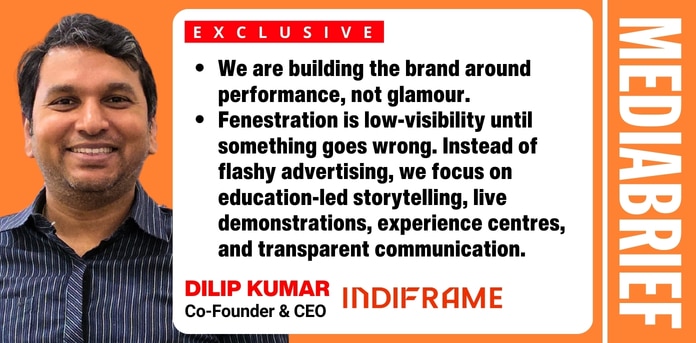
Discussing brand-building in a functional, low-visibility category, Kumar adds, “We are building the brand around performance, not glamour. Fenestration is low-visibility until something goes wrong, leakage, noise, warping, or safety issues. Instead of flashy advertising, we focus on education-led storytelling, live demonstrations, experience centres, and transparent communication.”

“Brand-building in this space is about reassurance,” says Kumar. “When a homeowner invests in windows and doors, they are investing for 20–30 years. Our communication reflects that longevity. We are positioning IndiFrame as a reliability partner rather than a trend-driven brand. We have also been fortunate because our customers are our biggest advocates and help us with a lot of referrals.”
Trust at scale: Proof over persuasion
On building trust at scale through marketing, Kumar says, “Trust at scale comes from proof, not persuasion. Word-of-mouth will always remain powerful, but we can amplify it through structured storytelling. We plan to leverage customer testimonials, documented installations, educational content, architect partnerships, and performance demonstrations. Digital platforms allow us to explain complex concepts in simple ways, while on-ground engagement builds tactile trust.”
“Our marketing strategy,” he says, “is built around showing real outcomes — reduced noise, improved insulation, better durability, rather than making abstract claims. We have an excellent team with great technical credentials and a state of the art manufacturing facility, we fully intend to leverage these as our marketing pillars to differentiate ourselves from local competition.”
He further elaborates on the role of content, education, and digital platforms, Kumar says, “Education is central to behaviour change. Many homeowners are unaware of how poor-quality windows impact energy bills, indoor comfort, and maintenance costs. Through digital content, explainer videos, case studies, and interactive tools, we can simplify decision-making.

“Digital platforms,” he adds, “also allow transparency in pricing logic, project tracking, and customer communication. Over time, informed consumers begin to prioritise performance and reliability over short-term cost savings. That shift is what will transform the category.”
Kumar adds, “At this stage, brand awareness and education take precedence over aggressive demand generation. This is a considered purchase category, not an impulse one. If the category understanding improves, demand follows naturally. We are investing in building long-term brand equity rooted in trust, engineering credibility, and performance. Once that foundation is strong, demand generation becomes more efficient and sustainable.”
Technology and the future of Fenestration
On technology’s role in IndiFrame’s business operations and growth, Kumar says, “Technology plays a central role in IndiFrame’s business. It helps us bring structure and predictability to an otherwise unorganised windows and doors market.
“From digital measurements and design to project tracking and installation, technology ensures accuracy, better coordination and consistent quality. It also enables us to scale efficiently across locations while maintaining uniform standards. We also use technology to provide more transparency with the customer throughout the purchase journey.
“Simply put,” Kumar says, “technology allows us to deliver customised, high-performance solutions with transparency, reliability and operational efficiency.”
What’s next for IndiFrame
Concluding on IndiFrame’s long-term ambition, Kumar says, “India’s housing landscape is evolving rapidly. People are investing more thoughtfully in their homes, and expectations around comfort and durability are rising. Fenestration may have been overlooked in the past, but it plays a critical role in how a home feels and performs every day.”
He wraps up by saying, “At IndiFrame, our ambition is not just to sell windows and doors, but to bring structure and predictability into a category that has operated informally for decades. If we can make even a small shift in how homeowners think about performance and accountability, we will have contributed meaningfully to the industry’s evolution.”