

































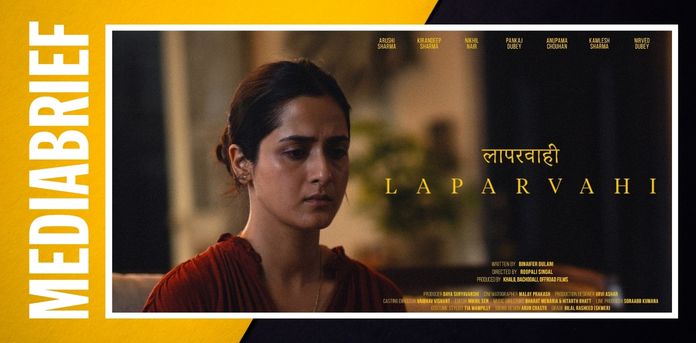
Laparvahi, a 4-minute-45-second independent short film, explores the silence, self-blame and unintended emotional hurt that women can experience within families following a miscarriage.
Written by Binaifer Dulani, Founding Partner and Creative at Talented, the film is directed by Roopali Singhal and independently produced by Khalil Bachooali of Offroad Films. Drawing on conversations with women who have experienced pregnancy loss, it examines how well-intentioned care can sometimes add to grief rather than create space for it.
The film emerges from conversations with women who have experienced miscarriage, and from the observation that many carry a profound sense of self-blame; as though every scan were a report card on their own body. In the context of an Indian family, where concern often arrives through euphemisms, advice and an instinct to look ahead, the experience can become particularly difficult to articulate.
At the heart of Laparvahi is a simple question: why does a woman often leave a miscarriage feeling that she was what went wrong?
For writer Binaifer Dulani, the film was an attempt to bring a conversation that is usually exchanged in whispers into the living room. “The film ends with my own scan from my miscarriage and I hope any woman who’s going through the experience does not feel lonely. We’ve lost the intergenerational stories around loss within our families. So many women who have shared the film with their families have since discovered stories of pregnancy loss from their mothers and mothers-in-law. We need these conversations to happen, so women know they are not alone”.
Director Roopali Singhal approached the film with the intention of resisting easy melodrama. “There is no villain,” she says. “Everyone in this family is speaking from a place of love and concern.” The discomfort, she believes, comes from the fact that people can be trying to help while unknowingly adding to someone’s guilt.”
For producer Khalil Bachooali, the decision to make the film independently was secondary to the importance of the idea itself. “Producing has always been about recognising an idea worth backing,” he says. “Binaifer had a deeply personal connection to the subject, and Roopali immediately saw the voice and language the film needed.”
Laparvahi ultimately asks audiences to reconsider not just how we talk about miscarriage, but how we understand grief within families. In a society where the instinct is often to say aage ki socho, move on and find a way to make things better, the film makes space for acknowledging that care does not need to fix anything.
The makers hope Laparvahi can become a starting point for intergenerational empathy, the language of pregnancy loss, and the loneliness that can exist even inside a loving home.