

































In an exclusive piece for MediaBrief, India TV MD and CEO Ritu Dhawan writes about the evolving preferences of Indian news audiences and the rapid rise of Fast News as a dominant format. She highlights how digital platforms, shifting viewer habits, and technological advancements are driving this transformation.
Dhawan also shares insights on India TV’s pioneering launch of the country’s first 24-hour Fast News HD channel, Speed News, and outlines the emerging trends set to shape the future of news consumption in India.
In an age driven by speed and instant gratification, the Indian news consumer is evolving rapidly and so is the way news is delivered. Traditionally, news broadcasts in India featured longer segments, often presented in a formal tone within a set narrative structure. Anchors would deep-dive into stories, offering context and analysis in neatly packaged bulletins aired at fixed times.
However, with the advent of digital platforms and a shift in viewer behaviour, this conventional approach began to evolve. Fast-format news — with its sharp visuals, scrolling tickers, rapid updates, and anchor-less formats — has now carved out a significant space in both television and digital ecosystems, appealing especially to younger audiences who prefer quick, no-frills information.
The shift is accompanied by the rise of HD households in India which showcased a remarkable uptick of 35% in the past three years, indicating the demand for high-definition and rich content. Of this, 78% HD viewers fall within the 15-50 age range, stressing the appeal of HD programming to a younger, more affluent audience.
News organisations have been swift to pick up on this trend and introduce innovative formats. As the demand for immediate, brief, and easily accessible news updates is growing, Fast News has become an ideal way to cater to this segment while offering superior quality content. Such a development is being led by numerous factors, which have contributed to the acceptance of this format.
Catalysts shaping the rise of fast news
Audiences are gradually preferring Fast News due to varying reasons. First, with people leading busy lives, there is an intensifying demand for news that can be consumed on-the-go. Headlines, summaries, and bite-sized video clips aptly serve this need, enabling individuals to stay informed.
Secondly, attention spans are shortening, particularly among younger demographics. News organisations are adapting to it by generating content that is less text-heavy, paired with the use of lists, infographics, or short videos to convey information efficiently. Lastly, shorter formats are considered to be more shareable, eventually enhancing content distribution among viewers.
As a result, news organisations have embraced the wave of faster delivery of information. The transference has also led to the development of significant features that define Fast News.
Nevertheless, the fast adoption of smartphones, high-speed internet connectivity, and a surge of digital platforms has brought forth a transition, impacting the way news is consumed today.
Key attributes of fast news delivery
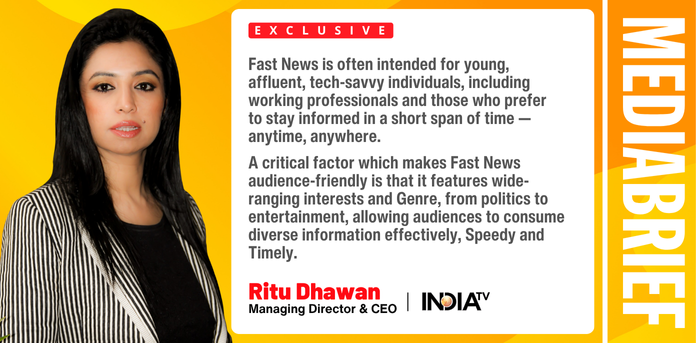
Fast News is often intended for young, affluent, tech-savvy individuals, including working professionals and those who prefer to stay informed in a short span of time — anytime, anywhere.
A critical factor which makes Fast News audience-friendly is that it features wide-ranging interests and Genre, from politics to entertainment, allowing audiences to consume diverse information effectively, Speedy and Timely.
In addition, it comes with frequent updates, giving them a sense of on-going engagement and a motive to return for the latest developments throughout the day. At the present time, many such platforms are even tapping into audience feedback via data analytics to deliver customised content that appeals to specific interests of viewers.
For instance, the 24×7 Speed News channel by India TV which is a leading format in the Fast News segment. It is India’s first 24-hour Fast News channel in HD, and India TV is the first broadcasting platform to launch something like this. It originated on digital and then transitioned to linear TV.
The platform delivers swift and high-impact news bulletins. Renowned for its brisk delivery, Speed News ascertains that viewers remain updated with events across a range of areas like politics, business, sports, and entertainment.
Moreover, it comprises an impressive viewership on CTV platform, with 1.1 million average monthly aggregated viewers, 6.8 million average monthly watch minutes, and an average watch time of 13 minutes per viewer. The channel also caters to app audiences in HD, targeting metro city viewers.
Likewise, it is enriched with high-quality visuals and a clutter-free presentation. Its success is just one example of how the Fast News segment is developing, and it indicates the emerging trends shaping the future of news consumption.
Forthcoming trends in a competitive landscape
In India, prominent news organisations have adapted to the Fast News format. To stay ahead of the curve, several key strategies can be of aid to them. It comprises strengthening online presence through website and apps, pairing domestic news with global perspectives to reach a broader set of audiences, and incorporating social issues to make the content relevant to audiences.
Looking ahead, they ought to focus on streamlining their delivery process to boost speed and accuracy.
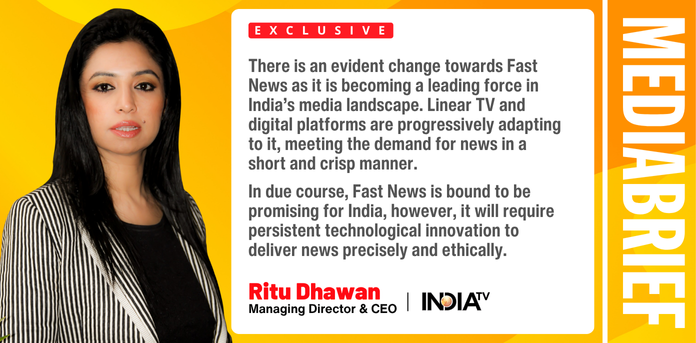
Summing it up, there is an evident change towards Fast News as it is becoming a leading force in India’s media landscape. Linear TV and digital platforms are progressively adapting to it, meeting the demand for news in a short and crisp manner.
In due course, Fast News is bound to be promising for India, however, it will require persistent technological innovation to deliver news precisely and ethically.