




























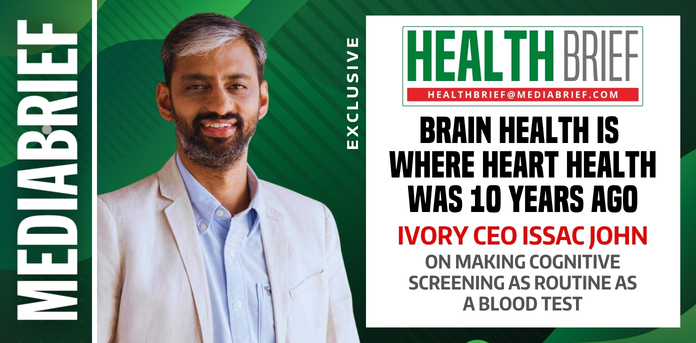
In an exclusive interaction with MediaBrief, Issac John, Co-founder and CEO of Ivory, speaks about the future of preventive brain health. John speaks about why most people ignore brain health until it becomes a problem, how technology can reduce friction in proactive brain function assessments, and why preventive brain health is still not part of everyday self-care routines like fitness or sleep.
Ivory, the brainchild of John and his co-founder Rahul Krishnan, is an early-stage company focused on cognitive health. The company provides clinical-grade cognitive assessments and personalised brain health solutions. It combines neuroscience, neuropsychology, and data-driven interventions to help individuals monitor and improve their cognitive well-being.
Read on.
Why do most people still ignore brain health until it becomes a problem?
Preventive health side has really evolved over the last decade or so, and one can think of brain health as being where heart health was 10 years ago, when not everybody was getting their LDL (low-density lipoprotein) checked every year, or even how devices that measure glucose levels in your bloodstream were not as abundant back then. It’s the ease of access that has completely changed the way we are proactively taking steps against conditions of heart health and diabetes.
Brain health will also get there. So far, there has been a lot of friction in how to get a proactive brain function assessment done. So either things were pen and paper assessments, or they were physically invasive like a CSF tap or an MRI.
But technology today allows us to reduce that friction in helping people understand their brain health better, and it’s the form factor and the friction involved that have so far prevented it from being mainstream.

How do you make something as abstract as “brain fitness” feel real and urgent to consumers?
Everyone understands how important their brain function is, but it’s become common to brush concerns with regard to things like brain fog and forgetfulness under the carpet. To make brain health feel real and urgent for those in their 40s and beyond is both about awareness and distribution.
Thankfully, with so much awareness about our brain being constantly stressed and things like diminishing attention spans now becoming mainstream in preventive health, brain health discourse is not only rising, it’s taking center stage.
The second angle is distribution. People who want to go ahead with these tests or want to know more about their brain health should be able to access it through their trusted doctors / healthcare providers / diagnostic chains with ease.
Why do you think preventive brain health is still not part of everyday self-care routines like fitness or sleep?

Why is it important to remove fear and stigma from cognitive testing and make it more mainstream?
Extremely important, because neurodegeneration is one of the most debilitating conditions that a human body can be subjected to. It completely takes away your physical freedom and mental faculties. And to get to a stage where things are too late to be reversed is the last thing that we should do to our bodies.
Modern medicine and vaccinations have done a lot to improve our lifespan. But there’s no point in living longer if, for our “marginal decade,” as Dr Attia calls it, we have little physical or mental agility.
Why do you think people are now more open to tracking mental and cognitive health than before?
There is a real tailwind of how the preventive health wave is taking off. Prevention, almost every urban consumer today understands, is the best way to reduce your own financial health burden and the emotional burden on your loved ones. And just like how preventive health has taken off significantly in the last few years, especially post-COVID, it is inevitable that we are going to get to a stage from treating neurodegeneration to preventing neurodegeneration.
How do you make users trust a digital tool with something as personal as their cognitive data?
Great question. People nowadays want to make decisions with regard to their sleep, glucose levels, and physical step tracking on their own. And just like how they have built trust in these health habits, they also trust devices and companies like ours that provide them enough scientific credibility and a frictionless user experience.
If that is solved, customers will trust the digital tool. The second way in which this can be addressed is through distribution. Ivory today works with several trusted healthcare providers. So when a healthcare provider that the consumer trusts tells them that they should get this done as part of their regular health checkup, there is an innate level of trust that goes along with it.
Why is awareness still the biggest challenge in building the brain health category?
Awareness is a problem, yes. But as mentioned earlier, it is also the lack of ease and access. There was always awareness that blood glucose spikes are harmful, but the ease with which CGM patches have enabled measurement has helped consumers track their sugar levels. Similarly, having a digital, language-agnostic, mobile-friendly assessment will go a long way in building the category.

How do you position Ivory differently in a space crowded with wellness and productivity apps?
Ivory is differentiated because we complement the preventive healthcare ecosystem today. So whether you’re a diagnostic chain or a psychiatrist or a neurologist, we complement your services by giving you an objective, quantified measurement tool.
So more than us being in the wellness and productivity space, we would like people to think of us as an essential brain function assessment that gives them science-led scores that can be tracked longitudinally. The very nature of our core proposition differentiates us from wellness and productivity apps.
Should a healthy young user care about cognitive screening today?
They shouldn’t. We don’t recommend anyone below 40 to really get themselves assessed. Instead, focus on building health habits that involve adequate physical activity, a healthy diet, and restful sleep.
How do you see consumer perception of brain health changing in the next 3–5 years?
With the constant onslaught of screen time and the invasion of AI in our lives, preservation of strong cognitive function will become mainstream and essential for every individual.
Every neighborhood clinic, every diagnostic chain, every health and wellness clinic will have assessment tools that will help people understand their working memory, attention skills, and long-term memory better.
This is the missing piece of the healthspan equation today, and getting brain function assessed objectively will go a long way in people having sustainable, healthy lives well into their 50s, 60s, and 70s.