































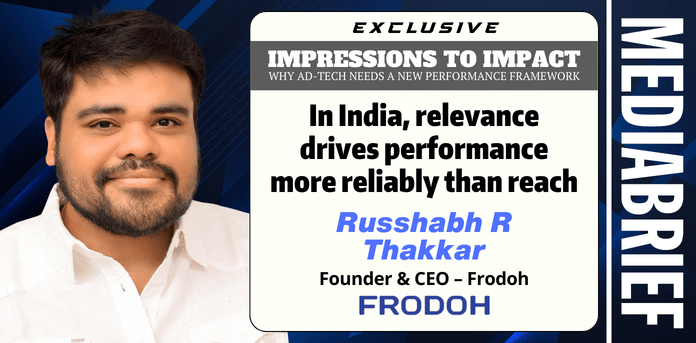
In a MediaBrief exclusive, Russhabh R Thakkar, Founder and Chief Executive Officer, Frodoh, weighs in on India’s mobile-first, multi-screen and privacy-conscious media ecosystem, where marketers are moving beyond impressions and clicks to prove real business impact. Thakkar outlines the shift from scale metrics to attention, the role of AI in decoding cross-screen journeys, and how privacy-first measurement is reshaping marketing effectiveness in India.
With advertisers increasingly prioritizing outcome-based accountability, retail media measurement models are evolving beyond traditional impressions and clicks to focus on tangible business and brand outcomes. Speaking on this evolution, Russhabh R. Thakkar, Founder and CEO of Frodoh, says, “Retail media measurement is shifting from visibility to verifiable value. Impressions and clicks worked earlier because commerce signals were fragmented.
“Today,” Thakkar says, “brands expect media to prove whether it influenced consideration, drove store or app visits, increased basket value, or accelerated repeat purchase. Modern frameworks focus on closed loop attribution, incrementality, and full funnel accountability. At Frodoh, impressions and clicks are hygiene metrics. The real KPI is whether media moved a measurable business outcome.

Decoding complex consumer journeys
Speaking about how AI is helping decode increasingly complex consumer journeys across commerce, mobile, social, and digital media channels to deliver more accurate and actionable performance insights, the Frodoh founder says, “Consumer journeys today are non-linear and spread across devices and contexts, which breaks traditional attribution models. AI helps by stitching fragmented signals across commerce, mobile, CTV, and social environments, and by weighting actions based on intent strength rather than interaction volume.
“The shift,” he says, “is from asking who clicked last to understanding which exposures genuinely influenced consideration or purchase. At Frodoh, AI is used to optimise for influence, not just efficiency.”
Navigating privacy-first ecosystems
With privacy-first ecosystems becoming the norm, measurement innovation is evolving to balance transparency, compliance, and actionable business intelligence. Addressing this crucial aspect of measurement, Thakkar says, “The next phase of measurement will be trust led. As third-party identifiers fade, the industry is moving toward consented first party signals, contextual and cohort based measurement, and privacy safe modelling. The objective is not perfect user level visibility, but reliable directional truth at scale.”
He adds, “Frodoh follows a privacy by design approach, using aggregated and anonymised signals to deliver clear business intelligence without compromising user trust.”

Leveraging India’s unique digital signals
Outlining how platforms like Frodoh are leveraging India’s digital landscape—characterized by mobile-first audiences, vernacular content consumption, and growing online commerce—to build more contextually relevant and outcome-driven measurement frameworks, Thakkar says, “India’s digital ecosystem is structurally different. It is mobile first, vernacular led and closely tied to commerce intent. Outcome driven measurement therefore needs to be context aware and commerce native.
“Platforms like Frodoh,” he says, “map regional and language signals to category level purchase behaviour, measure engagement through interaction depth rather than surface activity, and link media exposure to commerce outcomes.”
Thakkar closes the conversation by saying, “In India, relevance drives performance more reliably than reach.”