





























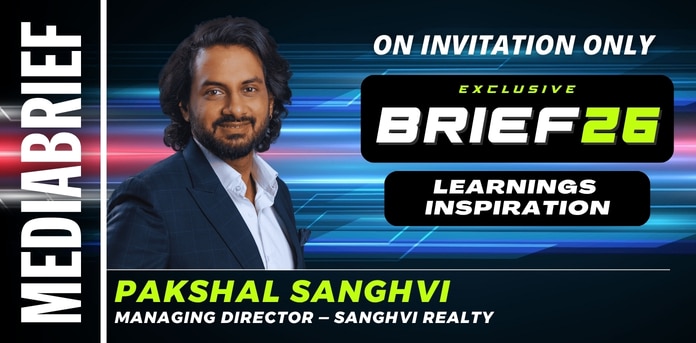

This Year-Opener under BRIEF26 has been authored by Pakshal Sanghvi, Managing Director of Sanghvi Realty, exclusively for Mediabrief.com. Insights and inspiration for tomorrow.
I don’t remember any big news stories or announcements from 2025 that stand out to me. Instead, I remember a quieter change—a year when things started to feel like they had a meaning. I remember standing at one of our project sites during a normal review and watching the teams work together.
Engineers, planners, contractors, and site supervisors were all on the same page, decisions were made carefully, and there was a sense of calm control instead of haste. That moment captured the year for me. We were no longer chasing speed. We were building with intent.
For Sanghvi Realty 2025 was a year of both growth and looking back. During the year we completed four residential projects, there are thirteen ongoing projects and seven upcoming projects in Mumbai. These milestones showed progress but they also made people feel more responsible. With each launch, expectations grew and with each handover, families and communities put their trust in the people who would have to live with the results for years to come.
What mattered most was not how much we did but how deliberately we did it. Every project undertaken during the year was evaluated with sharper internal scrutiny than before. We asked about feasibility, deadlines, capital discipline, and long-term livability at every step. Growth was not treated as an automatic positive; it had to be justified. This internal recalibration closely mirrored what we were witnessing in the broader market.
The most important characteristic of 2025 was that city buyers were growing older. People addressed more than just the obvious benefits and conveniences. Buyers were more knowledgeable, patient and picky. They wanted to understand more about delivery capabilities, governance standards, and how developers handle challenges as they emerge. Trust, which was once solely a promise of branding has developed into an expectation of how things will work.

This trend was especially noticeable in the redevelopment sector. Across Mumbai ageing housing societies began approaching redevelopment with greater seriousness. They were no longer looking for aggressive projections alone, but for partners who could demonstrate execution capability, financial discipline, and the ability to stay present throughout the lifecycle of a project. Redevelopment today is not merely about replacing structures; it is about renewing confidence and improving quality of life.
Being entrusted with multiple redevelopment mandates during the year reinforced an important lesson for us: trust compounds responsibility. Each society comes with its own history, emotional investment, and concerns about displacement and delay. The role of a developer in this context extends beyond construction. It needs to be open, talk to each other and have the self-control to put delivery before visibility. The level of responsibility we have in 2025 has affected how we perceive leaders.
The market also gave a clear sign. Reach was less crucial than reliability. Developers that grew too quickly or tried to grow by taking risks found it hard to keep things running. People who prioritized strong governance, efficient capital allocation and performance earned trust over time. It became evident that in a maturing market balance is a strength rather than a drawback.
Letting Go of Old Assumptions
One belief that 2025 challenged decisively was the idea that faster always means better. For years rapid expansion was equated with success. This year highlighted the limits of that thinking. Cities do not respond well to haste, and families certainly don’t. Decisions in real estate shape lives for decades and speed without stability ultimately erodes trust.
Another assumption that faded was the notion that sustainability could be addressed later. Taking care of the environment is no longer a way to stand out; it’s a basic expectation. People who bought things expected that plans and buildings would be made in a responsible way. The main difference was how deeply sustainability was built into daily choices.
Even scale began to take on a new meaning. Bigger no longer automatically implied stronger. In many cases controlled growth inspired greater confidence than unchecked expansion. Longevity, the industry realised, is built as much on restraint as it is on ambition.
Looking Ahead
In 2026, I feel optimistic—not because growth will be easier but because it will be more meaningful. The next phase of urban development will reward developers who understand context. Projects that integrate into neighbourhoods rather than overpower them will stand out. Redevelopment will require heightened sensitivity to social dynamics, infrastructure capacity and environmental impact.

One of my key goals for the next ahead is to improve how things are done. Better communication with stakeholders, better collaboration with consultants, and better internal governance will all change the way projects are done. In the future, real estate leadership will be more about mechanisms that make sure things are done consistently and that people are held accountable.
Financial resilience will also take centre stage. Access to capital alone is no longer enough; credibility is shaped by how responsibly that capital is deployed. The industry is moving away from speculative growth toward projects grounded in genuine demand and long-term viability. In this environment discipline becomes a competitive advantage.
A Message to Teams and Young Professionals
For teams within Sanghvi Realty and young professionals entering the sector 2026 will demand patience and accountability. This is not an industry built on shortcuts. The most enduring careers will belong to those who can think in decades rather than deal cycles.
Professionals who step beyond silos—engineers who understand customer sentiment or finance teams who appreciate construction realities—bring far greater value. Consistency in small actions, honesty during challenges and ownership of outcomes will matter more than clever positioning.
Closing Reflections
One thing that 2025 taught us is that cities remember what people want. Buildings stay longer than balance sheets and communities remember how they were handled long after projects are done. A developer’s job is more than just building things; they also need to think about how their work will fit into the city.
As we navigate 2026, urban India will need developers that see themselves as long-term caretakers instead of people who just want to make money quickly. Growth based on trust, discipline, and purpose may be quieter, but it lasts. That’s the kind of legacy that is worth leaving behind.