




























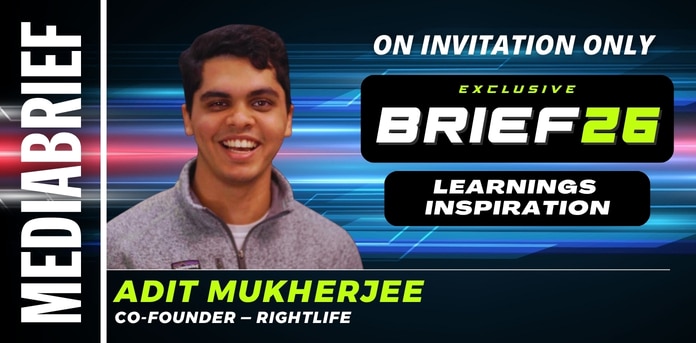
This Year-Opener under BRIEF26 has been authored by Adit Mukherjee, Co-Founder, RightLife, exclusively for Mediabrief.com. Insights and inspiration for tomorrow.
India is quietly undergoing a profound change in its approach to health that is not characterized by any dramatic announcements or overnight transformations. However, the shift in mindset is steady and noticeable. Individuals are increasingly asking more insightful questions about their bodies, their habits, and the long term impact of the choices they make daily. This change is not a result of a single trend but rather a series of wake up calls.
Air pollution, for instance, was an abstract concern earlier, but it has now become a reality that people are experiencing. People have started to talk about AQI numbers every day, and as a result, they are coming face to face with the fact that health risks can also originate from the places we live, work, and the air we breathe. The abolition of GST on health insurance has therefore been instrumental in consolidating the idea that healthcare is both a matter of concern and a priority.
Young Indians are emerging as one of the most influential forces behind this shift in mindset. Both data and personal testimonies point to a clear trend among those aged 18 to 25: alcohol consumption is declining.
Unlike previous generations, this cohort is far more open to conversations around sleep quality, nutrition, mental wellbeing, and longevity. For them, health is not defined solely by the absence of illness, but by the presence of good health. Wellness is beginning to be integrated into everyday choices, and deeply connected to how they want to live, work, and feel over the long term.

Having worked closely in the space of preventive healthcare, one lesson has become unmistakably clear to me: trust and education are both the hardest and the most critical challenges to solve. And they cannot be treated in isolation.
People genuinely want to take charge of their health, yet they are navigating an environment crowded with half-truths, shifting trends, and promises of quick fixes. In that confusion, decision-making becomes fragile. Without credible knowledge, trust erodes; without trust, even the best information fails to land. Solving for one without the other simply doesn’t work.
Education takes time. But it is also the only way real, lasting behaviour change happens. The knowledge gap today is vast, starting with basic questions like, “Am I getting enough protein?” and extending to more complex ideas such as how VO₂ Max impacts health and ageing over the long term.
Preventive healthcare cannot be built for just one end of this spectrum. It has to meet people where they are, acknowledge what they know, and support them as they learn and evolve at their own pace.
Context is also very important. Although access to qualified doctors has become easier, what people still value even more is continuity. They do not want to tell their health story again every time they ask for help. Consistency creates trust, and trust is what leads occasional users to become long term believers.
India can no longer afford to ignore preventive healthcare. Diabetes and hypertension have become progressively more common every year. The approach of waiting to treat these conditions is not only costly and tiring, but also, in most cases, ineffective. Early intervention is the only viable way to prevent lifestyle- related issues from turning into chronic complications.

Nevertheless, the concept of prevention is not very attractive because it does not bring instant rewards. Health improvements through changes in lifestyle are gradual. Hence, anyone who chooses to build or work in this field must take a long term perspective. The idea of shortcuts and overnight transformations may be tempting but rarely result in sustained outcomes.
This is the reason why I continue to be skeptical of the increasing hype surrounding weight loss drugs such as Ozempic, Wegovy, and Mounjaro in the Indian context. These medications essentially work in Western markets where diets are already moderately to highly rich in protein, thus muscle mass can be retained even during quick weight loss.
In India, however, protein deficiency is one of the major nutritional problems we face. Without mending the basics, these interventions are like fixing a leaky faucet when your entire bathroom plumbing is in disarray.
I am still hopeful despite such difficulties. People are becoming more conscious. They are reading labels, tracking habits, and questioning old health related assumptions. This change will lead to an inevitable preventive healthcare boom.
The healthcare industry’s true challenge will be whether it can seize the moment by being accessible, honest, and aspirational, instead of being intimidating or transactional. If we manage that, this silent reboot might turn out to be one of the biggest health movements India has ever experienced.