































Every August, Hair Loss Awareness Month encourages men in India to talk more openly about hair loss, challenging the silence and resignation that often surround the issue.
For most men, that resignation has a script. The water in his city. The helmet. And when all else fails, the one that ends the conversation entirely: his father’s hairline. Hair loss gets discussed as fate, something to accept, rarely something to diagnose. There is also a deeply rooted belief that hair loss is something that cannot be managed, and acceptance is the only option left.
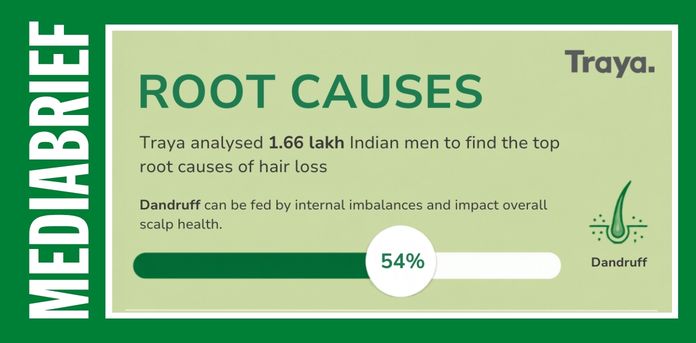
Between June and August 2026, Traya Health assessed 166,460 Indian men to map the primary root causes of hair loss across states. The study focuses on the primary cause identified for each individual, highlighting the gap between treating hair loss symptoms and addressing the underlying reasons.
Male
| Root Causes | Male Count | Percentages |
| Dandruff | 89,863 | 54.0% |
| Genetics | 35,315 | 21.2% |
| Nutrition | 16,827 | 10.1% |
| Metabolism | 10,439 | 6.3% |
| Sleep | 7,884 | 4.7% |
| Digestion | 5,325 | 3.2% |
| Others | 804 | 0.5% |
Dandruff the root cause in more than half of all cases
More than half the men assessed had dandruff as their primary root cause of hair loss. Qualitative research done by Traya shows that many men don’t realise they have dandruff for long periods of time, and fewer still connect it to their hair loss.
Here is what is happening. A fungus called Malassezia overgrows on the scalp and creates constant inflammation. That inflammation pushes hair out of its growth phase too early. Hair sheds faster, comes back thinner every time, and eventually stops coming back at all.
Dandruff often outlasts every shampoo: a wash clears the flakes, not the overgrowth driving them. And the overgrowth itself rarely acts alone; internal health issues like a struggling gut, nutritional gaps, and disturbed sleep can aggravate dandruff, feeding the very inflammation that pushes hair out. It is this combination, the scalp condition and the internal imbalances fuelling it, that actually drives the hair loss. When the underlying inflammation and what feeds it are properly addressed, the cycle stabilises, the shedding slows, and hair starts coming back stronger. Dandruff is a treatable scalp condition, which makes the most common cause of male hair loss also a solvable one.
Genetics is real, but not a life sentence
Over 35,000 men had genetics identified as their primary root cause. The most common assumption around genetic hair loss is that nothing can be done. That assumption is wrong.
The body naturally produces a hormone called DHT from testosterone. In some men, hair follicles on the front and crown are sensitive to it. DHT slowly shrinks those follicles over years; each cycle, hair comes back thinner. But DHT sensitivity is not the whole story. Overall health, gut function, metabolism, and nutrition affect how aggressively DHT impacts the follicles.
Two men with the same genetic sensitivity can have very different outcomes depending on what is happening inside their body. Addressing those imbalances does not change the gene. But it can significantly change how it progresses. DHT can be blocked. Health can be corrected. The earlier both are addressed, the more can be preserved.
Genetic hair loss is not new. What has changed is when it shows up. Where earlier generations associated it with their 40s and 50s, dermatologists today increasingly see it surface in men in their 20s and lifestyle is widely believed to play a role. Because if the gene loads the gun, it is often the body that pulls the trigger: poor sleep, a struggling gut, nutritional gaps and daily habits can accelerate how early and how aggressively DHT sensitivity plays out. The gene hasn’t changed in a generation. The conditions around it have.
Nutrition: the signal that goes unread
Nearly 17,000 men had nutritional deficiency identified as their primary root cause. Hair follicles need a constant supply of protein, iron, zinc, and vitamin D to keep producing hair. When these drop, the body makes a simple call: send available resources to vital organs first. Hair follicles get cut from the supply.
The result does not look like genetic hair loss. No receding hairline. No pattern. Just an overall, even thinning across the scalp. The body is not failing; it is running low on what it needs, and the hair is the first place it shows. When the specific deficiencies are identified and corrected, the body reprioritises hair growth, and the thinning begins to reverse. Nutrition-linked cases peaked in Jammu & Kashmir, at 13%, the highest of any state compared.
When hair speaks first – sleep, gut, and metabolism
23,648 men in this study had their hair loss traced to how their body was running: metabolism (10,439 men), sleep (7,884), and digestion (5,325). Sleep-linked hair loss peaked in New Delhi at 6.0%, the highest of any state compared.
Traya was founded on one principle: that hair loss is a symptom of deeper imbalances, not a problem that begins and ends on the head. These 23,648 men are that principle in data. Sleep debt, a struggling gut, a slowed metabolism – these typically run silently for years, and hair is often the first place they become visible, because hair is the first thing a stretched body stops investing in.
This is also why Traya assesses the whole system: scalp, gut, nutrition, and lifestyle before treating a single strand. For these men, hair loss wasn’t the problem. It was the body’s earliest report of one, and a report, once read, can be acted on.
The Regional Picture
Traya mapped male hair loss across the country. The expectation was regional variation: different states, different climates, different causes. The data revealed something more precise: the cause never changes. Only its intensity does. And the intensity follows the climate.
Nationally, dandruff stands as the primary root cause in 54.0% of cases. Move across the map, and that number rises and falls with the weather. In India’s humid, coastal, high-rainfall states, dandruff runs well above the national average of 54%; Kerala leads at 65.3%, more than eleven points over, with West Bengal (59.7%), Odisha (59.5%) and Assam (58.5%) close behind.
Travel northwest into the dry belt, and the share slips below the average in Punjab at 47.4% and Rajasthan at 47.8%, six to seven points under. From India’s driest states to its most humid, the swing is nearly eighteen percentage points.
The gradient is scientifically coherent. Malassezia, the fungus behind dandruff, thrives in humidity. The wetter the climate, the harder it pushes.
But here is the finding that matters more than the gradient: even at its lowest in India’s driest states, six points under the national average, dandruff still ranks first. In not one state, humid or arid, coastal or landlocked, did any other root cause take the top spot. Climate turns the dial up or down. It never changes the diagnosis.
Nutrition tells the mirror story. Against a national average of 10.1%, nutrition-linked hair loss runs highest in the northern belt, Jammu & Kashmir, at 13.0%, with Rajasthan, Punjab and Haryana at 12.2% each and lowest along the southern coast, with Kerala at 5.0%, half the national average. In Traya’s reading, this points to regional differences in diet patterns and lifestyle, a signal worth deeper study.
Across Top States
| States | Dandruff | Genetics | Nutrition |
| Maharashtra | 54.9% | 21.7% | 9.4% |
| Uttar Pradesh | 53.5% | 19.2% | 11.2% |
| Rajasthan | 47.8% | 22.6% | 12.2% |
| Karnataka | 57.9% | 22.0% | 8.6% |
| Madhya Pradesh | 50.3% | 23.1% | 10.7% |
| Gujarat | 50.1% | 23.0% | 11.2% |
| Bihar | 56.1% | 19.6% | 10.4% |
| Haryana | 51.5% | 20.0% | 12.2% |
| New Delhi | 53.8% | 20.0% | 9.2% |
| West Bengal | 59.7% | 21.0% | 7.0% |
| Odisha | 59.5% | 20.6% | 6.7% |
| Jammu & Kashmir | 54.2% | 17.4% | 13.0% |
| Punjab | 47.4% | 23.0% | 12.2% |
| Assam | 58.5% | 18.5% | 8.4% |
| Kerala | 65.3% | 20.3% | 5.0% |
The Verdict
Hair Loss Awareness Month is built on three things: breaking the silence, understanding the cause, and knowing that identity and self-worth are not determined by hair.
For men, the silence usually sounds like acceptance of the belief that hair loss is inherited, inevitable, and already decided. Traya has never accepted that belief, and now the data doesn’t either.
Every case in this study, all 166,460, traced to an identifiable primary root cause. For more than half the men, that root cause was a treatable scalp condition. For most of the rest, it was a findable and actionable deficiency, a lifestyle factor, or a genetic sensitivity whose progression can be managed.
This is the conviction Traya was built on: hair loss not being a cosmetic accident to be covered but a health signal to be read, and no signal can be answered before it is understood. Which is why, in Traya’s view, the way forward always begins in one place: identifying the root cause.
Saloni Anand, Co-Founder, Traya Health, said, “Hair Loss Awareness” The month usually asks men to accept hair loss. Our study of 1.66 lakh Indian men asks them to find their root cause instead because every root cause we identified can be acted on. Awareness shouldn’t stop at ‘It’s happening. It should reach ‘Here’s why’ and then ‘Here’s what to do.”